
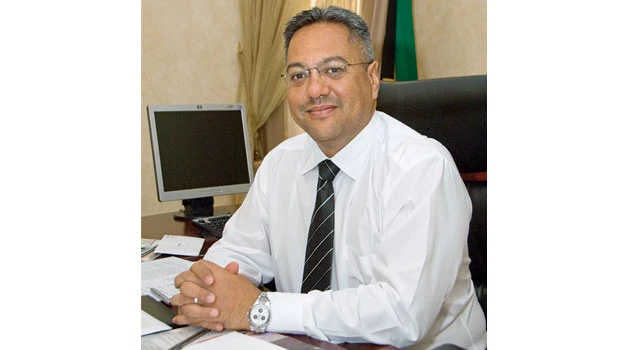
- JEDDAH: Ebrahim Edries was recently appointed the consul general of South Africa in Jeddah.
- His ambition while here is to develop the potential for trade and tourism, and build increased understanding of the historical relationship between the Kingdom and the republic.
An affable gently-spoken man and self-confessed rugby and cricket fanatic who has been known to sprint between rooms to watch both sports on different televisions at the same time, Edries took his position in Jeddah a little over a month ago. His previous visits to the Kingdom for both Haj and Umrah gave him a taste of his current environment.
He said that his priorities for the mission he heads were informed by the priorities in South Africa. “We have just, in terms of a country’s history, emerged from a very tragic past of apartheid where 80 percent of South Africans were denied their basic dignity, access to education and health care.”
This had, he said, led to enormous inequalities in South African society and the government’s priority, guided by its key mission to create a better life for all, was to create jobs.
He noted that Saudi Arabia had been a very strong supporter of the African National Congress in exile and the liberation movement in difficult times. “There is a strong historical relationship between the two countries,” he said.
Edries thought that, with Saudi Arabia’s enormous potential and wealth, a partnership between the Kingdom and South Africa would contribute toward the South African goal of “the elimination of poverty and underdevelopment.”
He sees the way forward as increasing bilateral trade, mutual investment and importantly, Saudi tourism to the republic.
“Trade between the Kingdom and South Africa is unfortunately skewed at the moment,” said Edries, referring to the imbalance of imports of oil to the republic. He said that South Africa’s imports from the Kingdom, overwhelmingly crude oil, were worth about 24 billion rands (SR13 billion) per annum and exports only about 2.5 billion rand (SR1.36 billion).
“We would like to address that imbalance by introducing South Africa as a destination for Saudi tourism, import of South African manufactured goods and raw materials,” he said.
He said that South Africa’s own mineral wealth stood at an estimated $3 trillion, including 80 percent of the world’s platinum reserves and enormous reserve of gold.
He said that the mining expertise developed in the country was world class, noting that a South African team drilled the parallel rescue shaft for last year’s successful recovery of Chilean miners.
“There is enormous potential for cooperation between our two countries in the area of mining,” he said.
Edries saw a major opportunity to increase the variety and volume of food exports to Saudi Arabia.
South Africa has a large agricultural sector, but the export of food to Saudi Arabia is largely (70 percent) made up of a single product: fresh fruit, mainly citrus.
The area that Edries said that he wanted to particularly develop was tourism. He said that only about 6,000 visas per year were taken up by Saudis and he wanted to increase this number. Saudi Arabia he thought had a large traveling middle class, but its destinations were usually Europe and the Americas, perhaps a result of having studied there. “The message we want to get across is that we have tremendous beauty, variety and opportunities to offer. That is the one thing we are trying to get across to Saudi travelers.”
On his personal ambitions about what he wished to achieve during his term in the Kingdom, Edries said he wanted to create a better understanding about the republic. The reaction to South Africa among many was, he said, “Oh, Africa,” implying a hint of negativity and an assumption of poverty and disease.
“I am not saying that these issues do not exist in South Africa or anywhere in Africa, but it is not the overwhelming picture of South Africa. We offer tremendous opportunities.”
He said that the republic, because of its history of apartheid and skewed development, is a country of two interlinked economies. On the one hand, it hosts a world-class banking and industrial capability together with a vast reserve of undeveloped skills. The main challenge facing the republic was to capitalize on that potential and create jobs within South Africa.
A great deal of that creation he thought would come from tourism and cited the experience of the World Cup football last year, which by any standards was a huge success.
“We estimated that each visitor to South Africa creates 16 jobs in the tourism sector and its downstream support industries,” Edries said, validating his desire to focus on tourism as a main ambition of his time as consul general in the Kingdom.
“If we are able to increase exports from South Africa to Saudi Arabia by 20 to 50 percent, which would have a significant knock-on effect to jobs creation and development, it would for me constitute a job well done,” he said.