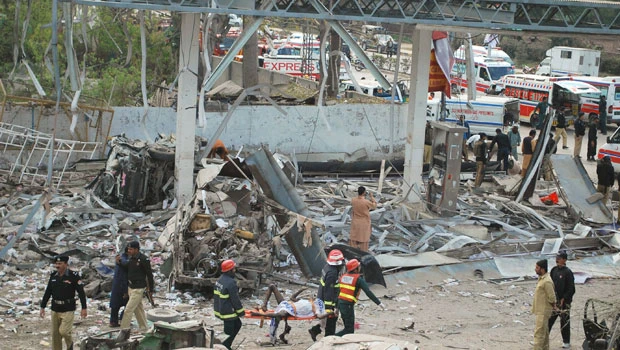
- ISLAMABAD: Twenty-five people were killed and over 150 injured when Taleban detonated a car bomb in Pakistan's third-largest city of Faisalabad on Tuesday.
- The attack took place near the office of the country’s main intelligence agency.
Commissioner of Faisalabad Tahir Hussain and hospital sources confirmed only 20 deaths in the deadly explosion.
The blast in Faislabad underscored the reach of Al-Qaeda and Taleban in the US -allied nation. The militants are based in the tribal regions close to Afghanistan, but have been able to tap into extremist networks in the country’s heartland of Punjab and strike there with regularity over the last three years.
The remote-controlled bomb also devastated a gas station and an office of Pakistan’s state airline in the industrial city. Police said the offices of a “sensitive” security agency were nearby but were not damaged in the attack.
Taleban spokesman Ahsanullah Ahsan said militants detonated the bomb by remote control and that the target was the Inter-Services Intelligence, a powerful agency that plays a major role in Pakistan’s fight against militants.
He said the attack was revenge for the shooting of militant commander Omar Kundi in Faisalabad last year by security forces.
Militants seeking to overthrow the government have bombed hundreds of police, army, commercial and civilian targets in Pakistan over the past three years. The ISI offices in the Punjabi cities of Multan and Lahore have been attacked, as well as in the northwest city of Peshawar.
Tuesday’s bombing apparently caused secondary explosions at the fuel station, adding to the destruction, Faisalabad police chief Aftab Cheema told the Associated Press.
Pakistani TV footage showed piles of bricks and chunks of twisted metal from cars strewn across the neighborhood.
Rescue workers struggled to pull victims out of the rubble.
Cheema said 20 people were killed and more than 100 were wounded. “This was a terrorist activity,” he said. Faisalabad, 260 km south of Islamabad, is home to Pakistan’s textile industry. Militants have never staged a major attack there, but extremist groups have deep roots and are believed to be growing in strength. The region is home to extremist networks that were once nurtured by the state to fight in Afghanistan and Pakistan.
The US has pushed Pakistan to crack down on extremist groups in its borders, saying they threaten not only Western troops engaged in the Afghan war effort but also the stability of Pakistan itself. The army has launched offensives in the northwest, but questions remain over whether the state has fully severed ties with extremist networks, especially those primarily fighting in Afghanistan.
The United States regularly fires missiles from unmanned drones at militant targets in the border region.
One such attack Tuesday killed five alleged militants in South Waziristan region, intelligence officials said on customary condition of anonymity.
The missiles hit a house near the main town of Wana, they said.
Missile attacks in South Wazristian have been rare over the last 16 months. The vast majority of the more than 120 attacks have been in North Waziristan. The Pakistan army launched a major offensive in the south in 2009, but has yet to move into the north.