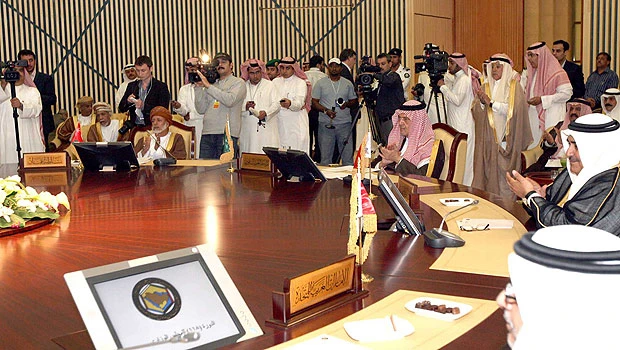
- RIYADH/PARIS: The six members of the Gulf Cooperation Council (GCC) stressed on Thursday that the Libyan regime of Muammar Qaddafi is illegitimate and that contacts should be initiated with the rebels.
“The (GCC) foreign ministers council stresses that the existing Libyan regime is illegitimate and calls for the need to initiate contacts with the interim national council,” a statement said following a GCC foreign ministers’ meeting in Riyadh. The alliance urged Arab League foreign ministers, who are due to meet in Cairo on Saturday, “to shoulder their responsibilities in taking necessary measures to stop the bloodshed.”
The council condemned Qaddafi’s use of heavy weapons and foreign mercenaries to kill innocent civilians as criminal acts. It accused Qaddafi of violating human rights and the international law.
The bloc vowed to deal “decisively” with threats to any member’s security.
“The GCC believes that any threat to the security of any member state harms the security of all states and will be dealt with decisively and immediately, without hesitation,” they said in a statement read out at the end of a meeting in Riyadh.
“The GCC states and peoples totally reject any attempts for foreign interference in its affairs and declare they will firmly curb those trying to foment sectarian rift,” said the statement issued after the foreign ministers’ one-day meeting.
French President Nicolas Sarkozy favors airstrikes on Qaddafi’s command base, a source said Thursday, as France became the first country to formally embrace Libya’s rebels. At an EU summit he will propose “striking an extremely limited number of points which are the source of the most deadly operations” by Qaddafi’s forces, said a source close to discussions, who asked not to be named.
The three sites being considered are Qaddafi’s Bab Al-Azizia command headquarters in Tripoli, a military air base in Sirte, east of Tripoli and another in Sebha in the south, the source added.
NATO defense ministers met in Brussels on Thursday to discuss the conflict, with major powers divided on how to proceed. NATO Secretary-General Anders Fogh Rasmussen said the alliance stands ready to act if there is a clear mandate. Washington wants any military action to be under the NATO banner, with Arab regional backing. Sarkozy’s office declined to confirm the claim about the air strike proposals. “We are not there yet. We are first going to ask for legal authorization to prevent the use of force by Qaddafi,” an official said.
France Thursday seized the initiative against Qaddafi, formally recognizing the Libyan rebels’ national council as the country’s legitimate representative and planning to send an ambassador to rebel territory, after Sarkozy met with its envoys Ali Al-Issawi and Mahmud Jibril in Paris.
Libya’s official news agency Jana quoted a Foreign Ministry official as saying in response that Libya was planning to cut its diplomatic relations with France for its “dangerous intervention in Libyan affairs.” Libyan state television meanwhile relayed reports “of a grave secret that will trigger the fall of Sarkozy, maybe his trial, in connection with fundings for his presidential campaign.”
The European Union leadership has hesitated to recognize the rebels, pending the summit on Friday at which EU leaders will urgently discuss the Libyan crisis.
Germany has taken a more cautious line and Silvio Berlusconi, prime minister of Italy which is Libya’s former colonial ruler and has close diplomatic and economic ties with Tripoli, said it was better to wait for a joint EU position.
Portuguese Foreign Minister Luis Amado on Thursday said he had sent a message to Qaddafi through a Tripoli envoy saying: “The Qaddafi regime is over.”
Meanwhile, Qaddafi’s forces pummeled Ras Lanouf on Thursday as tanks swept toward the key oil town, forcing rebels to retreat east under a hail of rocket fire. Rockets exploded near the town’s hospital and a mosque, forcing medics to evacuate hurriedly as Qaddafi loyalists appeared to wrest back control of the town and push the battle lines deeper into rebel-held territory in the east.
Packed into dozens of pick-up trucks mounted with machine guns, rebels fled the town under a continuous barrage of shelling, rocket and sniper fire that swept from the western outskirts of Ras Lanouf to the east. They had controlled it for only a week.
“We’ve been defeated. They are shelling and we are running away. That means that they’re taking Ras Lanouf,” said one rebel fighter, dressed in military fatigues, who gave his name as Osama. A Katyusha rocket screamed down close to the mosque, just minutes after rebels had ended prayers. Airstrikes hammered positions east of town.
Dr. Mahmud Zubi was the only man left after everyone fled the hospital, his sole companion the body of a man laid out on a stretcher, his nose and the top of his head blown away, and puddles of blood on the floor. “This man’s brains are in a plastic bag. He was killed outside the hospital. He was one of the guards hanging out here all the time. The explosion killed him,” the doctor said.
“We have evacuated the hospital. They were shelling us. It’s only me here.” At least four people were killed and 35 wounded in the assault, a hospital official in the town of Brega, further east, said.
Mahmoud Ibrahim, a retreating rebel in his late teens, wept and called on US President Barack Obama and British Prime Minister David Cameron to intervene. “Where’s Obama? Where’s Cameron? Tell Obama to help us,” he sobbed.
In another development, a report said Thursday Qaddafi has “tens of billions” of dollars in cash hidden in Tripoli, which allows him to battle the uprising despite an international freeze on Libyan assets. The New York Times, citing US and foreign intelligence officials, said Qaddafi’s cash — in US dollars, Libyan dinars and possibly other foreign currencies — is stored at the Libyan Central Bank and other banks around Tripoli.
Qaddafi “likely has tens of billions in cash that he can access inside Libya,” an unnamed US intelligence official said. The cash hoard is vast enough for Qaddafi to comfortably pay his troops, African mercenaries and his political supporters.
The same source told The New York Times that the regime had hired between 3,000 to 4,000 mercenaries from sub-Saharan Africa and was paying them $1,000 a day each. US officials, however, could not confirm the numbers of mercenaries or the amount they were paid.
British newspaper The Guardian said Thursday that one of its most experienced correspondents and a Brazilian journalist he was working with had gone missing in Libya. Iraqi national Ghaith Abdul-Ahad, who has been reporting from western Libya for the past two weeks, was last in touch with the daily through a third party on Sunday.
He was on the outskirts of Zawiyah.
The news comes after three BBC journalists in Libya said they had been arrested, beaten and subjected to a mock execution. The trio was arrested on Monday at a checkpoint 10 km south of Zawiyah, the BBC said. The men were then taken to military barracks in Tripoli where they “suffered repeated assaults” by members of Libya’s Army and secret police before being released 21 hours later. All three have now left the country.
The UN’s High Commissioner for Human Rights Navi Pillay said the abuse suffered by the three BBC journalists could amount to torture.