- ZAWIYA, Libya: Muammar Qaddafi’s regime gained momentum Friday, showing off its victory over rebels in Zawiya, a key city near Tripoli as it strengthened its hold on the capital and surrounding areas.
The government had claimed victory on Wednesday, but the rebels who are seeking to oust Qaddafi said fighting was ongoing.
The rebels also seemed to have a tenacious hold around the oil facilities at Ras Lanouf, taking refuge among the towering storage containers of crude oil and gas.
An Associated Press reporter, who was escorted with other journalists into the city on Friday, said the main square that had been the center of resistance was clearly in government control after nearly a week of fierce fighting.
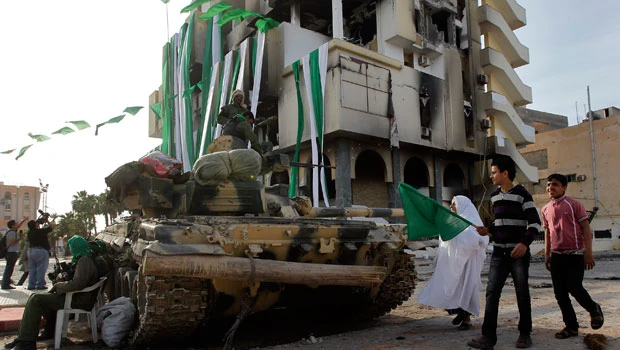
Tanks manned by Qaddafi loyalists and trucks mounted with anti-aircraft guns were stationed in the middle of the square and supporters of the longtime leader were rallying in the area. The nearby mosque has been destroyed, its dome and minaret smashed, and the facades of other buildings overlooking the square were devastated.
Rubble and shattered glass covered the streets. A resident, who spoke on condition of anonymity for fear of reprisals, said the government had used bulldozers to raze a rebel graveyard in the area, although that could not be confirmed. A death toll also was not immediately available.
The battle for Zawiya has emerged as a key test for the government’s staying power because of the city’s proximity to the capital, Qaddafi’s main stronghold.
But pro-Qaddafi forces also appear to be turning the tide in the country’s east, bottling up rebels at a key oil port in a powerful offensive, even as Western nations struggled to decide what kind of action to take in Libya’s crisis.
Government forces stopped directing their fire at those positions, apparently to avoid blowing up the facility’s infrastructure, according to fighters.
Rebels skirmished with Qaddafi's forces in Ras Lanouf on Friday night but neither side was in full control of the largely deserted eastern Libyan oil town, rebel fighters said.
Pro-Qaddafi troops, positioned in Ras Lanouf’s residential about 10 miles (16 kilometers) east of the oil port, were raining rockets and shelling along the main coastal highway, targeting rebel vehicles trying to reinforce and bring supplies to the port, said Mohammed Gherani, a rebel fighter.
Government forces launched a fierce land, sea and air attack to retake the town, the site of a major oil terminal where rebels said storage tanks of a state-owned refinery were hit by a Qaddafi air strike. The government denied hitting the plant.
It was the second time this week an oil installation was hit. Rebels blamed government forces for another air strike that destroyed storage tanks and other facilities at Es Sider further along the coastal stretch where fighting has raged.
Rebels had advanced to the town of Bin Jawad about 60 km (40 miles) west of Ras Lanouf a week ago, but have been driven back across the strip of desert and scrub. Though out-gunned, rebels have kept up stiff resistance.
“Ras Lanouf is a ghost town. There are skirmishes between rebels and Qaddafi forces going back and forth,” said rebel captain Mustafa Al-Agoury, adding that rebels were positioned on the east and Qaddafi’s forces on the west of the town.
Neither side had full control, although Libyan state television said the town was cleared of “armed gangs” opposed to Qaddafi and a spokesman for the rebel movement, Hamid Al-Hasi, told Al Arabiya that Ras Lanouf was back in rebel hands.
Asked late on Friday if rebels now controlled Ras Lanouf, rebel Ahmed Abdelmula Zayed said: “No. But God willing we will return.” He was among a group of rebels who gave different accounts of the status, indicating the town’s uncertain fate.
“They have been going back and forth with heavy bombardment. Qaddafi’s philosophy is if you cannot rule it, he’s going to burn it. So he is bombarding Ras Lanouf indiscriminately from the sea, from the air and with tanks,” a media officer for the rebel movement in Benghazi, Mustafa Gheriani, told Reuters.
The bodies of at least three opposition fighters killed in the shelling were brought to rebel-held Brega, a larger oil port to the west, bringing the toll from two days of battles at Ras Lanouf to at least nine.
The standoff in Ras Lanouf was an attempt by the rebels’ ragtag force to halt a dramatic shift in the momentum of Libya’s upheaval, which is shaping into a potential civil war. Last week, opposition forces that hold the entire eastern half of the country came charging along the Mediterranean coast westward, trying to push toward the capital Tripoli, Qaddafi’s strongest bastion.
But the regime struck back with an overwhelming force, backed by warplanes, artillery, rockets and tanks, that over the past few days pushed the rebels back to Ras Lanouf, 380 miles, 615 kilometers, southeast of Tripoli. On Thursday, pro-Qaddafi forces barraged the port for hours, reportedly adding warships shelling from off shore to their arsenal, in an assault that stunned the once-confident rebels and sent hundreds of their volunteer fighters fleeing in an unorganized retreat.
“They came from the air, they came from the sea, and there were rockets everywhere. It was a big surprise for us,” one rebel fighter, Mustafa Mehrik, a 39-year-old coffeeshop owner, said in Brega. “Everyone is worried.
Today they say there will bring heavy weapons from Benghazi.” In Tripoli, Qaddafi’s son Seif Al-Islam vowed to retake the eastern half of the country. If government forces take Ras Lanouf, they could threaten the opposition’s bastions further east.
“I have two words to our brothers and sisters in the east: We’re coming,” he told a cheering crowd of young supporters late Thursday. The son depicted Libyans in the east as being held “hostage” by terrorists.
The rebel force at the Ras Lanouf front appeared thinner Friday, perhaps a sign they had yet to regroup from Thursday’s blow. The core of the opposition port holding out at the oil facilities appeared to be the more disciplined soldiers from army units that defected and joined the uprising.
At Brega’s western entrance, facing Ras Lanouf, there were few rebel fighters to be seen at the checkpoint — usually the scene of many fighters waving their automatic weapons.
Few fighters or equipment were seen passing through on the way to Ras Lanouf, except an occasional pickup truck with an anti-aircraft gun mounted on the back. Doctors in Brega said six people were killed in Thursday’s fighting, raising their previous count of four.
The assault on Ras Lanouf was a sign of greater confidence in the Qaddafi camp after it first seemed to reel in confusion for the much of the uprising that began Feb. 15.
In Washington, US Director of National Intelligence James Clapper stressed that Qaddafi’s military was stronger than it has been described and said that “in the longer term ... the regime will prevail.” President Barack Obama has called on Qaddafi to step down, and the White House later distanced Obama from the director’s assessment.
The regime confidence may stem in part from a surer hold in the capital, where a heavy crackdown by pro-Qaddafi militiamen has stifled attempts at protests. At the same time, there has been little sign of military intervention by the West, where leaders have struggled with finding a way to respond to the crisis.
The prospect of the quick imposition of a no-fly zone over Libya to protect the civilian population from the Qaddafi regime’s fighter jets appeared to be fading, with German Defense Minister Thomas de Maiziere insisting that the Arab League must first make clear what it wants. The Arab League meets on Libya in Cairo on Saturday.
Qaddafi opponents have attempted to hold protests every Friday for the past weeks in Tripoli, met each time by a fierce retaliation from militiamen.
On Friday, it appeared that no demonstrations got off the ground. In Tripoli’s Tajoura district — scene of some of the heaviest past protests — police deployed in significant numbers outside the main local Murad Agha mosque to prevent marches after prayers. The main road from Tajoura to downtown was blocked by repeated checkpoints.
Qaddafi’s government sent a text message to Tripoli residents, warning imams at mosques against allowing protests after Friday prayers. The message quoted Saudi cleric Sheik Saleh Fawzan, a member of the Saudi Supreme Scholars Council, as saying it was “unacceptable” for any imam “who incites people (or) causes disturbances of the society in any mosque.” European Union leaders were meeting in a summit Friday, promising measures that would increase Qaddafi’s isolation.
But there was a backlash among them against French President Nicolas Sarkozy after he unilaterally announced France’s diplomatic recognition of Libya’s opposition governing council.
Sarkozy was unrepentant. “Democracy is a right for all people,” he said, urging the EU to recognize the opposition “because nothing would be worse than to see a country in a situation like Somalia, without leaders and representatives.” German Chancellor Angela Merkel, whose relationship with Sarkozy is sometimes prickly, said the European Union needed to send a united signal, “since ‘divide and rule’ would only play into the hands of Qaddafi.” The council France recognized is an umbrella group of Libyan rebels based in the eastern city of Benghazi, which was taken over in a deadly uprising that has spread throughout much of the oil-rich North African country.