
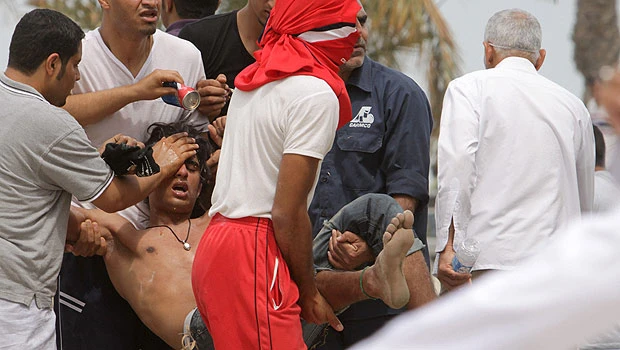
- MANAMA: Riot police in Bahrain fired tear gas and rubber bullets at anti-government demonstrators blocking the highway into the capital’s financial district Sunday and surrounded the protesters’ main camp in the capital, eyewitnesses said.
Authorities failed to dislodge the thousands of protesters blocking King Faisal Highway in Manama, the capital, demanding a greater political voice in the strategic Persian Gulf kingdom, the home of the US Navy’s 5th Fleet.
About three kilometers away, police moved on the Pearl Square protest camp in the largest effort to clear the area since the demonstrations started in mid-February.
That police push, too, was unsuccessful.
Another protest at a university also descended into violence Sunday with security forces and government supporters clashing with students.
Protesters defiantly pushed their cause a day after US Defense Secretary Robert Gates visited and urged Bahrain and other Arab governments facing popular uprisings to move quickly toward democratic reforms.
Bahrain has tried hard to position itself as an attractive investment destination and Middle East banking center. Even the passport stamps issued to incoming visitors declare the kingdom as “Business-friendly Bahrain.”
On Sunday morning, the protesters blocked a main highway leading to Bahrain’s main financial district in downtown Manama, causing huge traffic chaos during morning rush hour.
The protest prevented many who work in the financial district from reaching their offices Sunday, the first work day of the week in the Arab world.
“We can’t even get to the Bahrain Financial Harbor,” a banker who works inside the office complex told The Associated Press. “The roads are completely blocked. They (the protesters) won’t allow anyone to go in there.” “When we found out the whole thing was blocked, we told employees not to even come to work,” the banker said on condition of anonymity because the company has a policy of not commenting publicly on the protests.
Eyewitnesses at Pearl Square said security forces surrounded the protests’ tent compound, shooting tear gas and rubber bullets at the activists.
Protesters showed an Associated Press photographer rubber bullets apparently fired Sunday. Activists tried to stand their ground and chanted “Peaceful, peaceful.”
Bahrain’s government said in a statement that security forces are conducting “operations to reopen the King Faisal Highway.” Police dispersed about 350 protesters “by using tear gas,” the government said.
The statement did not mention police activity at Pearl Square.
By early afternoon, police pulled back from the square after crowds refused to back down, eyewitnesses said. “No going back,” they chanted.
The crowd swelled into thousands with protesters streaming to the square to reinforce the activists’ lines as police continued firing tear gas.
Hundreds were looking for medical help, mostly with breathing problems from tear gas.
Four people were killed at Pearl Square last month when security forces stormed it just days after the protesters set it up. Three other people were killed at protests aimed at reclaiming the square.
“The police were determined to clear the protesters from the square, but we are on a peaceful mission here, demanding our rights, and we are ready to die for our country,” said Mohammed Abdullah, a 38-year-old protester at the square.
An employee at the Arts Collage of Bahrain University, Layla Al-Arab, said plainclothes pro-government backers and security forces had broken up an anti-government protest.
Al-Arab said the main gate of the university was locked, forcing students fleeing the clashes to seek refuge in classrooms and lecture halls.
Bahrain holds particular importance to Washington as the host of the Navy’s 5th Fleet, the main American military counterweight to Iran’s efforts to expand its armed forces and reach into the Gulf.