- FUKUSHIMA: Japan struggled on Monday to avert a nuclear disaster and care for millions of people without power or water, three days after an earthquake and tsunami killed an estimated 10,000 people or more in the nation’s darkest hour since World War Two.
A grim-faced Prime Minister Naoto Kan described the crisis at Japan’s worst since 1945, as officials confirmed that three nuclear reactors were at risk of overheating, raising fears of an uncontrolled radiation leak.
“The earthquake, tsunami and the nuclear incident have been the biggest crisis Japan has encountered in the 65 years since the end of World War II,” Kan told a news conference.
The nuclear crisis intensified Sunday as authorities raced to combat the threat of multiple reactor meltdowns and more than 170,000 people evacuated the quake- and tsunami-savaged northeastern coast where fears spread over possible radioactive contamination.
Nuclear plant operators were frantically trying to keep temperatures down in a series of nuclear reactors — including one where officials feared a partial meltdown could be happening Sunday — to prevent the disaster from growing worse.
But hours after officials announced the latest dangers to face the troubled Fukushima Daiichi nuclear complex, including the possibility of a second explosion in two days, there were few details about what was being done to bring the situation under control.
Chief Cabinet Secretary Yukio Edano said Sunday that a hydrogen explosion could occur at the complex’s Unit 3, the latest reactor to face a possible meltdown. That would follow a hydrogen blast Saturday in the plant’s Unit 1, where operators attempted to prevent a meltdown by injecting sea water into it.
More than 170,000 people have evacuated as a precaution, though Edano said the radioactivity released into the environment so far was so small it didn’t pose any health threats.
Such statements, though, did little to ease public worries.
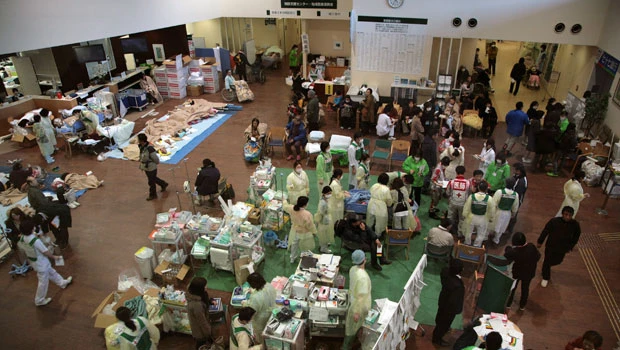
At the makeshift center set up in a gym, a steady flow of people — mostly the elderly, schoolchildren and families with babies — were met by officials wearing helmets, surgical masks and goggles.
About 1,500 people had been scanned for radiation exposure, officials said.
Up to 160 people, including 60 elderly patients and medical staff who had been waiting for evacuation in the nearby town of Futabe, and 100 others evacuating by bus, might have been exposed to radiation, said Ryo Miyake, a spokesman from Japan’s nuclear agency. The severity of their exposure, or if it had reached dangerous levels, was not clear.