- MANAMA: Bahrain’s king imposed a three-month state of emergency Tuesday and gave the country’s military chief wide authority to battle a pro-democracy uprising that has threatened the ruling monarchy and drawn in forces from around the Gulf.
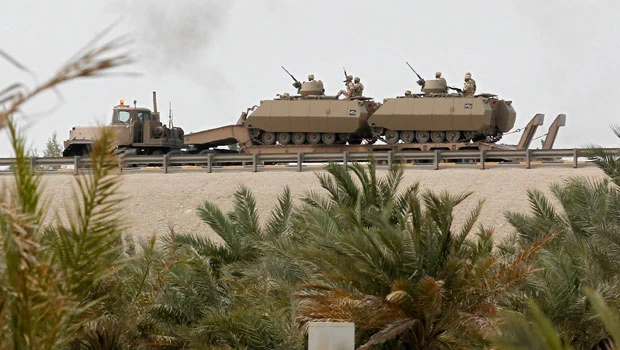
The martial law-style order — read on Bahrain state TV — comes a day after more than 1,000 Saudi-led troops arrived to help prop up the US -backed regime in the first major cross-border action against the revolts that have erupted across the Arab world. The United Arab Emirates also confirmed that it is sending 500 troops.
Bahrain’s Ministry of Information, meanwhile, denied earlier reports that a Saudi police officer had been shot dead by a protester on Tuesday in Manama. The ministry said it was a member of Bahrain’s security forces who was killed in clashes with protesters.
“A member of the security forces passed away in Maameer this evening when he was deliberately run over by one of the rioters,” the ministry said in a statement read on state television.
A Saudi Defense and Aviation Ministry source also denied press reports that Sgt. Ahmed Salim Al-Radadi, a Saudi military officer who works for the Peninsular Shield Forces in Bahrain, had died. "This baseless report. Our men are in Bahrain as part of the Peninsular Shield not for any fighting mission but to safeguard some vital areas of the country," the source said.
The dispatch of troops from Gulf allies on Monday highlighted the regional worries about possible spillover from Bahrain, where members of a majority Shiite population have led a month of relentless protests against the Western-backed Sunni dynasty to try to break its monopoly on power.
There are fears that gains by Bahrain’s Shiite Muslims could offer a window for Shiite power Iran to expand its influence on the Arab side of the Gulf.
The emergency law statement said the head of Bahrain’s armed forces has been authorized “to take necessary steps to restore national security.” Hours before the announcement, Bahrain’s capital was in lockdown mode with stores and schools shuttered and main highways blocked by police.
In Tehran, Iran’s Foreign Ministry spokesman, Ramin Mehmanparast, denounced the presence of foreign troops in Bahrain as “unacceptable” and predicted it would complicate the kingdom’s political crisis. Iran holds no deep political ties to Bahrain’s Shiite groups, but some Iranian hard-liners in the past have hailed their efforts for greater rights.
Bahraini opposition groups also have strongly condemned the military move, calling it an occupation that pushes Bahrain dangerously close to a state of “undeclared war.” The United States — which relies on Bahrain as a pillar of its military framework in the Gulf — has urged Americans to avoid travel to the island nation due to “the potential for ongoing political and civil unrest.” The State Department statement also advised Americans currently to consider leaving Bahrain, which hosts the US Navy’s 5th Fleet.
Thousands of protesters held their ground in Manama’s Pearl Square, the symbolic center of their revolt. But opposition leaders have not yet announced their next move.
Bahrain’s largest Shiite Muslim opposition group, Wefaq, condemned the imposition of martial law and called for international intervention. “The army is in control of society now,” said Jasim Hussein, a Wefaq politician.
Bahrain has been gripped by its worst unrest since the 1990s after protesters took to the streets last month, inspired by uprisings that toppled the leaders of Egypt and Tunisia.
Unlike those countries, where the mainly Sunni populations united against the regime, Bahrain is split along sectarian lines, raising the risk of a slide into civil conflict.
Violent clashes between youths wielding clubs, knives and rocks have become daily occurrences, forcing Bahrain University and many schools to close in order to avoid further trouble.
The United States has urged Saudi Arabia, the world’s top oil exporter, to show restraint, though analysts said the escalation showed the limits of US influence when internal security was threatened.
The United Nations and Britain echoed the call for restraint and the Group of Eight powers expressed concern.
In a sign that security could deteriorate, the US State Department advised against all travel to Bahrain due to a “breakdown in law and order.”
Underlining the growing tensions, armed youths attacked the printing press of Bahrain’s only opposition newspaper Al Wasat overnight in an effort to stop its publication.
Metal barricades and piles of sand and rocks blocked the main thoroughfare to the financial district and most shops in Bahrain were shut.
“We are staying peacefully. Even if they attack we are peaceful,” said Ali Mansoor, an activist at Manama’s Pearl roundabout, where thousands of protesters have camped out.
Around Bahrain, residents have placed skips, bins and pieces of metal on the road, to prevent strangers from entering their neighborhoods. Young men, some wearing masks and carrying sticks, guarded the entrances to their areas.
Mansoor Al-Jamri, editor of the main opposition newspaper, Al-Wasat, said pro-government mobs stormed the paper’s printing facilities early Tuesday and smashed equipment with metal pipes, clubs and axes. The paper is now using presses from other papers to publish.
Shiites account for 70 percent of Bahrain’s population of some 525,000, but are widely excluded from high-level political or security posts. The protesters also demand the repeal of a government policy to offset the Shiite demographic advantage by giving citizenship and jobs to Sunnis from other Arab nations and South Asia.
The protests began last month with calls for the monarchy to give up most of its powers to the elected parliament.
But as violence has deepened, many protesters now say they want to topple the entire royal family.
A statement Monday on the state-run Bahrain News Agency said troops from the six-nation Gulf Cooperation Council’s Peninsula Shield Force have been deployed “in line with the principle of common destiny bonding.” The bloc is made up of Saudi Arabia, Oman, Kuwait, Bahrain, Qatar and the United Arab Emirates.
Saudi Arabia and the UAE have announced roles in the Bahrain force, but the contributions from the other countries were not immediately clear.
The reason for the mission was “the common responsibility of the GCC countries in maintaining security and stability,” the statement said.
The Peninsula Shield Force was created in the 1980s.
Military units under a GCC command have been sent to Kuwait, including during the 1991 US -led campaign to oust Saddam Hussein’s force and in 2003 before the US -led invasion of Iraq. The current action marks a significant shift to help a government quell internal unrest.
Jane Kinninmont, a senior research fellow and Bahrain expert at the London-based think tank Chatham House, said Monday’s operation “changes the role of the GCC,” which has always had collective defense pacts.
“The idea of gathering together to protect a government against its own people seems to be quite another thing,” Kinninmont said.