- In the crepuscular light African dawn of Feb.
- 23 last, an international team of 12 climbers with a dual purpose watched the pink-red disc of the sun slide into the sky over the vast Tanzanian landscape.
They had achieved, just seven months after the idea popped out over a casual coffee one summer’s day, both the summit and the raising of funds for the charity they had made all the effort for. It was a moment to treasure.
The very word, Kilimanjaro is heavy with mystery and challenge. The highest mountain peak in Africa and uniquely the highest freestanding mountain in the world it looms over the northern section of Tanzania.
It is also a volcano, rising to an altitude of 5,895 meters above mean sea level (asl). Composed of three distinct volcanic cones: Kibo 5,895 meters, a dormant crater and where Uhuru Peak the highest point is located; Mawenzi 5,149 meters and Shira 3,962 meters, both extinct, if that is ever true.
The charity the team had selected, the Palestine Children’s Relief Fund (PCRF), was one that had occupied the attention of the group of friends who made up most of the team. “Prior to this, we had been discussing for many months how we needed to help the Palestinian children and this was the perfect way to help raise money for the cause and awareness of what’s going on,” said Reem Shaath, one of the climbers.
At this point, only two people were on board and Shaath became instrumental in the fundraising for the climb and the charity. “I reached out to every single company I knew, told them about what we were planning to do and the amount of money we wanted to raise.”
The sum she had targeted was $150,000; in the final analysis the project had attracted enough interest to raise $500,000, far beyond their best expectations.
The funds started appearing in early January with the help of a dedicated website and personal donations as seed money. “Corporate sponsors were paying between $5,000 to $50,000. We promised all sponsors that we would thank them from the top of Kilimanjaro, the roof of Africa,” said Shaath.
The size of the climbing team gradually expanded and was joined by Steve Sosebee, the president and founder of the PCRF with his 14-year-old daughter Deema on the climb. “This catapulted the fundraising effort and it came at a time when we opened sponsoring to all our friends and everyone wanted to take part.”
Ten days before the climb, donations passed the $350,000 mark and one day before the climb they broke through the $500,000 mark; this was at a time when not yet a step had been taken.
Arriving in Kilimanjaro airport, the team underwent intense briefing for the climb. It is not a technical climb or as challenging as the peaks of the Himalayas, but it is physically extremely challenging. The altitude, low temperature and deceivingly high winds make it a very difficult and dangerous trek. Acclimatization is essential, and even then most experienced climbers suffer some degree of altitude sickness. Kilimanjaro National Park statistics show that only 30 percent of climbers actually reach the Uhuru summit. The majority of climbers stop at Gilman’s Point, 300 meters short of Uhuru, or Stella Point, 200 meters short. It was not therefore going to be a walk in the park.
“The next morning, we were up bright and early, making our way to Kilimanjaro National Park. We had been preparing for many months in advance and also had reached our target so half the challenge was done. We were in great spirits,” said Shaath.
As soon as we started the climb around 12:30 p.m., it started raining very heavily. The climb was in the jungle, in the rain with mud adding extra interest. The wet southern slope contrasts with the dryer northern side, which, with forests of Sub alpine Erica, has the highest cloud forests on the continent.
After seven hours of climbing they reached the first camp, Machame Camp at 3,000 meters, where they slept in tents.
“Dalia (Alireza) and I were sharing a tent and we each had our own sleeping bag. It was the first time I had slept in a tent,” said Shaath. “The next morning, the rains had stopped, sun was shining and we were all smiles.”
For the next five days, the group climbed between 1,000 and 1,200 meters per day and then descended a little at the end of each day to acclimatize. “By day three, we had reached 4,600 meters but had to come down to 3,800 meters to sleep. Our bodies were getting used to the lack of oxygen in the air and the altitude sickness which many of us suffered from,” Shaath said.
The biggest challenge she said was the thin air and freezing temperatures at night which made sleeping difficult. “For the most part we were all doing well except for the headaches and nausea.”
Each day, the group walked an average of eight hours a day surrounded by beautiful scenery with Kilimanjaro as a backdrop. “The climb was tough but bearable but nothing could have prepared us for the last part of the journey.”
On day five, the last before the attempt on the summit, the team had reached 4,600 meters and was in very good shape physically, emotionally and mentally. “The reason we had made it so far was because we had great team spirit and we were extremely supportive of each other.”
The night of Feb. 22 turned out to be the toughest experience of their lives. At 11:30 a.m. after a meal, they set out for the summit to reach it by sunrise.
“It was freezing and we were dressed in five layers yet even that wasn’t enough to keep us warm,” said Shaath. The temperature was below minus 20 degrees Celsius, the wind was blowing in their faces, visibility was low and lack of oxygen took its toll. “There were a few moments where I was about to give up and all I could think of was ‘one foot in front of the other until you reach to the top,’” admitted Shaath.
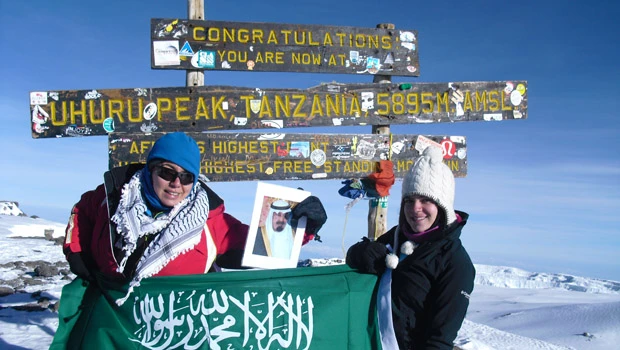
After an eight-hour slog, the team crested Uhuru Peak at 5,895 meters on the roof of Africa to welcome the sunrise on Feb. 23, 2011. “The experience was exhilarating to say the least. We were on top of the clouds, there was snow everywhere and the beauty was breathtaking.”
Twelve amateur climbers from countries as varied as Palestine, Saudi Arabia, Jordan, Lebanon and the United States, had achieved what even their African guides did not think they would accomplish. The head guide said that he felt at least three or four of them would not make it to the top when he first met the group. He was surprised by their resilience and determination. It seemed the harder the climb and conditions became, the more determined the group was. They could even hardly be called amateurs. Most had never climbed anything before, and Ali Alireza said, “the only mountains I ever conquered, I was in my car.” All told, the group trekked for 66 kilometers mostly uphill and in conditions of cold and little oxygen. A notable milestone was also achieved by the group when the Alireza Family of Ali, Salma, Dalia, and Husein became the first family from Saudi Arabia to reach the summit of Kilimanjaro together on the same day.
Banner were raised on the summit to thank and honor the trip’s sponsors. Also, the two Saudi young ladies, Reem and Dalia, raised the Saudi flag and a picture of Custodian of the Two Holy Mosques King Abdullah to celebrate his safer return from his medical trip and honor his continuous commitment to Arab causes and especially to Palestinian children.
Reflecting on the experience, Shaath voiced the feelings of the group. “Reaching the highest peak in Africa meant that I could do anything. Having been through such an experience, I can honestly say that when you put your mind to something, and you have the will to do it, you can achieve anything.”
Ali Alireza, Salma Dajani, Dalia Alireza, Husein Alireza, Fouad Dajani, Tarek Dajani, Toufic Farah, Steve Sosebee, Deema Sosebee, Hisham El Farouki, Samer Sarraf and Reem Shaath.