- TRIPOLI/UNITED NATIONS: Muammar Qaddafi warned the rebel stronghold of Benghazi he would storm the city in the night showing no mercy, while the United Nations edged toward a resolution allowing air strikes to stop him.
“We will come zenga, zenga. House by house, room by room,” he said in a radio address to the eastern city.
Thousands of residents of Benghazi gathered in a central square, waving anti-Qaddafi tricolor flags and chanting defiance of the man who has ruled the country for four decades.
“It’s over. The issue has been decided,” Qaddafi said, offering pardon to those who lay down their arms. “We are coming tonight...We will find you in your closets.
“We will have no mercy and no pity.”
French diplomatic sources said military action could begin within hours of a Security Council vote on Thursday night.
Rebel National Council head Mustafa Abdel Jalil told Al Jazeera television air strikes were essential to stop Qaddafi.
“We stand on firm ground. We will not be intimidated by these lies and claims...We will not settle for anything but liberation from this regime.”
Qaddafi’s troops, far better armed than the rebels, appeared to be at least 100 km (60 miles) from Benghazi and it was unclear if his threat to seize the city in the night was anything more than bluster. But Thursday saw three air raids on the city and fierce fighting on the highway approaching along the Mediterranean coast, residents and a rebel spokesman said.
The threats, at the very least, increased the sense that a decisive moment had come in an month-old uprising inspired by rebellions against autocratic rule across in the Arab world.
The United Nations Security Council was preparing to vote on Thursday night on a resolution backed by Western and Arab powers that could trigger air strikes to protect civilians from retribution by the man who has ruled Libya for four decades.
The draft submitted by France, Britain and Lebanon would authorize a no-fly zone and ‘all necessary measures’ to protect civilians. Diplomats said Paris, London and Washington, which had long resisted military action, as well as between two and five Arab states, could participate in military action.
It ruled out any “occupation force” in the oil-exporting country; a nod both to Arab sensitivities and to Western capitals already chastened by involvement in protracted wars in Afghanistan and Iraq.
Paris appeared optimistic that China and Russia, who have expressed reservations, would not exercise their veto.
“We are convinced we have the nine votes,” one French diplomatic source told reporters. “Once the resolution is voted, an operation could start within several hours.”
By late evening, telephone lines to Benghazi and internet connections appeared to be cut.
Qaddafi’s Defense Ministry warned of swift retaliation, even beyond Libyan frontiers, if the UN voted for military action against the oil-exporting nation.
“Any foreign military act against Libya will expose all air and maritime traffic in the Mediterranean Sea to danger and civilian and military (facilities) will become targets of Libya’s counter-attack,” the ministry said in a statement.
To enforce a no-fly zone it would probably be necessary to attack Libyan air bases and air defenses. Any mission would have to be clearly defined to avoid escalation into ground action.
The move to a UN resolution followed a sharp shift in tone by the United States, which had resisted calls to military action. US officials said they wanted not only the no-fly zone requested by the rebels and the Arab League but also air strikes against Libyan tanks and heavy artillery.
US Undersecretary of State William Burns said he was concerned Qaddafi, famously dubbed the ‘mad dog of the Middle East’ by president Ronald Reagan in 1986, could “return to terrorism and violent extremism” and create turmoil in the region.
Qaddafi’s forces have worked their way steadily along the Mediterranean coast over the last couple of weeks.
Libyan state television said government troops had taken Zueitina, an oil port on the coastal highway 130 km (80 miles) from Benghazi, but the rebels said they had surrounded the pro-Qaddafi units on the approaches to the town.
Residential areas of Ajdabiyah, a strategic town on the coast road to Benghazi, was the scene of heavy fighting on Thursday and around 30 people were killed, Al Arabiya reported.
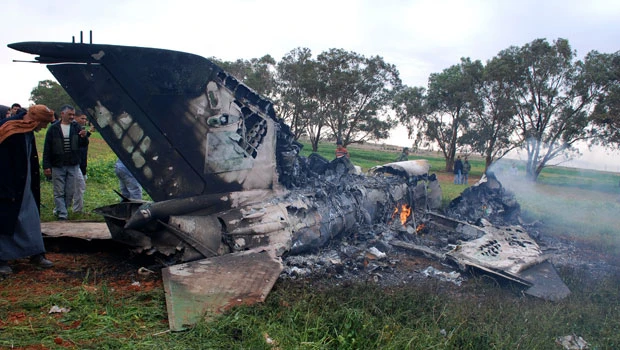
On the approaches to Ajdabiyah, burned-out cars lay by the roadside while Libyan government forces showed the foreign media artillery, tanks and mobile rocket launchers — much heavier weapons than those used by the rebels.
In Libya’s third city, Misrata, about 200 km (130 miles) east of Tripoli, rebels and residents said they were preparing for a new attack by Libyan troops, who had shelled the coastal city overnight. A government spokesman said Qaddafi’s forces expected to be in control of Misrata by Friday morning.
US Secretary of State Hillary Clinton laid out the case for removing Qaddafi in a televised question and answer program with Tunisians.
“Tunisia knows very well that if Qaddafi does not go, he will most likely cause trouble for you, for Egypt and for everybody else. That is just his nature. You know, there are some creatures that are like that,” she said.