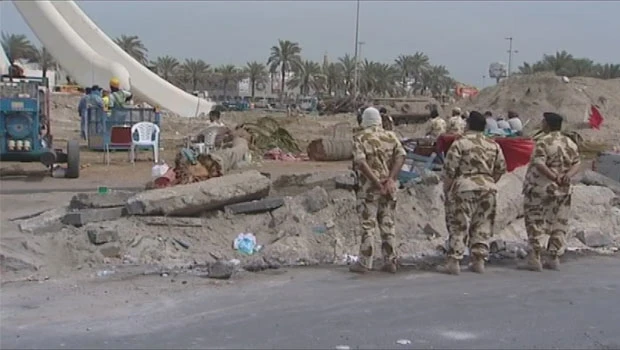
- MANAMA: Bahrain tore down on Friday the statue at the center of Pearl Square roundabout, focal point and symbol of weeks of pro-democracy protests in the Gulf island kingdom.
Drills and diggers cut away at the six bases of the statue for hours, until it collapsed into a mound of rubble and steel bars. Trucks stood by to take away the debris.
The concrete statue of six dhow sails holding up a pearl was erected in the early 1980s to mark a summit of formation of the Gulf Cooperation Council (GCC).
Each of the six sails represents one of the members of the GCC, which include Bahrain, Kuwait, the United Arab Emirates, Saudi Arabia, Qatar and Oman. The pearl represents the joint heritage of the Gulf countries, whose economies were based on pearl fishing before the discovery of oil.
Protesters had taken over the grass-covered roundabout near the financial district of Manama during weeks of protests, setting up a tent city where free food was handed out and political speeches and rallies were held into the night.
Bahraini riot police launched a crackdown on the Pearl Square protest camp on Wednesday, driving out demonstrators. Military troops later arrived to seal off the area which is under a 12 hour daily curfew.
“It is a kind of psychological victory for the protesters,” said Hussein Oraibi, who works in telecoms. “It upset them so much that people were gathering there, they had to go out of their way to pull this down and change the traffic directions.”
However, Bahrain’s foreign minister said on Friday the government remains committed to dialogue with the opposition but restoring security is a priority and more Gulf troops will arrive on the island to support its forces. Sheikh Khaled bin Ahmed Al-Khalifa said three or four Gulf states were sending troops and the forces would remain in the kingdom for as long as it takes to restore order.
Their role would be limited to guarding strategic assets such as oil facilities, however, and they would not be involved in quelling protests, he told a news conference in Manama. “We look with all confidence to the return of normal life in Bahrain,” Sheikh Khaled said. “We know dialogue is our path.”
Sheikh Khaled also rejected criticism from US Secretary of State Hillary Clinton, who said the Gulf intervention was a step on the “wrong track,” saying that Bahrain, home to the US Fifth Fleet, looked forward to clarifying the situation to its ally. He also dismissed suggestions that Saudi Arabia had pressured its tiny neighbor into allowing the intervention of outside troops, saying the issue had been discussed with the Gulf Cooperation Council in several talks.
Saudi Foreign Minister Saud Al-Faisal also said Friday that the Kingdom did not pressure Bahrain to allow troops’ intervention. It was agreed in Gulf talks.
Meanwhile, thousands of Bahrainis buried an activist killed in a crackdown on protesters.
Mourners carrying pictures of activist Ahmed Farhan, killed on Wednesday, followed a car carrying his flag-covered coffin.
A miltary helicopter buzzed overhead and tanks lined the entrance to Sitra, where Farhan was buried, but they did not disperse the mourners despite a blanket ban on gatherings imposed this week.
“This is a big loss... They can say what they want about us but we are nonviolent. We will never use violence,” said Yousif Hasan Ali, who was in jail with Farhan, 30, for over two years.
Bahrain has arrested seven opposition leaders and driven pro-democracy demonstrators from the streets after weeks of protests that prompted the king to declare martial law and sucked in troops from GCC countries.
Three protesters died in the security sweep. Three policemen were also killed, hit by cars driven by demonstrators.
Showing its desire to avoid new violence, the largest opposition party Wefaq told its followers by text message not to provoke police and not to use slogans that offend the royals.
The mourners appeared not to adhere to those requests.
Iran complained to the United Nations and asked other neighbors to join it in urging GCC troops to withdraw from Bahrain.
In a sign of rising tension, Bahrain said: “Iran's move does not serve security and stability in the Gulf region.”