- TOKYO: A “Chernobyl solution” may be the last resort for dealing with Japan’s stricken nuclear plant, but burying it in sand and concrete is a messy fix that might leave part of the country as an off-limits radioactive sore for decades.
Japanese authorities say it is still too early to talk about long-term measures while cooling the plant’s six reactors and associated fuel-storage pools, comes first.
“It’s just not that easy,” Murray Jennex, a professor at San Diego State University in California, said when asked about the so-called Chernobyl option for dealing with damaged reactors, named after the Ukrainian nuclear plant that exploded in 1986.
“They (reactors) are kind of like a coffee maker. If you leave it on the heat, they boil dry and then they crack,” he said.
“Putting concrete on that wouldn’t help keep your coffee maker safe. But eventually, yes, you could build a concrete shield and be done with it.”
Experts say the cores at the six battered reactors at the Fukushima Daiichi power plant, 240 km north of Tokyo, are likely to be safely contained, but worry about the cooling pools for spent fuel, one of which contains plutonium.
So far, authorities have failed to cool the pools, where normally water circulates continuously, keeping racks of spent nuclear fuel rods at a benign temperature.
Helicopters and water cannon trucks have dumped tons of water on the reactors, but still the water in the pools is evaporating and the rods are heating up. It is also feared that the quake has smashed the rods into each other, which could cause a nuclear reaction.
“It is not impossible to encase the reactors in concrete, but our priority right now is to try and cool them down first,” a Tokyo Electric Power official told a briefing on Friday.
At Chernobyl, an army of workers conscripted by the then Soviet government buried the reactor in tons of sand, then threw together a concrete container known as the “sarcophagus” within months of the fire and explosion there.
It failed to set properly and it cracked, leaking radiation into the atmosphere and water. Partly supported by the damaged walls of the reactor building, it has had to be reinforced.
Under a new plan for Chernobyl, a massive structure will be assembled away from the reactor at a cost of billions of dollars, then slid into place over the existing sarcophagus.
Chernobyl-style methods would be even more difficult at Fukushima Daiichi, given the number of reactors involved.
As Japanese officials have said, cooling is still the top priority. Pouring sand onto hot fuel could theoretically produce glass, and that same heat would prevent working on a durable concrete shell.
That means the stricken complex is likely to become an open sore, leaking radioactive particles into the atmosphere, for weeks and possibly months before the Chernobyl solution could even be implemented.
Authorities say radiation outside the Japanese plant is not high enough to cause harm. Still, the 20 km exclusion zone around the plant may end up as a permanent no-man’s land, a major problem for small, populous country.
A 30 km exclusion zone remains around Chernobyl.
Tokyo, though, is likely to remain largely unscathed no matter what happens because of its distance from the reactors, no matter how nervous its citizens may be.
It is not accidental that the nuclear plant was built so far away from Japan’s biggest city, said Yuki Karakawa, international coordinator at the International Association of Emergency Managers, an extension of the US Federal Emergency Management Agency.
“Those reactors in Fukushima are there for Tokyo’s power and Tokyo’s benefit, not for Fukushima’s,” he added. “After all, Tokyo is more than 200 kilometers away.”
Meanwhile, the US Navy is keeping all but critical missions from flying through a wide stretch of airspace above Japan's overheating nuclear plant.
Commander Jeff Davis, a spokesman for the US 7th Fleet, said Friday the air cordon is meant to ensure safety and to keep routine flights from passing through potentially hazardous airspace.
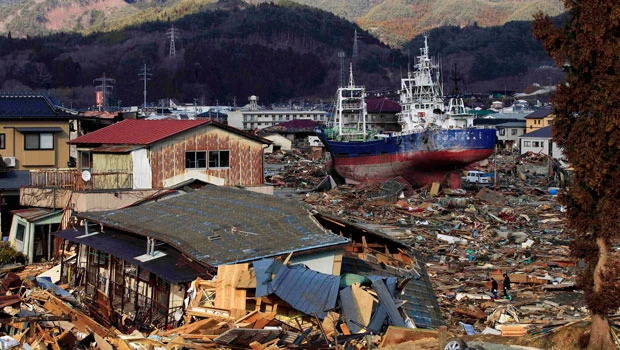
The restricted zone covers a radius of 100 nautical miles — or about 110 miles or 175 kilometers — above the Fukushima Dai-ichi nuclear plant, which has leaked radiation in the days after its cooling systems were crippled by the March 11 earthquake and tsunami.