- SANAA: Two prominent members of Yemen’s ruling party resigned on Saturday in protest against the killing of dozens of anti-government protesters, while troops enforced a state of emergency in the capital.
The officials quit their posts as President Ali Abdullah Saleh’s crackdown on dissent grows increasingly deadly. Police on Saturday stormed a protest camp in the southern city of Aden, firing live rounds and tear gas that wounded at least 13 people.
The Aden raid follows a dramatic escalation in violence Friday, when snipers on rooftops fired at a crowd of protesters holding camp at Sanaa University in the capital city, killing 46 and wounding hundreds.
Protesters said they had caught at least seven snipers carrying government identity cards, but President Saleh denied this, blaming gunmen among the protesters for the violence.
Nasr Taha Mustafa, head of the state news agency and a leading ruling party member, said he had resigned from his post and the party in protest over Friday’s killings.
“I find myself compelled to submit my resignation ... after the heinous massacre in Sanaa yesterday ... Nothing can justify the deaths of scores of youths whose only sin was to exercise the freedom guaranteed by Islam and the constitution to demand change,” Mustafa said.
Another party member, Mohamed Saleh Qara’a, told Reuters he had also quit because of the “completely unacceptable” violence. The tourism minister and the head of the party’s foreign affairs committee resigned on Friday.
Defying the crackdown, the opposition vowed to keep up its “peaceful revolution” in the poor Arabian Peninsula state, a US ally against Al-Qaeda.
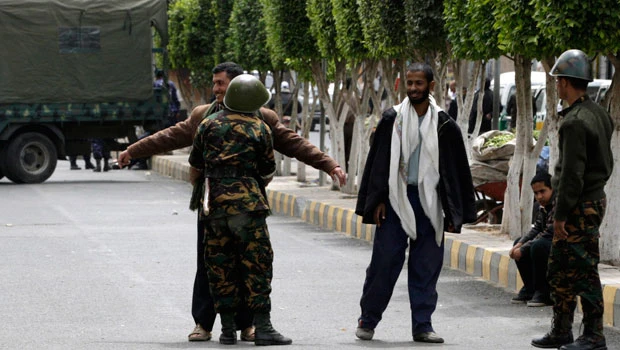
Soldiers set up checkpoints to enforce a ban on carrying firearms in public, even checking for hidden guns inside the ornamental scabbards of traditional Yemeni jambiya daggers.
Inspired by mass protests that toppled the leaders of Tunisia and Egypt, demonstrators have been demanding for weeks that Saleh steps down. More than 70 people have been killed.
Friday’s bloodshed prompted Saleh, struggling to preserve his 32-year rule, to declare a state of emergency for 30 days that restricts freedom of movement and the right to gather. It also grants police more leeway to make inspections and arrests. Tanks were deployed for the first time since the disturbances began. Yemen is the second country in the region to announce emergency rule this week, after Bahrain declared martial law on Tuesday.
Two out of every five Yemenis live on less than $2 per day. The US-allied government faces separatists in the south, maintains a shaky truce with rebels in the north and is fighting an aggressive local Al-Qaeda wing. Saleh has rejected demands to step down immediately but promised to leave office when his term expires in 2013. He has also offered a new constitution giving more powers to parliament.
Yemen’s opposition said there was no way it could negotiate with Saleh’s government after Friday’s killings. “Sending tanks to the streets is a sign that the regime is in a state of panic. But Yemenis are determined to move forward with their peaceful revolution until the fall of the regime,” said opposition spokesman Mohammed Al-Sabri.
In the southern port city of Aden, police shot and wounded six protesters as they tried to disperse demonstrators holding a sit-in in a main street, residents said.
“Tanks don’t scare us. They have killed dozens of us and hundreds were wounded. And we are not leaving until Ali Abdullah Saleh leaves,” said Abdullah Saif, one of the protesters in Sanaa.
The United States and France both condemned the violence on Friday. US President Barack Obama urged authorities to protect peaceful protesters and said those responsible must be held accountable.