
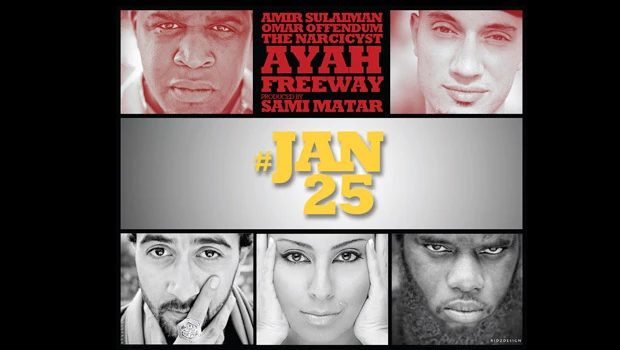
- Inspired by the resilience of the Egyptian people during their recent uprising, several notable musicians from North America have teamed up to release a song of solidarity and empowerment.
- The track is fittingly titled “#Jan25” as a reference to both the date the protests officially began in Egypt, and its prominence as a trending topic on Twitter.
Arab News caught up with The Narcicyst (an Iraqi-Canadian) and Omar Offendum (a Syrian-American) to talk about the track and the revolts in the Middle East.
The process of creating this song was very organic and involved a circle of friends/artists collaborating from their respective hometowns across the US and Canada. The idea came from my good friend and fellow musician Sami Matar, a Palestinian-American composer who produced this song. It began a few weeks ago when he first sent me the instrumental/beat and asked that I write a verse inspired by the events unfolding in Egypt. After I wrote mine, we felt that it would be important to add other artists/friends from North America in order to showcase a variety of voices and styles in support and solidarity with our protesting brothers and sisters. The Narcicyst (Iraq via Montreal), Freeway (Philadelphia), Amir Sulaiman (Atlanta), and Ayah (Occupied Palestine via Toronto) subsequently all wrote and recorded verses and sent them to us online for mixing at Sami's studio in Southern California. He put the song together and also created the video from Al-Jazeera English footage of the protests to go along with it — and we posted it on YouTube. In less than a week it has gained over 100,000 views. We are all very humbled by this and glad that we were able to contribute in this capacity. However, we are all aware of the fact that the true music of this revolution came from the people of Egypt themselves, singing and chanting on the streets of Cairo, Alexandria, Suez, etc.
I think the world is in shock, and at the same time, energized by what is happening. Never has this happened simultaneously, back-to-back in one region of the world. This is the Year of the Arab. I am in awe, amazed, blessed to be a part of the generation to see this happen and hope for the best in the future. Knocking down the old systems is one thing, but changing the system of governance is another. It's going to take a lot of groundwork to shift the tide and, insha'Allah, with the will of the people, and not external forces, we can see it happen.
As I mentioned above, we all live in different cities, so this was an online collaboration between us. It took coordination and group decisions that were made via e-mail and Skype, but it was ultimately very agreeable and easy. We all had the same end goal of creating a dedication to the men, women and children who protested, fought, and were martyred for this historic event to take place.
It feels just like collaborating with Omar Offendum or Shadia Mansour. We are all one big musical family and we are blessed to have each other. Every man is the same at the end of the day. But it is very nice to break bread with some of our favorite poets and share common thoughts and ideas about the world in a song. We are all blessed to be doing what we are doing and to share it with people we grew up listening to.
That it began in Tunisia and has ramifications in Egypt, Gaza and the rest of the Arab world. I sought to show that all our struggles are connected. I used lines referencing quotes from Ghandi, Malcom X, and Martin Luther King, Jr. in order to show that this is a universal struggle for human rights across space and time. The African-American MC Freeway and Spoken Word artist Amir Sulaiman took this idea one step further with their lyrics as well.
The track was featured on top hip hop sites and blogs. Do you feel that is because it features two American rappers?
It definitely didn't hurt, but I think this track garnered attention because of the significance of Egypt historically. Egypt is the middle ground between the Middle East and Africa. It is the bridge between our experience and the African experience. I think it was one of the first moments in history where two “Public Enemy No. 1s” in North America felt a common experience, and we shared it together.
I was in the Middle East, in Dubai, with Egyptian friends and family when he finally stepped down! At first I didn't believe that what happened in Tunisia could happen in Egypt, but when the protesters took to the streets on Jan. 25 I had an overwhelming feeling of joy, pride and optimism about what was taking place. I prayed that it wouldn't turn too bloody and am deeply saddened by the fact that hundreds of lives were lost for this cause. However, given the fact that 82 million people live in Egypt, I am relieved that more violence didn't take place. This was truly a peaceful demonstration for the most part, and I am so proud and honored to have been able to witness it.
We gave you fair warning: Beware.
To me, a peaceful revolution is one in which justice prevails, corruption is weeded out, bribery and nepotism become things of the past and the false borders that separate and divide the people of the Arab world are erased from our memory. Unity in every sense of the word is the ultimate goal: Where every single Arab woman and man will be able to live and love in safety, security, prosperity and, above all, peace.
I can certainly relate to the artists you mentioned (and many, many others) much more than the majority of artists in so-called “mainstream/commercial hip-hop” since those are the artists who inspired me with their dedication to a conscious message: Resistance to oppression, representing the universal struggle for human rights and dignity; these are ideas and themes that often permeate my lyrics and songs. Most importantly, it is meant to be an honest expression and this song displays the feelings and emotions I had watching the events in Egypt unfold.
Three of the artists have Arab roots, and this definitely gave us an ability to sympathize, empathize and relate to the struggle. Two others are African-American (Amir Sulaiman and Freeway), which is an important distinction to make. Yes, they are Muslim, but having an artist like Freeway join us — one who has been associated with the biggest names in hip-hop, like Jay-Z — opened a lot of doors for this song to be covered by big news outlets and featured on major hip-hop blogs. It thus brought the discussion of these events into an arena that perhaps wouldn't have been too concerned with Egypt — providing that necessary bridge between cultures.
Yes, especially a combination of hip-hop and online social media in these countries. They gives the youth an outlet that they previously didn't have. And since a large majority of the populations in these countries are under the age of 30, this has a great deal of potential in the region and across the developing world.
Yes, I have a lot of good friends and family in Egypt, and I was honored to hear that they enjoyed the song. Some even played it in Tahrir Square! Our YouTube stats show that it has been played in Egypt over 20,000 times so far, which is humbling. However, as I have said in previous interviews, this was just one of many songs about the Egyptian uprising that have contributed to the overall “sound track” of the revolution. The songs and chants by Egyptians in Egypt are truly the most powerful and inspiring, in my opinion. (Omar offers this link to one of his favorites: .)
It clearly did not create the civic uprising, but it brought attention to it, which is very important. It helped open eyes that were closed for a very long time.
It has always been a tough balance — especially after 9/11. Some people in the US have a very bad view of Arabs and Muslims since the media often portrays them in such a negative light. However hip-hop has given me a platform to express myself and challenge these stereotypes very directly over the past 10 years. I think through the efforts of artists like myself, as well as authors, professors, journalists, bloggers and everyday people living their lives in a positive way these things will change. I am so proud of my Arab and Muslim roots. I don’t feel the need to be apologetic about anything. I don’t get sucked into having to deny that I'm a terrorist or extremist. To me it is more important to tell people what we are: beautiful, loving, intellectual, compassionate and proud people with a long history and a bright future insha'Allah.