- FUKUSHIMA: Two units at Japan’s stricken nuclear plant safely cooled down Sunday, though pressure unexpectedly rose in a third unit’s reactor and traces of radiation was found in more foods, further shaking an already uneasy public.
The pressure increase meant plant operators may need to deliberately release radioactive steam, prolonging a nuclear crisis that has consumed government attention even as it responded to the catastrophic earthquake and tsunami that savaged northeast Japan on March 11.
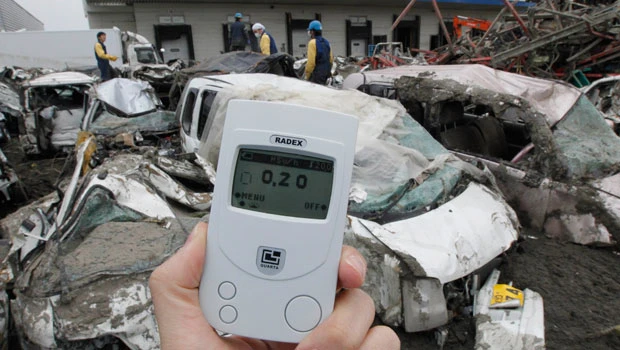
Beyond the disaster area, uncertainty grew over the safety of food and water. The government halted shipments of spinach from one area and raw milk from another near the nuclear plant after tests found iodine exceeded safety limits. But the contamination spread to spinach in three other prefectures and to more vegetables — canola and chrysanthemum greens. Tokyo’s tap water, where iodine turned up Friday, now has cesium. Rain and dust are tainted too.
In all cases, the government said the radiation levels were too small to pose an immediate risk to health. Still, Taiwan seized a batch of fava beans from Japan found with faint — and legal — amounts of iodine and cesium.
“I’m worried, really worried,” said Mayumi Mizutani, a 58-year-old Tokyo resident shopping for bottled water at a supermarket to give her visiting 2-year-old grandchild. “We’re afraid because it’s possible our grandchild could get cancer.” Forecasts for rain, she said, were an added worry.
All six of the Fukushima Dai-ichi nuclear complex’s reactor units saw trouble after the disasters knocked out cooling systems. In a small advance, the plant’s operator declared Units 5 and 6 — the least troublesome — under control after their nuclear fuel storage pools cooled to safe levels. Progress was made to reconnect two other units to the electric grid and in pumping seawater to cool another reactor and replenish it and a sixth reactor’s storage pools.
But the buildup in pressure inside the vessel holding Unit 3’s reactor presented some danger, forcing officials to consider venting. The tactic produced explosions of radioactive gas during the early days of the crisis.
“Even if certain things go smoothly there would be twists and turns,” Chief Cabinet Secretary Yukio Edano told reporters. “At the moment, we are not so optimistic that there will be a breakthrough.” Nuclear safety officials said one of the options could be to release a cloud dense with iodine as well as the radioactive elements krypton and xenon.
The plant’s operator, Tokyo Electric Power Co., temporarily suspended the plans Sunday after it said the pressure inside the reactor stopped climbing, though staying at a high level.
“It has stabilized,” Tokyo Electric manager Hikaru Kuroda told reporters.
Kuroda, who said temperatures inside the reactor reached 572 degrees Fahrenheit (300 degrees Celsius), said the option to release the highly radioactive gas inside is still under consideration if pressure rises. Growing concerns about radiation add to the overwhelming chain of disasters Japan has struggled with since the 9.0-magnitude quake.
The quake spawned a tsunami that ravaged the northeastern coast, killing more than 8,100 people, leaving 12,000 people missing, and displacing another 452,000, who are living in shelters. Fuel, food and water remain scarce.
Another nuclear safety official acknowledged Sunday that the government only belatedly realized the need to give potassium iodide to those living within 20 km of the nuclear complex.
The pills help reduce chances of thyroid cancer, one of the diseases that may develop from radiation exposure, by preventing the body from absorbing radioactive iodine. The official, Kazuma Yokota, said the explosion that occurred while venting the plant’s Unit 3 reactor last Sunday should have triggered the distribution. But the order came only three days later.
“We should have made this decision and announced it sooner,” Yokota told reporters at the emergency command center in the city of Fukushima. “It is true that we had not foreseen a disaster of these proportions. We had not practiced or trained for something this bad. We must admit that we were not fully prepared.” The higher reactor pressure may have been caused by a tactic meant to reduce temperatures — the pumping of seawater into the vessel, said Kuroda, the Tokyo Electric manager.
Experts have said the amounts of iodine detected in milk, spinach and water pose no discernible risks to public health unless consumed in enormous quantities over a long time. Iodine breaks down quickly, after eight days, minimizing its harmfulness, unlike other radioactive isotopes such as cesium-137 or uranium-238, which remain in the environment for decades or longer.
Rain forecast for the Fukushima area also could further localize the contamination, bringing the radiation to the ground closer to the plant.
Edano, the government spokesman, tried to reassure the public for a second day running Sunday. “If you eat it once, or twice or even for several days, it’s not just that it’s not an immediate threat to health, it’s that even in the future it is not a risk,” Edano said. “Experts say there is no threat to human health.” No contamination has been reported in Japan’s main food export — seafood — worth about $1.6 billion a year and less than 0.3 percent of its total exports.