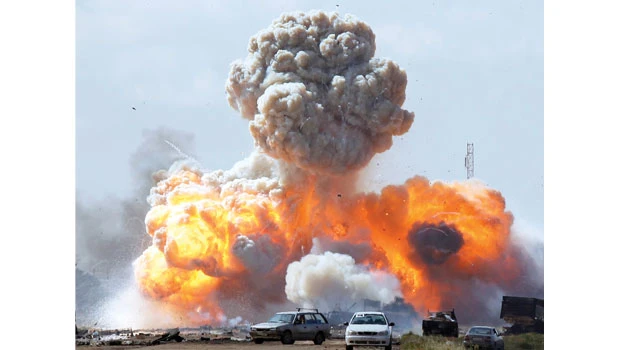
- TRIPOLI: Western forces pounded Libya’s air defenses and patrolled its skies on Sunday, but their day-old intervention hit a serious diplomatic setback as the Arab League chief condemned the “bombardment of civilians.”
As European and US forces unleashed warplanes and cruise missiles against Muammar Qaddafi’s air defenses and armor, the Libyan leader said the airstrikes amounted to terrorism and vowed to fight to the death.
While his eastern forces fled from the outskirts of Benghazi in the face of the allied air attacks, Qaddafi sent tanks into Misrata, the last rebel city in western Libya. Among the densely packed houses they were less vulnerable to attack from the air without the risk of killing innocent civilians.
Sixty-four people were killed in the Western bombardment overnight, a Libyan government health official said, but it was impossible to verify the report as government minders refused to take reporters in Tripoli to the sites of the bombings.
Arab League chief Amr Moussa called for an emergency meeting of the group of 22 states to discuss Libya. He requested a report into the bombardment which he said had “led to the deaths and injuries of many Libyan civilians.”
“What is happening in Libya differs from the aim of imposing a no-fly zone, and what we want is the protection of civilians and not the bombardment of more civilians,” Egypt’s official state news agency quoted Moussa as saying.
Arab backing for a no-fly zone provided crucial underpinning for the passage of the UN Security Council resolution last week that paved the way for Western action to stop Qaddafi killing civilians as he fights an uprising against his rule.
A senior US official rebuffed Moussa’s comments.
“The resolution endorsed by Arabs and UNSC (the United Nations Security Council) included ‘all necessary measures’ to protect civilians, which we made very clear includes, but goes beyond, a no-fly zone,” the official said during a visit by President Barack Obama to Rio de Janeiro.
The US Chairman of the Joint Chiefs of Staff, Adm. Mike Mullen, said the no-fly zone was effectively in place. But he told CBS the endgame of military action was “very uncertain” and acknowledged it could end in a stalemate with Qaddafi.
Mullen said he had seen no reports of civilian casualties from the Western strikes. But Russia said there had been such casualties and called on Britain, France and the United States to halt the “nonselective use of force.”
Aircraft from other countries, including Qatar, were also moving near Libya to participate in the operation, Mullen said.
Western intervention, after weeks of diplomatic wrangling, was welcomed with a mix of apprehension and relief in Benghazi where the main hospital was filled with men, women and children wounded in Saturday’s assault on the city by Qaddafi’s forces.
“We salute France, Britain, the United States and the Arab countries for standing with Libya. But we think Qaddafi will take out his anger on civilians. So the West has to hit him hard,” said civil servant Khalid Al-Ghurfaly, 38.
Outside the eastern city, the advance by Qaddafi’s troops was stopped in its tracks with smoldering, shattered tanks and troop carriers littering the main road. The charred bodies of at least 14 government soldiers lay scattered in the desert.
In Misrata, east of Tripoli, residents said government tanks and snipers had entered the center of the city after a base outside it had been hit by Western airstrikes. “Two people were killed so far today by snipers. They (snipers) are still on the rooftops. They are backed by four tanks, which have been patrolling the town. It’s getting very difficult for people to come out,” one Misrata resident, called Sami, told journalists by telephone.