- SANAA: Yemen’s president warned on Tuesday his country would descend into civil war if he were forced to quit and Washington voiced concern about instability in the Arabian state that has become an Al-Qaeda stronghold.
Seven weeks of unrelenting anti-government protests and defections among the ruling elite have piled pressure on Saleh to step down immediately after 32 years in power.
But an aide said he would leave office only after organizing parliamentary polls and establishing democratic institutions, by January 2012 — a declaration the opposition promptly rejected.
“Ali Abdullah Saleh does not seek power,” Saleh’s media secretary Ahmed Al-Sufi said. “Ali Abdullah Saleh will not leave without knowing who he is handing over to.” The US, grappling with the diplomatic fallout of uprisings and uncertainty across the Arab world, voiced rare public alarm about the situation in Yemen.
“We are obviously concerned about the instability in Yemen,” US Defense Secretary Robert Gates said. His chief concern was to avoid “diversion of attention” from opposing Al-Qaeda there.
Opposition spokesman Mohammed Al-Sabry, rejecting Saleh’s offer to go by January 2012, said the coming hours would be decisive.
An opposition leader said on Tuesday Saleh would be allowed to live a secure and dignified life in Yemen if he steps down peacefully after three decades in power.
Yassin Noman, rotating head of Yemen’s opposition coalition, said Saleh should avoid a violent fight to remain in power that could tear the country apart. “He shouldn’t follow the style of (Libyan leader Muammar) Qaddafi by destroying the country and killing people. After this long term of governing, he should say: Thank you, my people, I leave you peacefully,” Noman said. “I know the morality of Yemeni people. If he left peacefully, they will look at him as a real leader. He will be able to live wherever he likes,” said Noman, an economist who is also head of the Yemeni Socialist Party.
Noman was the last prime minister of an independent southern state before north and south Yemen were unified under Saleh’s rule in 1990, and Noman spent several years in exile after a 1994 secessionist rebellion that was quashed by Sanaa.
In speeches to army officers and tribal leaders in Sanaa, Saleh said Yemen faced a danger of civil war and disintegration because of efforts to stage a “coup” against his rule.
“You have an agenda to tear down the country, the country will be divided into three instead of two halves — a southern part, a northern part and a middle part. This is what is being sought by defectors against ... unity,” he said, referring to northern rebels and Al-Qaeda militants.
“Those who want to climb up to power through coups should know that this is out of question. The homeland will not be stable, there will be a civil war, a bloody war. They should carefully consider this,” Saleh told army commanders.
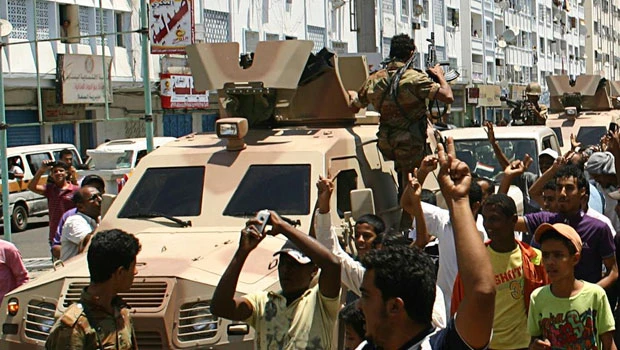
Presidential guards loyal to Saleh surrounded an air force battalion in the coastal city of Hudaida after its commander said he supported the protesters. A presidential guard and a soldier died in clashes between the two forces in the southern coastal city of Mukalla late on Monday.