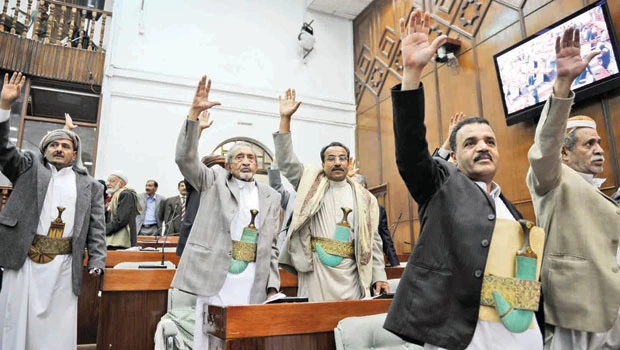
- SANAA: Amid the boycott of opposition and independent lawmakers, Yemen’s Parliament ratified Wednesday a state of emergency law that gave President Ali Abdullah Saleh wide powers to crush sustained protests in the streets calling for his ouster.
The embattled president declared March 18 a state of emergency, following the killing of over 50 people by snipers in the capital.
The lawmakers who defected from Saleh's ruling party also boycotted the session of the Parliament.
The emergency law suspends the constitution, allows media censorship, bars street protests and gives security forces powers to arrest suspects.
Commenting on the passage of the bill in Parliament, opposition MP Abdul Rahman Bafadhel told Arab News that the emergency law is unlawful as less than half of the MPs attended the session during voting. "For approving a law, the quorum must be more than half of MPs," he said,
But the Parliament Secretariat said 160 MPs out of 301 attended the session. Independent sources said that the number was less than 140.
Bafadhel added that there is no article in the constitution under which emergency can be imposed. "Article (121) says 'in case of emergency, a law should be made first then approved'. They put the cart before the horse."
The president, meanwhile, bowed to the opposition's road map and agreed formally on Wednesday to leave office before the end of the year. A source from Saleh's office said he had agreed to the opposition demand. "The president intends to solve the current political crisis and head off a civil war that could destabilize the country," the source was quoted as saying by Saba News Agency.
Youth leaders at the Sanaa square that has become the epicenter of the protests dismissed the move. “It is the revolution that now decides the future of the nation,” said Jamal Anaam, one of the protest leaders. “We pay no attention to the measures.”
The accelerating conflict has raised fears that Yemen could be pushed into even greater instability. Rival factions of the military have deployed tanks in the capital, Sanaa — with units commanded by Saleh’s son protecting the president’s palace, and units loyal to a top dissident commander protecting the protesters.
Saleh, who has worked closely with a US-offensive against the Yemeni branch of Al-Qaeda, has already dramatically increased his crackdown on anti-government demonstrators, with his security forces shooting dead more than 40 protesters on Friday in Sanaa.
On Tuesday he offered to step down by the year’s end, but the opposition rejected his offer.
He also warned that the country would slide into civil war following the defection of senior army commanders to the opposition.
Tribal leaders, diplomats, lawmakers, provincial governors and newspaper editors have also joined the opposition.
Saleh, who has ruled Yemen for 32 years, also called Tuesday for a dialogue with the leaders of the youth movements leading the protests at a central Sanaa square that has become the movement’s epicenter.
The defection on Monday of that commander, Maj. Gen. Ali Mohsen Al-Ahmar, a powerful regime insider who commands the army’s powerful 1st Armored Division, has been seen by many as a major turning point toward a potentially rapid end for Saleh’s nearly 32-year rule.
Clashes broke out late Monday between Saleh’s Republican Guard and dissident army units in the far eastern corner of the country. On Tuesday, Republican Guard tanks surrounded a key air base in the western Red Sea coastal city of Hodeida after its commander — Col. Ahmed Al-Sanhani, a member of Saleh’s own clan — announced he was joining the opposition.
The turmoil raised alarm in Washington, which has heavily backed Saleh to wage a campaign against a major Yemen-based Al-Qaeda wing that plotted attacks in the United States.