
- THE Bangladeshi Export Promotion Bureau has been executing its functions relentlessly to achieve equilibrium in foreign trade and economic growth through continued development and promotion of the export trade of the country, helping it to sustain itself in the rapidly changing and stiff competitive global trade.
Prominent activities include expansion of production of exportable products, product diversification, inclusion of new products in the export basket, policy support in the development of export trade, collection, preservation and dissemination of trade information, compilation of export data as well as export marketing development.
The export market is being expanded rapidly due to the timely initiative of the Export Promotion Bureau. Bangladesh’s export destinations were limited to 68 countries during the 1972-73 fiscal year, but now it has been extended to 187.
With the robust leadership and strategic planning of the Ministry of Commerce and Export Promotion Bureau, export earnings during 2009-2010 amounted to $16.2 billion.
Export growth was 40 percent between July and January of the 2010-2011 fiscal year. Export growth was 4,551 percent in 2009-2010 compared to 1972-73. The Export Promotion Bureau is playing a great role in product diversification and product development.
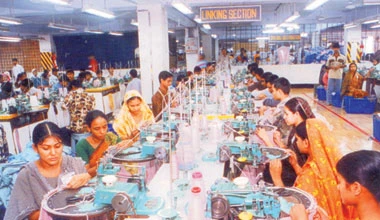
Exportable products during 1972-73 were 25. This number is now 168. Though Bangladesh is exporting 168 products, the major share of export earnings is limited to only a few products. Main players in the export market include readymade garments, jute and jute products, frozen food, leather and leather goods, agricultural products and home textiles. The readymade garments sector accounts for 80 percent of export earnings. To improve export diversification, eight products were introduced, taking into consideration their export potential and production capacity. They include agro-products and agro-processing products, light engineering products (including auto-parts and bicycles), footwear and leather products, pharmaceutical products, software and ICT products, home textiles, ship building, and toiletries.
Twelve sectors have been earmarked for special development.
They include crushed and finished leather production, frozen fish production and processing, handicrafts products, electric and electronic products, fresh flower and foliage, jute and jute products, hand-woven textiles from hill areas (pahari tant bostro), uncut diamonds, herbal plants, medicine and medicinal products, ceramic products and melamine, plastic products, and furniture.
A report on the export of ships from Bangladesh has been prepared to develop the shipbuilding sector.
To implement the recommendations made in the report, a standing committee headed by the vice-chairman of the EPB has been formed. The committee has already prepared the strategic plan by reviewing the advantages of this sector.
It is hoped that if the recommendations are implemented, then the shipbuilding industry will emerge as a promising sector in Bangladesh.
It is worth mentioning that Bangladesh made $25.2 million by exporting ships to the European Union and Mozambique during 2009-2010.
Considering the potential of the furniture sector in the world market, a document has been prepared on how to develop this industry and a national work plan has been formulated as well.
The Export Promotion Bureau has undertaken an initiative to conduct promotional activities in villages under its One District One Product (ODOP) program. Fourteen products from 41 districts have been identified for development under this program. Steps have been undertaken to develop agar wood and ator, clay tally and rubber under this program.
It is worth mentioning that according to statistics by the International Trade Organization (ITC), most neighboring countries of Bangladesh experienced negative trends in their exports during 2009-2010.
But due to the dynamic and efficient leadership of the present government, the export growth of Bangladesh was positive during this period despite the global economic meltdown, while the export growth of India (-2.81 percent), Bhutan (-5 percent), Pakistan (-13.44 percent), Sri-Lanka (-13.14 percent), Maldives (-38.89 percent), Indonesia (-14.97 percent), Malaysia (-20.95 percent) and Thailand (-13.25 percent) and adjoining countries were negative. During the current 2010-2011 fiscal year, Bangladesh’s export target has been fixed at $18.5 billion. Between July and December 2010, export earnings were $10.2 billion, 41 percent more than the same period last year. The idea of holding the Dhaka International Trade Fair (DITF) was to give the local entrepreneurs the opportunity to see the various products being produced by their counterparts abroad.
The Ministry of Commerce and Export Promotion Bureau have been jointly organizing the DITF since 1995. Over 500 companies locally and internationally participated this year. Export orders amounting to 25 crore taka were made at the fair.
With a view to facilitate export trade by creating direct contact between suppliers and exhibitors, the Bangladesh-China Friendship Exhibition Centre project is being implemented with the financial support of the Chinese government.
Moreover, to accelerate export promotional activities, the initiative has been taken to construct the National Export House, allowing the EPB to conduct export-related activities from its own base.
To expand and to consolidate the export market as well as to introduce our exports in the overseas market, Export Promotion Bureau takes part in international fairs and organizes single country trade exhibitions in different countries.
During the 2009-2010 fiscal year, EPB participated in as many as 27 international trade fairs and organized 30 single country trade exhibitions. As a result export orders worth $352.3 million have been achieved. Moreover, as part of export market expansion activities, trade delegations have been sent to Russia, Ukraine, West Africa and Brazil.
In recognition of exporters’ contributions, export trophies and Commercially Important Person (CIP) cards have been awarded every year.
The efforts of the EPB help create a competitive environment among exporters that result in a favorable impact on export trade.
Seventy-five companies across 25 product categories have been awarded gold, silver and bronze trophies each year. Apart from this, in recognition of exporters’ achievements in different product categories, 125 outstanding businessmen and 40 individuals (as ex-officio exporters) have been declared as CIP in the export category.