- Mass resignations from dialogue panel over crackdown on protests
AMMAN: Jordan’s opposition, leftists and trade unions on Saturday demanded the ouster of Prime Minister Marouf Bakhit, who they blame for the recent violence.
The Interior Ministry said two people were killed and about 120 wounded, including 58 policemen, when security personnel intervened to end a clash between two rival groups of protesters.
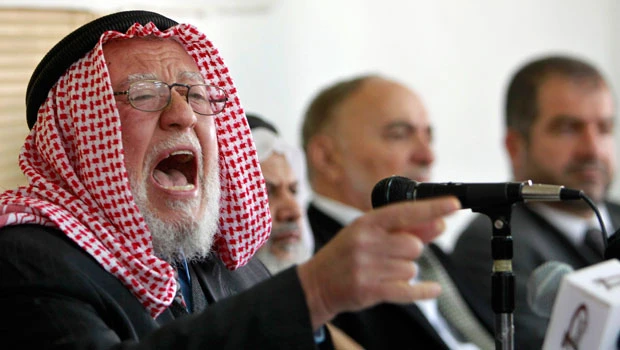
“The Islamist movement demands the resignation, or the sacking, of the government and the formation a national unity and reformist government that would win the people’s trust and protect their lives,” Hamza Mansour, chief of the powerful Islamic Action Front (IAF), said. “Any government that kills citizens loses legitimacy,” he told a news conference. Meanwhile, sixteen members of Jordan’s newly established National Dialogue Committee said Saturday they had decided to resign from the 53-member panel to protest the security authorities’ crackdown on pro-democracy protesters on Friday.
But the gathering of hundreds of young people, calling themselves “March 24 Youth,” said they were attacked by both policemen and stone-throwing government loyalists at the Nasser Square, where they staged a rally since Thursday to press their demands for political reforms.
Among those resigning from the dialogue panel were Saeed Thiab, secretary-general of the opposition left-leaning Popular Unity Party, and Munir Hamarneh, secretary-general of the Jordan Communist Party.
“What happened was not a clash between the ‘March 24 Youth’ and pro-government loyalists but rather a systematic action on the part of the authorities which should be responsible for the massacre,” the resigning group said in a joint statement.
“This proves that any talk about political reform is nothing more than allegations that lack foundation, which means that our membership in the committee is an act of time buying while also misleading the Jordanian public.”
Prime Minister Marouf Bakhit set up the panel two weeks ago for discussing “speedy and real reforms” that King Abdallah tasked the government to carry out.
The country’s main opposition groups, the Muslim Brotherhood movement and its political arm, the Islamic Action Front (IAF), have decided to boycott the committee’s meetings, citing its failure to include amendment of the constitution on its agenda.
The new withdrawals from the committee, which brought the total resignations so far to 21, put the political reforms process in disarray, especially that the actions coincided with a vehement attack by Bakhit on Islamists, whom he charged with “receiving instructions from Egypt and Syria.”
In an interview with the state-run television on Friday, Bakhit accused the Brotherhood and the IAF of being the organizers of the Nasser Square rally and said they had to “stop playing with fire.”
Islamists have tense record with Bakhit whom they accused of “rigging” the 2007 elections when he was prime minister in order to disrupt their chances in the polling process.
“The door is still open for you to join the dialogue, otherwise I hold you responsible for the pattern of action you follow because it leads to sedition,” Bakhit told Islamists on Friday.
“We are not going to accept dialogue that is conducted from the streets,” he added, alluding to almost weekly rallies to which Islamists contribute throughout the country over the past three months.