- JEDDAH: The interfaith dialogue movement initiated by Custodian of the Two Holy Mosques King Abdullah has had its reverberations all over the globe.
- Getting inspired from the movement, International Interfaith Dialogue India (IIDI) started functioning in 2009.
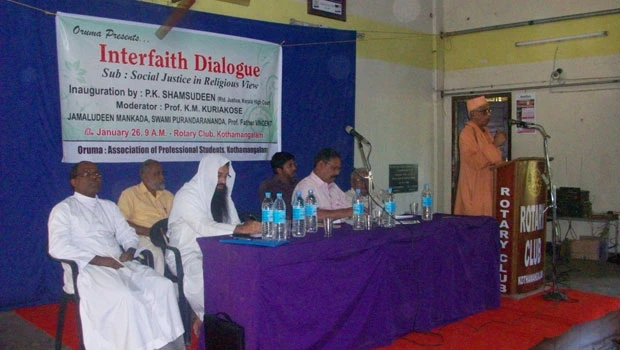
Under the leadership IIDI in association with a platform named "Oruma" formed by students of M A College of Engineering, an inter-religious dialogue was held at Rotary Club Hall, Kothamangalam Kerala. Justice P.K Shamsuddin, patron of IIDI inaugurated the function titled "Social Justice in Religions."
He said: "India is a country which is a museum of all world religions with an array of languages, cultures, castes and communities. It gives us beauty and aesthetics due to the varieties and multiplicities of colors, languages and religions. A monolithic condition gives the impression of aridity and monotony. There is only a tiny minority of proprietors of armament industry and terrorists (both secular and so-called religious) who want a conflict of civilizations and religions. Majority of humankind yearns for peace and wants to live cooperatively amidst religious differences. We have to realize that there is a concerted effort undertaken by vested interests to craft prejudice and misunderstanding. Upon the realization of this brute fact, we can easily identify the real villains, who are acting behind the curtain. Extremism and communalism are not only anti-Islamic but also anti-Christian and anti-Hindu."
Professor K.M. Kuriakose, who moderated the function, argued that we have to attain an enlightened state of mind wherein one can revere the religious susceptibilities and temperaments of others. "What we need is not to create upper hand by fabricating altercations and posing religious superiority; but to mutually exchange ideas in a fraternal atmosphere. This will educate us, how much common are our concerns and how much uniform are our aspirations and values."
Swami Purandarananda of Cochin Sri Ramakrishna Mission Ashram presented the subject "Social Justice in Hinduism". He argued: "The future of Indian nation is at the shoulders of the 54 million youths. Real knowledge should germinate from inner side and not to be inculcated from outside. This real wisdom could be obtained, only if the youths are ready for a change. We have to fight various attachments of our mind, sprouted from bodily and material benefits which are temporal. Only by this method, one can attain the ideal condition of social justice. Altruism and sense of dedication for the cause of the betterment of the unfortunate marginalized and oppressed are the two vital characteristics for such a fight. A nation could be said to be attained safe, only if a beautiful girl can travel safely in the darkness of night."
Jamaluddin Mowlawi Mankada, imam of Palayam Juma Masjid, made a presentation on "Social Justice in Islam." He said: "Social Justice is the central theme of Islam. The monotheistic concept underlines that only God crowns the superlative position and all the people are at par and are equal. Since humankind originated from a single parent, they have to attain three types of social justice: justice without discriminations, no type of partisanship and bias, and resources may be distributed on equitable terms."
Rev. Fr. Dr. Vincent Kundukulam spoke about "Social Justice in Christianity." He said: "Certain problems usually arise, when mere outward form of religiosity is used for identity politics and earning power. This is happening all over the world and this has to be identified as the major problem confronting the world. The inner truths of religions, despite their outward differences, are one that militates against the regime and reign of injustice. Only by eradicating social and economic injustices, that religious fraternity is built; otherwise such conflicts are destined to be continued, orchestrated by vested interest groups. Therefore, constructive building up of a just social and economic system is vital for the curtailment of religious conflicts."
More than 350 students participated in the deliberations. IIDI is planning to organize similar programs in various colleges of India, so that the idea of religious fraternity through 'positive dialogue' will be deep-rooted in the country.