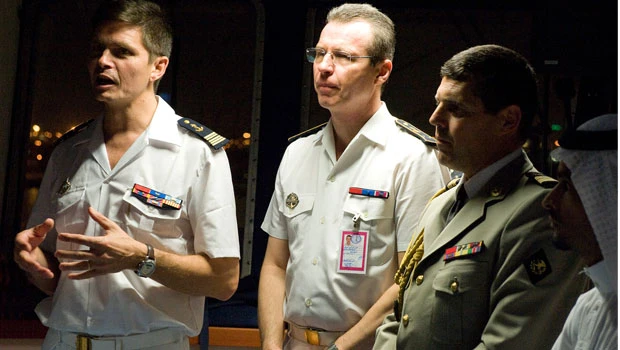
- JEDDAH: The French naval ship Mistral and her destroyer escort Georges Leygues paid a courtesy call to the Kingdom last week.
- CV (Capitaine de Vaisseau) Commandant Xavier Moreau of the 21,300-ton craft, which gave her name to a new class of carriers, invited Saudi and foreign guests aboard the ship.
The ship’s company, which stood at 605 on the Jeddah visit, has in the manner of many navies a mixed crew with about 13 percent women. The regular complement is 188 that include 135 cadets, in line with the ship’s role as a post-academy officer training ship.
Mistral is one of the French Navy’s amphibious assault, command and power projection ships and also its first all-electric warship. It has neither conventional engine room nor power train.
Three 16V32 and one 18V200 Wartsila diesel generators provide 20.8MW of power that drives two self-contained Alstom 7MW electric azimuth propulsion pods at the stern and deliver the main propulsion. A bow thruster provides lateral propulsion. The pods can be rotated through 360 degrees and allow the ship to turn in her own length and maneuver in difficult or shallow waters. This is a significant advantage for an amphibious assault ship that is designed to deploy up to four landing craft and 450 assault troops and their equipment rapidly.
The pods, which give Mistral a top speed of 19 knots, yield up to 10 percent less drag in the water and can even be changed in a few days without the need for the ship to enter dry dock.
Although the 199-meter long slab-sided ship looks similar to an aircraft carrier, its role is fundamentally different. Each ship in the Mistral class has a cavernous interior with a 1,800-meter hangar and the payload capacity and versatility to carry up to 16 heavy helicopters and one-third of a mechanized regiment, plus two LCAC hovercrafts or up to four landing craft in its well deck. Its primary role is to support forces rather than dispatch strike aircraft, although the 5,000-meter flight deck has six helicopter landing spots and can handle six simultaneous helicopter movements and easily act as a landing strip for the Harrier jet.
The Georges Leygues, commanded by CV Captain Christophe Lucas, is the escort to Mistral. Classified by the French Navy as a frigate, it is rated by the authoritative publication Jane’s Fighting Ships as a destroyer. With a displacement of 3,830 tons and a crew of 218 she was launched in 1978. Powered by two Rolls-Royce Olympus TM3B gas turbines rated at 46200 bhp and two SEMT-Pielstick 16PA6 CV280 diesels rated at 10400 bhp the ship can reach a top speed of 30 knots and 21 knots on the diesel engines.
The Georges Leygues class are versatile warships and heavily armed. Among the weaponry are 26 anti-aircraft missiles, an automatic 100mm gun, cannons, torpedoes and the formidable Exocet missiles. All this is augmented with Lynx helicopters that can be used for anti-submarine warfare.
It was this function that the Georges Leygues put to admirable use with the fleet escort Guépratte while cruising on a fleet training exercise.
A Soviet submarine was detected and a 19-hour chase ensued that ended with the Soviet Victor class boat having to surface.
Modified in 1999 to accommodate student officers, the ship was assigned to attend the aircraft carrier Jeanne D’Arc. That year the two ships were assigned to deliver humanitarian aid to victims of the catastrophic flooding in Mozambique. In 2004, the two ships supported the French intervention after the coup in Haiti and also assisted with aid in Indonesia after the 2004 Indian Ocean earthquake and tsunami.
Warships of necessity have first-rate medical facilities and the Mistral is no exception. She carries a medical facility equivalent to the field hospital of an army division or army corps, or to the hospital of a 25,000-inhabitant city, complete with dentistry, diagnostics, specialist surgical and medical capabilities, food hygiene and psychological capabilities. To handle even very complex operations, the 20-room 69-bed (including seven intensive care beds) complex is equipped with a telemedicine system that allows performing complex specialized surgery. A further 50 beds are kept as a reserve and with its large hangar space can double as a hospital ship on humanitarian missions.
Normally fielding a medical team of one doctor and five nursing staff, when being used on military or humanitarian missions, such as during Israeli mass air attacks on Lebanon in 2006 when it was used to evacuate hundreds of EU citizens, it takes on board extra medical staff. These include two each doctors, surgeons and ITU nurses, an anesthetist and a radiologist. Mistral was also sent to Tunisia to help in the humanitarian mission to transport foreign refugees that had fled from Libya. In the event, the Mistral was not needed; the refugees were flown out.
After leaving Jeddah, the Georges Leygues and Mistral will use their powerful surveillance capabilities and perhaps armament in anti-piracy and drug trafficking operations in the Gulf of Aden and the Indian Ocean before sailing on to India and the Far East.