
- When walking into a bookstore, whether a mega franchise like Barnes and Noble, or an intimate book boutique, one can easily find an abundance of referential texts and coffee table books celebrating the artistic achievements of the Western world.
- If one is determined enough, a more thorough search may yield a book or two on art from Lebanon or Egypt.
Kameel Hawa of Al-Mohtaraf is on a mission to rectify that. One design book at a time.
Hawa is one of those individuals who, after talking to, you can’t help but form unreserved admiration for. His kind blue eyes and rosy cheeks reminds one of Santa Claus from the vintage Christmas Coke-a-Cola ads. And not unlike Saint Nicholas, Hawa is a giver. His gift is his exemplary passion for Arab art and promoting the Saudi talent behind it.
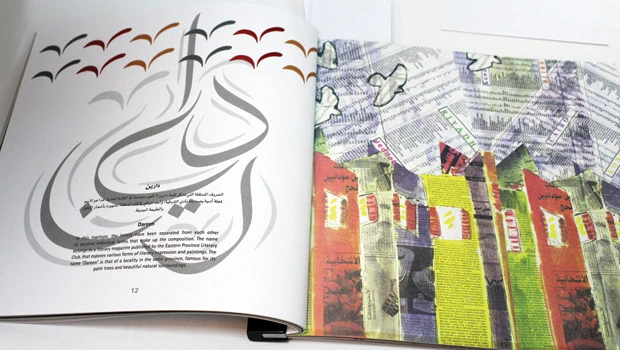
As managing director of Al-Mohtaraf Assaudi, Hawa’s mission to celebrate and enhance the Saudi design industry has been fruitful, with such commendable achievements as “Young Saudi Lenses” (2011) and “Saudi Artists Today” (2011). Most recently, Hawa and his team released “Word Art,” a cherished project more personal to the devoted designer, as it consists of his idiosyncratic talent and thus warranted his role as author.
How long has “Word Art” been in the making? “Thirty years!” he laughs, maintaining that this book is a culmination of a career’s objective to highlight a genre often overlooked in the design world. “Though it (word art) has gained popularity, it has yet to be fully understood.”
Hawa explains that the book, or “sample portfolio,” is a compilation of designed Arabic words that do not fall under the category of classical Arabic calligraphy. The designs are not restricted by any specific parameters, but instead follow a much simpler approach characteristic of both modern and abstract art.
“We write a name,” he explained, “and consequently, we create a drawing.” But not all words are art, he warns. The beauty of word art lies its dual intricacy to extract meaning from the letters themselves, which when combined, morph into a comprehensive composition. “Herafeyyat, or the presence of letters within a piece of art doesn’t necessarily translate to ‘word art,’” reveals Hawa. In past decades, the trend in modern paintings within the Arab world has been to use letters within their paintings. “Not every designer can deal with calligraphy and vice versa,” continues Hawa, “but a great calligrapher is a designer.” This is because they do not simply create calligraphy, but also construct a word and/or sentence into a true piece of art.
“Artists and designers can use a letter like any other element in design — for its geometric composition, or shape,” reveals Hawa, “but word art is a true relationship between the letters and the meaning of the word — a real expression within the word.” An artist who creates aesthetically appealing work does not necessarily create a relationship. In word art, there must be an intentional meaning toward a word in order to produce an emotional association. “Art is equal to feeling, it carries a feeling to the viewer. The more it does, they greater the art is,” states Hawa. “This is true for all mediums, including film, photography, and painting. The final judge of art is feeling.”
The book contains two types of word art. The first is spontaneous, drawn free-hand ink strokes, while the second is more studied and intended to display representations of an object, idea, or person’s name. Similarly, simple hand strokes eliminate unnecessary details, leaving a bold, striking expression to be witnessed. Both abstract forms and free hand strokes are distinguishing features of modern art.
“Word Art” is a unique collaboration between the design house, Al-Mohtaraf Assaudi Ltd., the prestigious Italian paper company, Fedrigoni Paper, and the Kingdom’s award-winning printer, Sarawat. Together, they’ve given birth to a distinctive collection of remarkable designs, brought to life through fine quality paper and innovative printing techniques.
According to Hawa, there’s more to this book than it’s beautiful design cover. The book represents an emergence of “Design Thinking.” The concept, he explains, permeates throughout the pages of the book, whether through the paperweight, metallic ink embellishments, or even the colors and designs themselves.
Historically, paper was produced in conjunction with the designer’s vision, while today, the printing technique has become a design medium in itself. “Sheikh Abdulaziz Al-Ghamdi of Sarawat is proof of this coalescence,” states Hawa. “Over the years, his experience has given him a true eye for design and an acute awareness of the potentials of the printing press.”
Yet perhaps one of the biggest concepts this book represents is the increasing trend to incorporate cultural identity into various sectors other than design. “We didn’t revive the interest in cultural art, such as typeface design and cultural calligraphy,” clarifies Hawa. “Instead, it’s about the revival we have instigated in the corporate sector.”
For years, Hawa and his team have been shaping the world of design and advertising. “I can prove it, the same way a scientific formula is proven,” affirms Hawa. Ramadan ads, congratulatory messages to the King and royal family, even condolences and obituaries have been affected by the influence of word art. “We have over the years changed the visual style that these announcements have been presented.” If it sounds like Hawa is tooting his own horn — he’s not. Many professionals agree with him and attribute the “beautification” of the publishing industry to the design house’s efforts.
And now, thanks again to the Al-Mohtaraf team, this book is a binded source of inspiration for the numerous students and professionals in the field of design, and more specifically, graphic design. A testament to that claim can be witnessed in the book’s immediate popularity. Currently, it is a bestseller for its respective price category at Virgin Megastore in the Kingdom. A perfect gift to a creative friend who appreciates the more beautiful things in life, “Word Art” is one of those pioneering books that showcases the talent and abilities of a country often reduced to an inaudible volume by its louder neighbors.
“If anything has frontiers, it is art. If anything has no, then it is still art,” muses Hawa. “Take my word — ‘art’ for it!”