
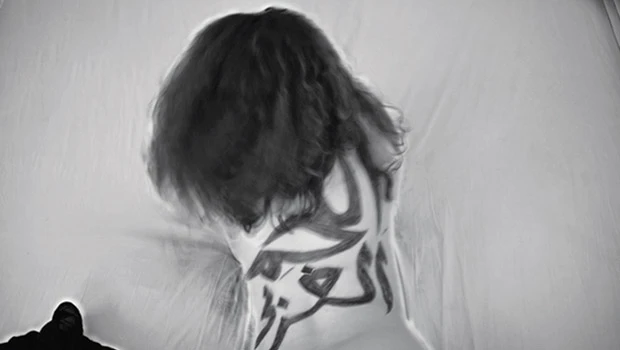
- On Wednesday, Dubai’s premiere gallery, TRAFFIC, is presenting an exhibition of recent works by one of Saudi Arabia’s best-known contemporary artists, Faisal Samra.
“Resistance,” which will be at the gallery through May 11, grapples with issues of the human condition in Samra’s characteristic fusion technique of mediums; this time incorporating the digital world of multimedia to his expansive portfolio of artistic tools.
The Bahraini-born Saudi national has had over 25 solo exhibitions and participated in over 50 group shows around the world. Nevertheless, he considers this first solo show at TRAFFIC a significant affair.
“It’s an important exhibit because of the current situation us Arabs are facing at the moment,” explained Samra.
Yet he says the current political weather and his exhibition is only a remarkable coincidence.
“I didn’t do these pieces based on the prevailing events in the Arab world,” Samra confessed, “I never dedicate my work to an event because once that event is over the artwork stops becoming ‘contemporary’ and turns into something historical.”
Instead, he argues, art should be universal and therefore, possessing the ability to not only transcend physical borders, but also periods in time.
In “Resistance,” Samra fuses digital photography, painting, sculpture, video and performance to explore different states of the human condition.
“I’m using the tools of the media and advertising to comment on the ‘distorted reality’ that these mechanisms represent,” stated Samra. “For me, the content dictates the medium and not vice versa.”
In an ironic twist, he uses what he calls "artistic photography," which is staged in order to present a desired reality — one which comments on the "distorted reality" that is constantly fed to us via the mass media, advertisements and our political leaders. His work boldly denounces their large-scale manipulation.
As he draws upon the mundane — bread in an oven, an empty bed, animal feet — he raises questions about the nature of identity, liberation, resistance, survival, mortality, hatred and belief.
“The characters are rebelling against temporariness, and trying, out of frustration, to counter the media image that controls and veils them. It shows how our visual field is loaded and invaded with images,” said Samra, “The man becomes a warrior who has no arms, a Don Quixote. His defense is to remove himself from the image rather than adding another layer.”
Samra’s recent works have a disarming depth that draw in the viewer by using seemingly simple visuals to explore taboo issues and unsettling emotions. These powerful, evocative pieces command one’s attention and elicit a response. Much like a painter with his paintbrush, Samra utilizes today’s tool of the digital camera to manipulate the image, in the same way agencies do today — albeit, presenting an enlightened reality to the completely distorted one constantly found flashing across our TV and computer screens.
The artist explains that most of the art shown in Cairo, Dubai, and even Beirut, was banned not more than two decades ago.
“I always feel that if an artist's work needs to be censored then it is not meant for that particular place and time,” he said.
Apparently, today's Saudi Arabia isn’t ready for Samra; the images for this article had to be carefully filtered and censored through cropping before publication due to bare female legs and suggestive nudity.
But do not misunderstand. This phenomenon of distorted reality is not restricted to the Middle East. Although, Samra may intersperse commentary on issues and ideologies in the Middle East, his overall themes are ones that face all nationalities and cultures.
He insists he doesn’t work within the constructs on his own Arab identity. “When I work, I don’t think ‘I’m a Saudi artist,’” he explained, “I just think 'I’m an artist.’”
After having lived and worked in Paris, New York, Beirut, Marrakesh and the East Asia, Samra describes himself as a man without a classification, a nomad wandering through time. He approaches his work depending on the paradigm of whatever issues seem to speak to him as a citizen of the world, not based on the color of his passport. This unique fusion and cultural amalgam is an appealing signature characteristic of Samra’s work.
Having studied, worked and taught in four continents, Samra’s experiences within these diverse cultures have culminated to his distinct artistic practice and personal obsession with visual culture and imagery, incorporating references to historical and contemporary realities. Samra attributes much of his formal education to the opportunity to study Fine Arts at the Ecole Nationale Supérieure des Beaux-Arts in Paris.
“There I learned about the rules of art,” explained Samra, “And one must learn the rules, before one breaks them.”
La plasticien, or the plastic artist (a French term that refers to an artist who has mastered the technique of mixed media), has had his works acquired by museums and private collections, including the British Museum (London), Institute de Monde Arabe (Paris), National Museum of Art (Mexico City), Bahrain National Museum (Manama), Saeb Eigner Collection (London), Sheikha Paula Al Sabah (Kuwait) and The Khalid Shoman Private Collection (Amman).
Having taught in numerous institutions, including a recent post in 2004 in the Fine Arts Department of Amman University in Jordan, Samra staunchly believes that what the Middle Eastern art scene lacks is advanced art education.
“Above all, the Middle East needs art schools!” he stressed, “Due to societal pressures, not all artists are able to travel abroad and receive adequate training.”
A local alternative is therefore required. Arab artists have the talent, he asserts, they just need to strip away the fear of stigma and shed the pressures of conformity. They need to be encouraged to liberate themselves from these societal taboos in order to create freely. Samra clearly has no qualms when it comes to expressing his creative voice.