- ROME: Italy dismissed feelers put out by Muammar Qaddafi for discussions to end the fighting in Libya and threw its weight behind the opposition Libyan National Transitional Council as the only legitimate voice in for the country.
Foreign Minister Franco Frattini also said Monday that the departure of Libyan leader Muammar Qaddafi is a precondition to any solution to the conflict in the north African country and former Italian colony.
Speaking after a meeting with Ali Essawi, a member of the Libyan rebel council with responsibility for foreign affairs, Frattini said Rome was giving its backing to the rebels.
“We have decided to recognize the council as the only political, legitimate interlocutor to represent Libya, he told reporters.
The comments were the clearest sign yet from Italy, the former colonial power in Libya and previously Qaddafi’s closest friend in Europe, that it now fully backs the Transitional National Council, the rebel group that has coalesced out of disparate anti-Qaddafi forces.
A Greek official on Monday said Libyan Deputy Foreign Minister Abdelati Obeidi expressed his government's intention to negotiate to end the strife in his country.
“We’ll now have to see how it is possible for such a process to start, a political process that will allow a national discussion,” Gregory Delavekouras, Greek foreign ministry spokesman, told Greece’s NET radio on Monday.
Beyond a willingness to talk, there was no sign of what Libya might offer to end the war that is bogged down on a frontline around the eastern oil town of Brega, while civilians are bombarded by Qaddafi forces in western rebel holdouts.
Greek Prime Minister George Papandreou had been talking by telephone with officials in Tripoli as well as the leaders of Qatar, Turkey and Britain over the past two days. Greece has enjoyed good relations with Qaddafi for a number of years.
Frattini said he had also spoken to officials in Greece after Obeidi's visit and said the proposals from Qaddafi’s government were “not credible.”
“The regime of Tripoli is sending people to some countries — to Greece, to Malta, sending people to make proposals. These proposals are not credible,” he said. “...nothing was said about the departure of Qaddafi, which is one of the conditions, so it is not possible to accept this point of view.”
Frattini said Qaddafi was not an acceptable interlocutor for the world community and a divided Libya was also not acceptable. He repeated western demands that he leave immediately.
“A solution for the future of Libya has a pre-condition — that Qaddafi’s regime leaves and is out and that Qaddafi himself and his family leave the country,” he said.
Speaking alongside Frattini, Ali Essawi sought to reassure his hosts that companies including oil giant Eni, one of the biggest foreign producers in Libya, would not be penalized by a future rebel government.
He said the legitimate rights of foreigners and foreign companies in Libya would be respected.
He also said proposals for some form of transitional government headed by one of Qaddafi’s sons was “not an option.”
Underlining the plight of civilians in west Libya, a Turkish ship that sailed into the besieged city of Misrata to rescue some 250 wounded under protection of Turkish warplanes had to leave in a hurry after thousands pressed forward on the dock.
Swathed in bandages, evacuees on board gave some of the most detailed accounts of conditions in Misrata. “There are snipers everywhere,” said Ibrahim Al-Aradi, 26, wounded in his groin.
“When Qaddafi’s men hear the NATO planes they hide in houses and mosques. When the planes are gone they destroy them,” said Mustafa Suleiman, a 30-year-old computer engineer.
Turkey’s foreign minister ordered the ship into Misrata after it spent four days waiting in vain for permission to dock.
The humanitarian mission took place under cover from 10 Turkish air force F-16 fighter planes and two navy frigates. The Ankara, a car ferry chartered by the Turkish government and turned into a hospital ship, is expected to reach Cesme in Turkey on Tuesday night.
Stalemate on the frontline, high-level defections from Qaddafi’s inner circle and the plight of civilians caught in fighting or facing food and fuel shortages have prompted a flurry of diplomatic contacts to find a way out.
One diplomat cautioned, however, that any diplomatic compromise — for example one in which Qaddafi handed over power to one of his sons — could lead to the partition of Libya.
“Various scenarios are being discussed,” said the diplomat. “Everyone wants a quick solution.”
If there were eventually to be a cease-fire leading to the partition of Libya, control of revenues from the oil ports, including Brega and Ras Lanuf to the west, would be crucial.
Qaddafi believes the uprising is fueled by Islamist radicals and Western nations who want to control Libya’s oil. The rebels, whose stronghold is in the eastern city of Benghazi, want nothing less than the removal of Qaddafi and his circle.
The UN-mandated military intervention, in which warplanes have attacked Qaddafi’s armor, radars and air defenses, began on March 19 and was intended to protect civilians caught up in fighting between pro-Qaddafi forces and the rebels.
Neither the Qaddafi troops nor the disorganized rebel force have been able to gain the upper hand on the frontline, despite Western air power in effect aiding the insurgents.
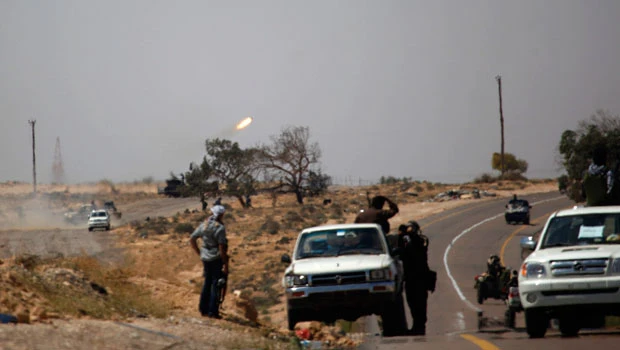
After chasing each other up and down the coast road linking the oil ports of eastern Libya with Qaddafi’s tribal heartland further west, the two sides are stuck in Brega, a sparsely populated settlement spread over more than 25 km (15 miles).
Yet Western countries, wary of becoming too entangled in another war after campaigns in Afghanistan and Iraq, have ruled out sending ground troops to help the rebels in what has become a civil war in the North African desert state.
The United States, which has handed over command of the air operation to NATO, said it had agreed to extend the use of its strike aircraft into Monday because of poor weather last week.
But it has stressed its desire to end its own involvement in combat missions, and shift instead to a support role in areas such as surveillance, electronic warfare and refueling.
Stephen Dalton, the head of Britain’s Royal Air Force (RAF), was quoted as telling Monday’s Guardian newspaper that the RAF was planning to conduct operations in Libya for at least six months. He said Britain would need planes “for a number of months rather than a number of days or weeks.”
The rebels, meanwhile, are working to impose discipline among the ranks of their many inexperienced volunteers in order to not only hold their positions but push forward. Many of them need more up to date weapons and training.
The rebels named a “crisis team” with Qaddafi’s former interior minister as their armed forces chief of staff, and attempted to stiffen their enthusiastic but untrained volunteer army by putting professional soldiers at its head.
“We are reorganizing our ranks. We have formed our first brigade. It is entirely formed from ex-military defectors and people who’ve come back from retirement,” former air force major Jalid Al-Libie told Reuters in Benghazi.
Without a backbone of regular forces, the lightly armed volunteer caravan has spent days dashing back and forth along the coast road on Brega’s outskirts, scrambling away in pick-ups when Qaddafi’s forces attack with rockets.
In the west, Qaddafi’s forces pressed their siege of Misrata despite Western air strikes to protect civilians, shelling a building that had been used to treat wounded, a resident said, killing one person and wounding more.
Misrata, Libya’s third city, rose up with other towns against Qaddafi’s rule in mid-February, but it is now surrounded by government troops after a violent crackdown put an end to most protests elsewhere in the west of the country.
“Even the big supermarket was destroyed. Some of my friends were killed. We have no vegetables, no fruit, only bread. Qaddafi wants to kill Misrata by fighting and starvation,” Suleiman said.
Hamen, a Libyan doctor who was accompanying the men, said: “Misrata is terrible. I have seen terrible things. Thirty people killed in one day. These are my patients. I must stay with them but I want to go back.”
After weeks of shelling and encirclement, Qaddafi’s forces appear to be gradually loosening the rebels’ hold on Misrata. Rebels say they still control the city center and the port, but government troops are pressing in.
Accounts from Misrata cannot be independently verified because Libyan authorities are not allowing journalists to report freely from the city, 200 km (130 miles) east of Tripoli.
Qaddafi’s troops are also mopping up resistance southwest of Tripoli. Government forces shelled the small town of Yafran, killing two people, Arabiya television reported, quoting a witness. They also shelled the city of Zintan, a resident said.