- BENGHAZI: The International Criminal Court has evidence Muammar Qaddafi’s government planned to put down protests by killing civilians before the uprising in Libya broke out, the ICC’s prosecutor said on Tuesday.
Protests against the government that began on Feb. 15 swiftly descended into civil war after Qaddafi’s forces opened fire on demonstrators. He then put down uprisings in Libya’s west, leaving the east and the city of Misrata in rebel hands.
Court prosecutor Luis Moreno-Ocampo is to report back to the UN on May 4, and is then expected to request arrest warrants.
“We have evidence that after the Tunisia and Egypt conflicts in January, people in the regime were planning how to control demonstrations inside Libya,” Moreno-Ocampo said. “They were hiding that from people outside and they were planning how to manage the crowds ... the evidence we have is that the shooting of civilians was a pre-determined plan.” “The planning at the beginning was to use tear gas and (if that failed to work) ..., shooting,” he added.
Western strikes have destroyed nearly a third of Libya’s military assets, and NATO is now making the defense of the besieged city of Misrata a priority, an alliance general said Tuesday. The bombing campaign has prompted Qaddafi to change tactics, moving his forces in light vehicles and using human shields to protect heavy artillery from airstrikes, said Brig. Gen. Mark van Uhm.
“We have taken out 30 percent of the military capacity of pro-Qaddafi forces,” van Uhm told reporters, citing an assessment by the Libya operation’s commander, Canadian Lt. Gen. Charles Bouchard.
Van Uhm, NATO’s chief of allied operations, said the pace of strikes has not slowed since NATO took command of bombing operations from a US-led coalition last Thursday on a UN mandate to protect civilians. NATO planes have conducted 851 sorties since March 31, including 334 missions aimed at spotting or hitting potential targets on the ground.
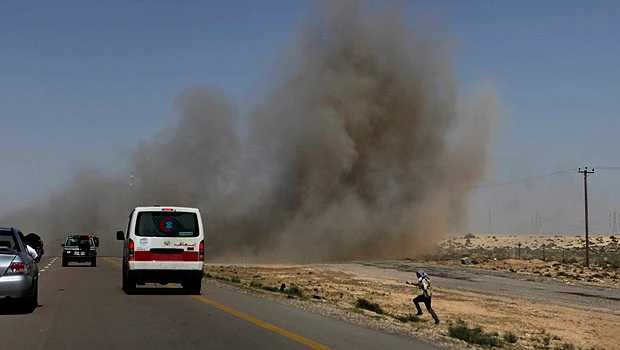
Government forces, meanwhile, unleashed a withering bombardment of freedom fighters outside Misrata on Tuesday as an Obama administration envoy met with the opposition leadership in its de facto capital, a possible step toward diplomatic recognition.
Libyan freedom fighters are exporting oil again for the first time in almost three weeks through a tanker that arrived Tuesday at an eastern port, potentially giving them crucial funding for their fight.
The Equator tanker, which can carry 1 million barrels of oil, was chartered by Geneva-based oil trader Vitol SA and would head for China once loaded, according to Rajab Sahnoun, a senior official at the rebel-controlled Arabian Gulf Oil Co., or Agoco, in Tobruk.
The one-off shipment would be only a tiny fraction of Libya’s pre-crisis exports of around 1.6 million barrels a day, but is viewed by analysts as a symbolic step forward. “The significance is not only that this is the first shipment in 18 days, but also a signal that Libya is open to international trade and shipping,” said Michelle Wiese Bockmann, markets editor at London-based shipping data provider Lloyd’s List.
In related news, government forces have razed a mosque formerly used by freedom fighters as a command center in a western Libyan city, stepping up efforts to eradicate symbols of resistance against Qaddafi.
Rebel forces held Zawiyah for several weeks after the uprising erupted in mid-February but were defeated on March 10 after a series of fierce battles.
The coastal town is now firmly under state control, with streets patrolled by state militiamen. But the mosque’s demolition has distressed some locals. “People are upset,” said Mohammad, a shop owner. “How can you remove a mosque in a central square just like that? It’s a Muslim country.”
The white stone building with a towering minaret — also used by rebels as a field hospital — was knocked down a week ago and bulldozed into a flat patch of sandy land.
A nearby makeshift graveyard in the central square where rebels buried their dead has also been flattened.