
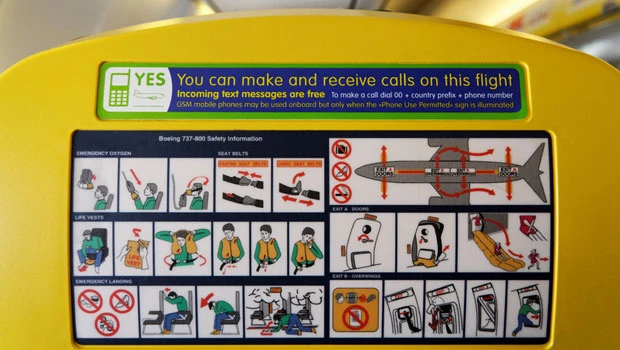
- A few weeks ago, due to the violence in the streets of Bahrain, rather than traveling to meetings in Bahrain on the King Fahd Causeway, I flew to Bahrain from King Fahd International Airport in Dammam.
- As usual, onboard the flight everyone kept chattering away on their mobile phones until the fight crew insisted that electronic devices be switched off.
Then we all heard the unmistakable ringing of a Nokia phone. Incredibly, rather than switching off the device, a South Asian man took it out and answered it. He managed to say, "Hello," before the steward snatched the phone from the passenger's hand and rushed back to his seat. After, the "fasten seatbelt" sign was switched off, a flight attendant returned the handset to the passenger, explained to him why the phone had been confiscated, and the man started laughing.
There's a lot of controversy about whether passengers should be allowed to use electronic devices on airplanes, and there is no intention to discuss that issue here. The fact is that on any aircraft in the Kingdom it is illegal to use mobile phones during takeoff and landing. Many handset manufacturers talk about the importance of enabling the next one billion mobile users — and that's great. But with the right to usage of mobile communications comes responsibilities, and those are being ignored.
"I don't know why I should turn off my phone on an airplane, but I do it because I have to follow the instructions," said taxi driver Amjad Hussain. "I am responsible, but some other people won't care. There are many people who think they can follow some instructions and ignore others. Just look around. People don't care about safe driving. They can't even stand patiently in a queue. There needs to be a penalty, a big one, to make people obey the order to turn off their phones."
Anil Madan, an insurance company executive, believes that the first step should be awareness rather than punishment.
"The instructions of the flight attendants are taken as a matter of routine," Madan said. "How many of us actually listen to what's being said? We already understand what's to be done before takeoff. It's not a learning experience. At airports in Saudi Arabia we find people who wouldn't usually be taking a flight. They are onboard a plane because the employer is paying for the ticket. These passengers have a very low level of education and it has never been explained to them that there are places that they can't use a mobile phone. There must be more outreach to these people in their own languages making them aware that for safety reasons, cell phone use is not allowed in certain places such as airplanes and hospitals."
Madan suggested that flight attendants must be more vigilant, even making brief announcements in the languages of those onboard to ensure that they understand that handsets should be turned off. This was an issue on the flight to Bahrain where the preflight information was provided in English and Arabic — but most of the passengers were South Asian and probably didn't understand any of the safety information presented. Handset manufacturers and Saudi telecoms could create awareness campaigns too, highlighting safety and social issues related to cell phone use. After all, Saudi streets are already lined with advertisements in numerous languages for the sale of cell phones and mobile services.
"Airlines can also reach out through travel agents to make passengers aware of this issue," said Shibu Thomas, sales manager, Al-Hussaini Travels. "Many passengers on Gulf flights are laborers. They don't have much education but they all know to ask the weight of the luggage that they are allowed to take onboard. Restrictions on cell phone use onboard aircraft should be printed under the terms and conditions section of the ticket and there should be a penalty for ignoring this regulation. The regulation should be emphasized to company representatives by the travel agent so they discuss the issue before turning the ticket over to the employee. When people understand that a certain action will cause them to lose money, they pay attention."
Thomas makes a good point. Smoking tobacco is banned on all commercial aircraft and there are nasty penalties if a passenger chooses to ignore this rule. The use of cell phones and electronics is an even more sensitive issue and it is one that has been ignored for a long time. This leaves flight crews to struggle with passengers, who increasingly are choosing to use their electronic devices until a flight attendant is forced into an ugly confrontation.
"Look at the culture here. It's fashionable to have three phones. Going to the plane you see people talking on one handset and texting on another. They don't pay attention and trip and fall, injuring themselves and even crashing into other people. Handset use should be halted at the gate from the moment the passenger submits the boarding pass to get onboard the flight. The flight crew shouldn't have to deal with this issue," remarked Hameed Uddin Ahmad, GM, Atlas Travel.
Ahmad asserted that the problem of cell phone use is not only on takeoff, but also creates chaos on landing. People turn on cell phones during the plane's descent. While the flight is on the runway, they dial their first call.
"Husbands tell their wives, 'The moment you land, call me.' She will take that instruction quite literally and be trying to make a call as the flight is touching down," he related. "A regulation not allowing cell phone use after the gate at Saudi airports would stop a lot of rude, unsafe behavior and help passengers focus on getting on or off the plane quickly and safely."
Just as they have recently cracked down on smoking at Saudi airports, the Kingdom's Civil Aviation authority needs to take the lead on this issue. Clear instructions, including penalties, must be conveyed to airlines concerning the steps to be followed in regards to the use of electronics onboard flights originating from or landing at Saudi airports. If a few passengers were ejected from flights and fined, word of the enforcement of the regulations would spread quickly and handsets would be turned off appropriately by all.