
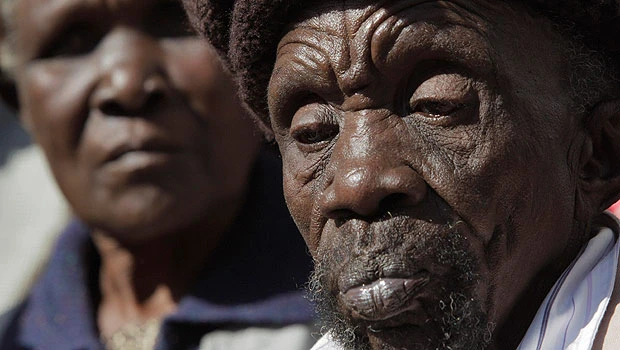
- LONDON: Britain’s Foreign Office admitted Thursday that some Kenyans had been tortured and killed during an anti-colonial rebellion in the 1950s but denied that the current government had any responsibility for the survivors.
The government was in court to defend itself against a suit by four elderly Kenyans who claim they were tortured by officers acting for the British administration that was trying to suppress the “Mau Mau” rebellion.
The Kenyan plaintiffs say both African and European soldiers and police officers carried beatings and acts of torture in detention camps. President Barack Obama’s grandfather, Hussein Onyango Obama, was one of thousands of Kenyans detained.
Robert Jay, a lawyer for the Foreign Office, admitted that several Kenyans were “screened” or tortured and interrogated inside the detention camps. However, he argued that the British government had not explicitly enacted a law that said prisoners were to be severely beaten or tortured, and it could not be held responsible for abuses.
In 1952, then-Prime Minister Winston Churchill declared a state of emergency in Kenya and launched an offensive against a group of militant nationalists who called themselves the Mau Mau.
The British described the Mau Mau as bloodthirsty terrorists. News reports in the US and Britain during the 1950s made the name Mau Mau synonymous with African tribal violence against whites.
Mau Mau veterans have since claimed that they were brutally tortured by both British soldiers and local security forces. The claimants argue that the British government knew that both British and African officers were abusing prisoners.
Between 1953 and 1956, more than 11,000 rebels were killed in the conflict.
The Kenya Human Rights Commission believes 90,000 Kenyans were executed, tortured or maimed during the crackdown and that 160,000 were detained in appalling conditions.
The High Court recently forced the Foreign Office to release hundreds of files relating to the case.
Kenyan prisons were run by both British and African people employed by the colonial administration, Jay said. He argued that the liability for this administration was transferred to the Kenyan government following independence in 1963.
The British government may be liable for the behavior of British soldiers who had been sent from Britain to Kenya specifically to fight the Mau Mau insurgency in the Kenyan countryside, Jay said. They “played no role in screening activities inside the camps,” he said.
In one incident, inmates at Hola prison — a detention camp that was later reclassified as a high security prison — rioted against being ordered to perform manual labor. In the fighting that followed, 11 prisoners were clubbed to death in front of other prisoners.
“The Foreign Office does not submit that this was anything other than an appalling event,” Jay said, blaming prison guards for the torture.