- BAGHDAD: A powerful Iraqi Shiite leader has threatened to reactivate his feared militia in Iraq if US soldiers extend their stay.
Muqtada Al-Sadr issued a statement to his followers on the eight anniversary of Saddam Hussein’s ouster that stopped just short of calling for violent action against US forces. He accused “the occupation” of inciting panic, corruption and unrest among Iraqis.
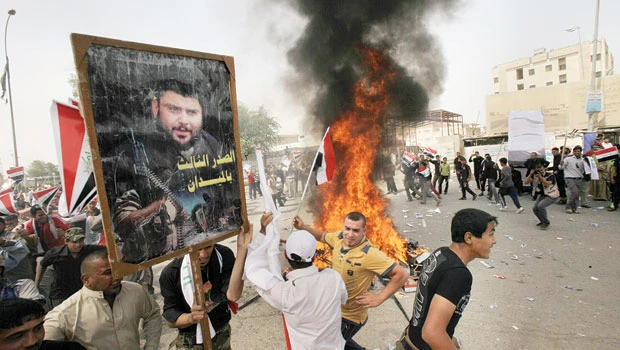
His statement was read aloud at a huge protest of tens of thousands in Baghdad’s Mawal Square, near Al-Sadr’s stronghold in an eastern Baghdad slum. The cleric is in Iran, where he has been studying religion for the last several years.
“What if the invasion forces will not leave our lands?” Al-Sadr asked in the statement, which was read at the protest by his aide Salah Al-Obeidi. “What if the US forces and others stay in our beloved lands? What if their companies and embassy headquarters will continue to exist with the American flags hoisted on them? Will you be silent? Will you overlook this?” “No, no America. No, no America,” the crowd shouted in reply.
In January, Al-Sadr visited his ancestral home in the holy Shiite city of Najaf, 100 miles (160 kilometers) south of Baghdad, and told followers to embrace a peaceful approach to diplomacy as his political wing gains power in Iraq’s government. But he also said that should the US troops remain in Iraq past 2011, followers might retaliate “by all means of resistance.” On Saturday, Al-Sadr elaborated on that point explaining he would quickly train newly armed followers and bring his feared Mahdi Army militia out of retirement. “We will have to adopt (this) approach if they will not leave our country,” he said.
The Mahdi Army ran rampant in Baghdad, Basra and other Iraqi cities at the peak of Iraq’s violence a few years ago, raiding homes and killing Sunnis in the widespread sectarian fighting that brought the country to the brink of civil war. Al-Sadr froze the militia after it was roundly defeated by Iraqi forces in Basra in 2008, dramatically reducing violence in the country.
Under a security agreement between Washington and Baghdad, US troops are scheduled to leave Iraq at the end of 2011.
Prime Minister Nouri Al-Maliki, who needed Al-Sadr’s support to keep his job after his party failed to win a majority in national elections last year, has said repeatedly he believes the American forces will no longer be needed in Iraq by next year.
But many Sunni and Kurdish lawmakers want US troops to stay, fearing Iraq is still too unstable to be able to protect itself should Iran begin to play a more active role in the country after American forces leave.
Visiting Iraq this week, US Defense Secretary Robert Gates said the Obama administration is willing to keep troops in Iraq past 2011. After meeting with Al-Maliki and other leaders during his two-day visit, Gates signaled that scenario was becoming increasingly likely.
On April 9, 2003, a US-led coalition ended Saddam’s nearly quarter-century regime in Iraq, deposing his government after he fled Baghdad.
Saddam’s fall was celebrated by millions of Shiites, Kurds and even Sunnis across the country, whose joy was immortalized in images broadcast worldwide of Iraqis beating a huge statue of the dictator with their fists, feet and shoes after American Marines pulled it down.
Many of those pictures were rebroadcast on Iraq state TV on Saturday. Images of men pulling the head of the Saddam statue down the street were followed by a map of Iraq and the slogan: “The day of change, the place of change.” But demonstrator Haidar Nuaman, 25, said Al-Sadr’s statement shows that many Iraqis won’t stand for a continued US military presence in Iraq.
“It seems that the government does not know what to do.
Muqtada’s is an important voice to stand against any intention by the government to extend the presence of forces,” he said.