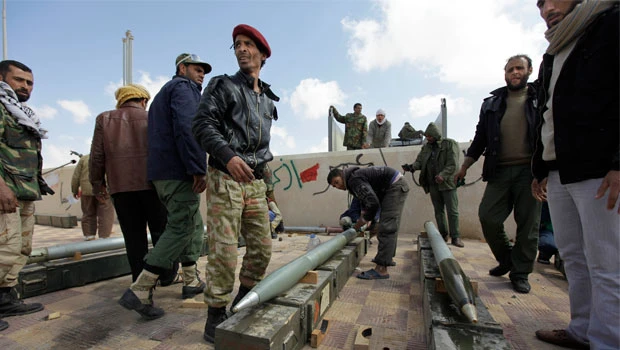
- AJDABIYAH, Libya: Government soldiers and opposition fighters battled in the streets of a key front-line city Saturday after the Libyan military used shelling and guerrilla-style tactics to open its most serious push into opposition territory since international airstrikes began.
At least eight people were killed, a hospital official said.
Recapturing Ajdabiyah would give the Libyan military a staging ground to attack the opposition’s main stronghold, Benghazi, about 160 km farther east along the coastal highway. Muammar Qaddafi’s forces were approaching Benghazi when they were driven back by the international air campaign launched last month to protect civilians and ground Qaddafi’s aircraft.
For the opposition, losing the city would effectively bottle them into a coastal strip of eastern Libya and allow government forces to more tightly squeeze the few pockets of resistance in the rest of the country, including the besieged western port of Misrata, where heavy clashes continued Saturday for a second day.
The push into Ajdabiyah was launched even as international envoys opened fresh initiatives for a peace deal. The African Union said it planned to send a team to Libya on Sunday to begin meetings with the government and opposition leaders.
The Arab League announced it would host a conference on April 14 on Libya, which will be attended by UN Secretary-General Ban Ki-moon and the European Union foreign policy chief Catherine Ashton.
The battle for Ajdabiya showed how Qaddafi’s forces are adapting their strategies to NATO airstrikes seeking to cripple the Libyan military.
Small and mobile units — less vulnerable to airstrikes than tanks and other armor — first ambushed a rebel convoy probing the lines outside the city. Government gunners then began shelling Ajdabiyah from desert positions and later ferried soldiers into the streets using civilian vehicles in attempts to foil NATO pilots.
A possible NATO airstrike, kicking up a huge mushroom cloud, temporarily halted the shelling. NATO officials did not immediately confirm the attack.
A helicopter gunship, flying the opposition flag and coming from the direction of Benghazi, passed over the city during the fighting. Separately, NATO warplanes intercepted a MiG-23 fighter jet operated by an air force pilot who had joined the opposition ranks, and forced him to land after he violated a UN-mandated no-fly zone, a NATO official said.
By nightfall, heavy gunfire was heard from apparent block-to-block combat inside the city, which had about 150,000 residents before many fled for safer areas.
A resident leaving the city, Abdul Fatah, said gunbattles raged along the city’s main street. A rebel fighter, Salah Ali, said Qaddafi’s forces were “spreading out inside Ajdabiyah” with weapons including heavy machine guns and grenade launchers.
In Misrata, opposition and government troops battled for the control of a key roadway linking the port — a lifeline for opposition fighters and trapped civilians. A doctor said at least eight people had been killed.
The government attacks on Ajdabiya quickly changed the fortunes of rebels who had earlier sent units deeper toward the strategic oil port of Brega, 40 miles (65 kilometers) from Ajdabiya, and captured two soldiers loyal to Qaddafi.
It’s unclear whether Qaddafi's troops would make a push of their own into the eastern town of Ajdabiya and risk coming under NATO airstrikes. But taking control of the town would open the way to the rebel stronghold of Benghazi and the eastern port of Tobruk near the Egyptian border.
Most rebel forces pulled back to Ajdabiya when the shelling began, but later appeared to attempt a counteroffensive with heavy machine guns and rockets. Black smoke rose from parts of the town.
Earlier, rebels had pushed deeper toward Brega, a key prize in the back-and-forth battles with government forces.
Rebels say they took two prisoners after a clash with soldiers near Brega’s Bright Star University, outside the government-controlled oil facilities, but it marks a noticeable advance by rebels struggling to push back Qaddafi’s forces.
The eastern Libyan port has changed hands more than five times since the uprising against Qaddafi’s rule began in February. The port and oil storage facilities are strategic for both sides.
Rebels have regrouped on the front lines after a mass retreat Thursday when NATO airstrikes accidentally hit a rebel armored column.
In western Libya, the Red Cross said a relief ship reached the only rebel-held city, Misrata, which was the scene of heavy battles on Friday.