
- NEW DELHI: At the outset, Kisan Bapat Baburao Hazare has nothing in common with India’s vaunted middle class.
- He: An austere Gandhian social activist.
Yet, when the 71-year-old Maharashtrian — better known as Anna Hazare — launched a “fast unto death” on Tuesday to force the Indian government to crack down on corruption, it touched a raw nerve with a substantial section of the middle class.
His immediate demand is the formation of a committee consisting of five government officials and an equal number from the civil society to draft a “Jan Lokpal” — Ombudsman — bill that will deal with corruption in public offices. The government’s response was to set up a panel that includes prominent ministers.
Hazare, a former Indian Army soldier, first captured headlines in the 1980s when he helped turn his village, Ralegan Siddhi in Maharashtra, into a model of conservation and self-sufficiency.
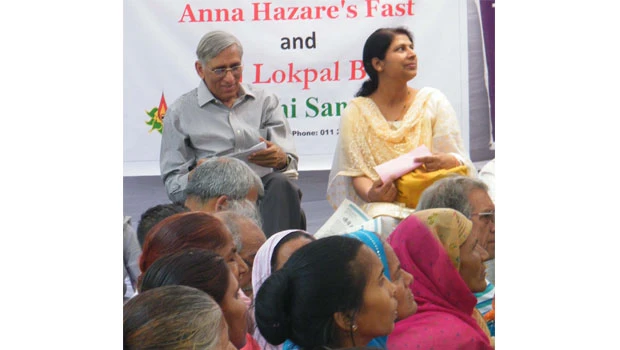
On the first day of his campaign, more than 3,000 turned up at the historic Jantar Mantar here to support him, and as many as 158 fasted with him. Most of them were young, urbane, middle class professionals, and had come forth offering support because they wanted to make their country a better place.
Vipin Mittal, 43, a dentist who lives in the up-market Kaushambi locality on the Delhi-Uttar Pradesh border, took time off his flourishing practice for a few days to take care of Hazare. While Mittal ran around to make sure that everyone stayed healthy, his wife and two pre-teen sons were fasting with Hazare.
“Corruption-free India will be on par with developed countries and then we can hold our heads high,” Mittal explained why he was there.
Mittal’s lofty goal was shared by Guddu, a marketing executive working with a multinational company in Indore. “When I go abroad, people ask me why we Indians are so corrupt? I wish to make India corruption-free and don’t care about losing my salary for a few days,” he said.
For years, middle-class Indians have been increasingly vocal and agitated about the growing corruption in their country. While their aspirations skyrocketed and the growing economy provided them with endless employment and lifestyle choices, a series of scandals in recent years have disillusioned them.
In the past six months alone, two major scams have rocked India. A report by the Comptroller and Auditor General said the government may have lost as much as $40 billion when spectrum licenses were sold below their market value. The former communication and information technology minister A. Raja, under whose office the 2G spectrum scam was dispensed with, was arrested recently.
When India hosted the Commonwealth Games last October, it too was marred by widespread corruption and cost overruns.
It is against this backdrop that Hazare, a life-long bachelor, has become a symbol for the middle class to coalesce around.
Those gathered in Delhi, braving the scorching heat, included a cross-section of the society, among whom were students, writers, software experts and self-employed youth.
Anil Rana, 21, is just out of college and hopes to join the elite Indian Administrative Services. But, for now, he has shelved that plan for a year for a greater cause. “IAS can wait for a year, but this golden opportunity to kick the vice of corruption out of this land that was once a sone ki chidiya (golden bird),” the Delhiite said, pledging: “Though I cannot observe fast unto death like Anna, I’ll be here as long as he stays.”
“Change” was the word on everyone’s lips. “Our vote only changes the people in power whereas we must change the system and not just the individuals. So I’m here,” Angad Singh, 36, who is from Chhapara, Bihar, and currently working with Amity University in Noida, at the outskirts of Delhi, said. “We’ll together put enough pressure to make the government budge,” he added.
Bengali writer Sushmita Banerjee, who fought the Taleban and lived to tell her tale in the best-seller Kabuliwala's Bengali Wife, sat there holding a placard that read, “We will fight. We will win. Bring Jan Lokpal Bill.”
(Banerjee lived in Afghanistan from 1985 to 1995 after her marriage to Jaanbaaz Khan, an Afghan.)
She was clear about her mission, “Corruption will never be eradicated unless we have a solid desire for it in our hearts. But, this bill will be a major tool to fight the institutionalized corruption in our country.”
“We’d need to run from pillar to post to run our business. To just get a clearance, all officials from petty clerks to officers, open their mouth wide,” according to Ashi Mishra, a young self-employed business management graduate from Manipal University, Sikkim, who now lives in Lucknow, Uttar Pradesh. She said, “This bill will shove garbage in their mouths and we’re determined to have it.”
A 35-year-old Maharashtrian farmer, Shaukat Ali, a veteran of Hazare’s many a campaign, was equally determined. “We’ll show these corrupt politicians that we’re a power to reckon with, he said.
A power, indeed, they are. And no one is more determined to prove it than Hazare.
“We demand to form a joint committee with half of our members and half theirs to draft the bill,” the septuagenarian roared. “Are we demanding something unjustifiable?
The answer from the audience was a firm, “No.”