
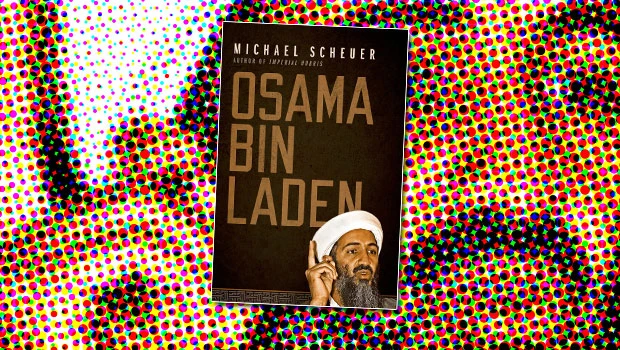
- Few names produce such a shocking effect, yet Michael Scheuer is convinced that the United States and its allies still underestimate the forces Osama Bin Laden commands and the threat they pose.
Scheuer is particularly upset that the former CIA officer who put an end to the plans to capture bin Laden in 1998-1999 is now President Obama’s senior adviser on “extremism.” As the chief of the CIA’s Bin Laden unit from 1996 to 1999 and a counterterrorism analyst until 2004, Scheuer believes America and its allies are fighting a war for survival: “If we do not win outright and irrefutably, we will surely lose in the same manner.”
Scheuer’s biography, “Osama Bin Laden,” is essentially based on primary sources such as Osama Bin Laden’s own words, as well as reflections and memories of those closest to him who are quoted for the first time. Consequently, this portrait is free of all the preconceptions mostly found in Western analyses. Scheuer’s aim is to understand Osama Bin Laden the way he is and not as we want him to be.
“I have not tried to make him seem like an admirable man (though, as might have become clear, I respect his piety, integrity, and skills), but instead like a formidable enemy, one whom we have almost willfully misunderstood,” writes Scheuer.
Although the author’s intention is not to praise Osama Bin Laden but “to bury him,” he has managed to write an engaging portrait of one of the world’s most feared personalities. He also challenges much of what is commonly taken for granted in the media.
He refutes the false claims concerning his failing health. Nothing could be further away from the truth. According to his son, Omar Bin Laden, his father found “grueling treks, the most pleasant of outings” and during their 1996-1997 stay in Tora Bora, they often crossed the border into Pakistan. Omar recalls his father insisting they memorize every rock because nothing is more important than knowing secret escape routes. Several factors helped Osama Bin Laden flee from the enemy: his perfect knowledge of the region, speaking fluent Pashtu, and being profoundly respected by Pashtuns on both sides of the border.
Osama Bin Laden’s strong ties with the Afghan mujahedin, who alongside he fought the anti-Soviet jihad, are superseded by a realistic assessment of the Arab mujahedin’s role in Afghanistan. Bin Laden has always attributed the mujahedin victory first to Allah and then to the Afghans, a population blessed with a high morale and ready to sell their sheep to buy ammunition for their rifles. On the other hand, according to Afghan field commanders, Arab fighters were undisciplined and mostly seeking martyrdom at the earliest opportunity. The 13 years of the jihad claimed less than 500 Afghan Arabs and several hundred thousand Afghan mujahedin. Bin Laden has always admitted that the war had been won by “poor, barefooted Afghans.”
He learned many lessons from fighting against the communists and their allies in Afghanistan. He also realized the necessity of a thorough military training and the importance of patience and piety, “the provision and weapon of he who hopes for victory.” He also saw the media as a means for teaching Muslims that jihad was a religious duty to be performed whenever there was a threat to Islam.
The postwar period in Afghanistan increased Bin Laden’s hatred towards the United States, which along with the United Kingdom, Germany and the U.N., wanted to establish a regime that would include representatives of all Afghan groups as long as there were not Islamists. In an interview given in March 1997, Bin Laden remarked:
“We were fighting against the communists since 1979, and now the United States was pressuring us to cooperate with those very same communists. The United States has no principles. To achieve its own interest, it forgets every principle.”
Four years later, Bin Laden warns his audience that he would no longer speak in public as often: “We have many other things to do… our silence is our real propaganda.”
The 2003 invasion of Iraq gave Bin Laden the perfect reason to launch a jihad. The country had been attacked without provocation, invaded and then the rule had been handed over to the Shia. Towards the end of 2007, Bin Laden admitted the presence of an Al-Qaeda stronghold in Iraq whose influence, he said, would spread to Lebanon and Palestine.
The new members of al Qaeda have trained in Iraq, Chechnya, the north Caucasus, southern Thailand, Mindanao, Kashmir, Afghanistan and also in countries such as Bangladesh, Pakistan and northern Nigeria (where the influence of the Taliban is growing). According to the author, this new generation will be, no less devout, more professional and less visible. Second, it will be larger, with more adherents and potential recruits. Third, it will be better educated and more adept at using modern tools, especially weapons and communications.
In his early fifties, Bin Laden has still many goals to achieve: defeat the United States, destroy Israel, fight the Shia and incite Muslims to jihad. Thanks to previously untranslated documents written by those who grew up with him in Saudi Arabia and fought alongside him against the Soviets, this biography reveals Osama Bin Laden in a manner never done before. Described by his son Omar as the most kind among the people around him because “some are much, much worse,” he remains a staunch and lethal enemy of the West.