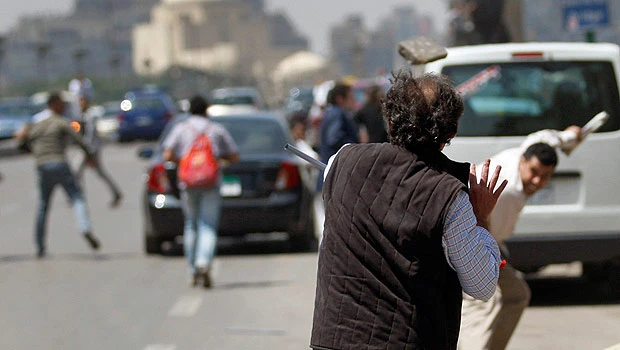
- BENGHAZI, Libya: Libyan fighters begged for more NATO airstrikes on Thursday, saying they faced a massacre from government artillery barrages on the besieged city of Misrata, but Western allies squabbled over how to respond.
The fighters said a hail of Grad rockets fired by besieging forces into a residential district of Misrata, Libya's third largest city, had killed 23 civilians, mostly women and children.
Aid organizations warn of a humanitarian disaster in Misrata, the lone opposition foothold in western Libya, where hundreds of civilians are said to have died in a six-week siege.
"A massacre... will take place here if NATO does not intervene strongly," an opposition spokesman in Misrata told Reuters by telephone. Al Jazeera television showed hundreds of Misrata residents demonstrating after the dawn attack. "The blood of martyrs will not be in vain," they chanted, waving the opposition flag.
The International Organization for Migration said a rescue ship had left Benghazi, in east Libya, to begin evacuating 6,000 stranded migrants from Misrata. Many were dehydrated and weak and in "desperately worrying condition", it said. Migrants from Egypt, Niger, Bangladesh, Ghana, Sudan and Nigeria have been stranded in Misrata, living in the open for weeks with limited food and no clean water.
NATO warplanes later launched strikes on the Libyan capital Tripoli. State television said there were civilian casualties. Reuters correspondents heard four blasts and anti-aircraft fire, and saw plumes of smoke to the southeast.
US Secretary of State Hillary Clinton expressed concern at a NATO meeting in Berlin over "atrocities" in Misrata but gave no hint Washington was prepared to re-engage in airstrikes. French Foreign Minister Alain Juppe said after talks with Clinton that the United States rebuffed a French request for US warplanes to resume major air raids in Libya.
Reflecting concern at strains in the alliance over the bombing campaign, Clinton called for NATO to maintain "resolve and unity" against Muammar Qaddafi, saying he was trying to test Western determination. Papering over differences, NATO foreign ministers pledged in a joint declaration to provide "all necessary resources and maximum operational flexibility" for the air campaign to maintain a "high operational tempo against legitimate targets".
French Defense Minister Gerard Longuet has said Qaddafi's attacks cannot be stopped without US participation in strikes on his tanks and artillery. Paris cited Spain, Italy, the Netherlands and Sweden among allies who could do more.
But Spain said it had no plan to join the seven NATO states that have conducted ground strikes while Italy, Libya's former colonial power, expressed reluctance to launch attacks.
Amid a flurry of diplomacy over Libya, UN Secretary-General Ban Ki-moon, EU foreign policy chief Catherine Ashton, Arab League head Amr Moussa and officials from the African Union and the Organization of the Islamic Conference discussed the war at a meeting in Cairo.
Delegates at the meeting were unanimous in their call for a cease-fire. They also wanted to ensure the protection of civilians and unrestricted access for humanitarian aid.
"Although the situation on the ground remains uncertain, the main parameters of a solution are clear," Ashton told reporters. "The only solutions to end this crisis are political. We believe that the regime has lost all legitimacy, should leave power and allow the Libyan people to determine their own future through a process of dialogue between different sides."
Meanwhile, five so-called BRICS emerging powers — Brazil, Russia, India, China and South Africa — voiced misgivings over NATO airstrikes after talks in China and urged an end to the two-month civil war.
Their criticism contrasted with the first joint call for Qaddafi's overthrow from a "contact group" of Middle Eastern and Western countries meeting in Qatar on Wednesday, which demanded the veteran ruler leave power and vowed support for the fighters.