
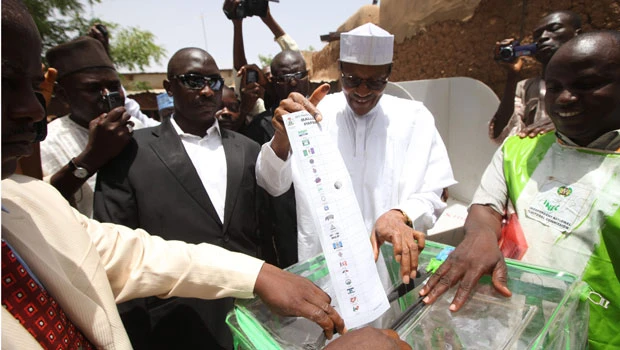
- ABUJA: Tens of millions of Nigerians voted on Saturday in what they hope will be their first credible presidential election for decades, polls which could set an example in Africa and cement their emergence from military rule.
From the tin-roofed shacks of the Niger Delta, where front-runner President Goodluck Jonathan voted, to the dusty alleyways of Daura, the northern village of his main rival, ex-military ruler Muhammadu Buhari, voters came out en masse.
Across most of the country of 150 million there was little sign of the chaos and violence that has dogged past elections although two bombs panicked voters in the troubled northeastern city of Maiduguri. There were no reports of casualties.
Voters in the sprawling commercial hub of Lagos, where many polling stations finished early, stayed on to watch the count, shouting out the total as polling agents tallied the ballots.
“The politicians should know if they don’t perform they are going to be voted out...The electorate now know we have the power to chose our leaders,” said businessman Ahibuogwu Brian among the populous lagoon-side shanties of Makoko.
The polls pit Jonathan, the first head of state from the oil-producing Niger Delta, against Buhari, a northern Muslim with a reputation as a disciplinarian.
The African giant, home to more people than Russia, has failed to hold a free and fair presidential election since military rule ended in 1999, leaving many of its citizens with little faith in the benefits of democracy.
But a relatively successful parliamentary election a week ago, deemed credible by observers despite isolated acts of violence, has renewed voter confidence. Turnout appeared to be much higher than for the parliamentary election.
“There is no mago mago,” said local election observer Agu Michael, 42, using the Yoruba expression for trickery in Lagos, Nigeria’s biggest city. Market women took advantage of the swelling crowd to sell boiled plantain bananas and meat stew.
There were reports of underage voting and attempts at ballot-stuffing in some areas. In the northern state of Bauchi irate youths torched an electoral commission office after officials were allegedly found thumbprinting ballot papers.
“There are concerns that need to be addressed, but overall this is much better than the past,” said Clement Nwankwo, head of the Policy and Legal Advocacy Center (PLAC) in Abuja, working with more than 20 civil society groups to monitor the vote.
“We have not seen large-scale reports of malpractice, nor of collusion between electoral officials and politicians.”
President Jonathan, a former zoology teacher born to a family of canoe makers, is the favorite. He is backed by the national machinery of the People’s Democratic Party (PDP), whose candidate has won every presidential race since 1999.
“Nigeria is now experiencing the true democracy, where we the politicians have to go to the people,” said Jonathan, voting with his wife Patience and his mother before leaving in a motorcade through cheering crowds.
There are more than 73 million registered voters and 120,000 polling stations. Results from the handful that had already declared in Lagos showed Jonathan with a strong lead. He won all 234 of the votes cast in his home village of Otuoke.
But Jonathan is resented by some in the north, who believe he is usurping the right of a northerner to the presidency for another four years. He inherited office after his predecessor, northerner Umaru Yar’Adua, died last year in his first term, interrupting a rotation between north and south.
Buhari, a strict Muslim known for his “War Against Indiscipline,” is hoping to capitalize on some of the resentment and is likely to win strong northern support despite his Congress for Progressive Change (CPC) being a young party.
The former general told Reuters he feared the ruling party was trying to manipulate the vote out of desperation.
“They could do anything and they are trying everything but luckily people are very sensitive this time around and they are determined to make their vote count,” he said.
Buhari would need to prevent Jonathan from taking at least a quarter of the votes in two thirds of the 36 states if he is to stop him winning in the first round, a feat which northern support alone is unlikely to guarantee.
Fellow opposition contender Nuhu Ribadu’s Action Congress of Nigeria (ACN) party has its stronghold in the southwest, and could help force a run-off. But the two failed to agree a last minute alliance this week, leaving the anti-Jonathan vote split.
* * *
• The 53-year-old incumbent and ruling party candidate has been called an “accidental president.” The soft-spoken marine biologist became governor of Bayelsa state after the impeachment of its elected governor. Jonathan later became vice president under elected Muslim leader Umaru Yar’Adua after a widely criticized 2007 election. Yar’Adua left Nigeria for Saudi Arabia in late 2009. A power vacuum stalled the country for months until lawmakers took an extraconstitutional vote to give Jonathan presidential powers in February 2010. Jonathan became president in May 2010 after Yar’Adua’s death. Known for wearing the traditional caftan and bowler hat of his Niger Delta home, Jonathan is a Christian of the minority Ijaw ethnic group.
• - The 69-year-old former military ruler first came to power in a 1983 coup. His regime executed drug dealers, returned looted state assets and sent soldiers to the streets with whips to enforce traffic laws. His “war against indiscipline” won many followers, though his regime detained journalists critical of the government and laws were passed allowing indefinite detention without trial.
Despite his recent assurances that he is a convert to multiparty democracy, some worry the perennial candidate could return to his autocratic ways. Still, Buhari, a Muslim, has drawn thousands to his rallies across Nigeria’s dissatisfied north.
•- The 50-year-old former police official gained prominence in Nigeria after being appointed as the chairman of the Economic and Financial Crimes Commission by former President Olusegun Obasanjo. Ribadu pursued top politicians in the country, though critics say he targeted Obasanjo’s opponents. Ribadu once estimated that corruption has cost Nigeria more than $380 billion since gaining its independence from Britain in 1960. After Yar’Adua came to power, officials reduced Ribadu’s police rank. He fled the country in 2008 after what his lawyer described as a drive-by shooting. A Muslim from Adamawa state, Ribadu is the candidate of the Action Congress of Nigeria, the country’s strongest opposition party, though his campaign has been plagued by missteps.
• - The 55-year-old former teacher and educator has served as the governor of Kano state in Nigeria’s north. While governor, the typical hotbed of violence grew far quieter.
However, under his administration his state saw officials stop giving polio vaccinations to the young over unfounded fears the vaccine was a Western plot to sterilize Muslims.