
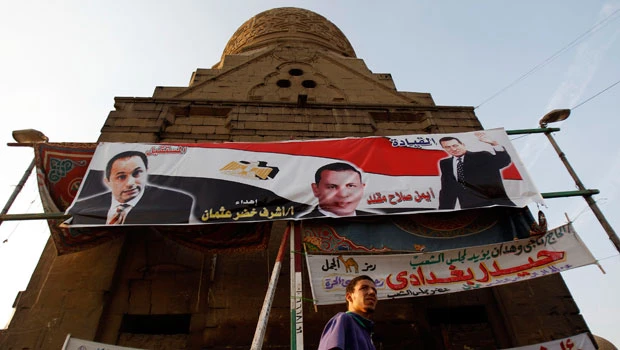
- CAIRO: An Egyptian court on Saturday ordered the dissolution of former President Hosni Mubarak's political party, meeting a demand of the pro-democracy movement whose protests ended his 30-year rule.
The disbanding of the National Democratic Party (NDP) was likely to further appease protesters who had called off fresh demonstrations after the military council that now rules Egypt earlier this week ordered Mubarak detained for questioning about corruption allegations.
The NDP had dominated Egyptian politics since it was founded by Mubarak's predecessor, Anwar Sadat, in 1978. For many in Egypt, it epitomized the graft and abuse of power that helped ignite the protests which forced Mubarak to quit in February.
"It's illogical for any instruments of the regime to remain, now that the regime itself has fallen," the High Administrative Court said in a statement.
The court also ordered the liquidation of NDP assets, with the funds to be returned to the state because, the statement said, "this money is actually the money of the people."
Mubarak was admitted to a hospital in Sharm El-Sheikh on Tuesday, suffering from an unspecified ailment, shortly after he was questioned. On Friday, prosecutors ordered him moved to a military hospital until he is well enough to be interrogated again. Security sources said this would likely happen Sunday.
Political analysts described the NDP's dissolution as an important step toward a multiparty system in Egypt, which is to elect a new Parliament and then a president later this year.
"All the central powers in Egypt of the Mubarak regime, all of them, were under the umbrella of the NDP," Nabil Abdel Fattah of the Al-Ahram Center for Political and Strategic Studies said.
He said the party had a vast network extending into villages and city neighborhoods that could be used to mobilize people in elections. "I think its infrastructure was very powerful," Abdel Fattah said. "The NDP also had huge money in banks, not just from membership fees, but I think also from businessmen who financed the NDP. The money came from many sources."
Many of the party's senior officials have been arrested on graft and other charges and are now in Cairo's Torah prison.
These include the former head of the upper house of parliament Safwat Sherif, who was the party's secretary-general, Mubarak's son Gamal, who was head of its policy secretariat, and steel magnate Ahmed Ezz, who headed its organizational committee.
Opposition leaders and protesters said Ezz had orchestrated last year's parliamentary elections, widely seen as the most fraudulent ever under Mubarak's rule, to ensure an NDP majority. Ezz denies this.
Before the court announcement, NDP spokesman Nabil Bibawi had said the party would comply with any rulings regarding the party. Earlier this week, the NDP appointed Talaat Sadat, the nephew of the former president, as its chief.
The NDP headquarters were torched during the protests that led to Mubarak's ouster, and its supporters were blamed for some acts of thuggery against demonstrators.