
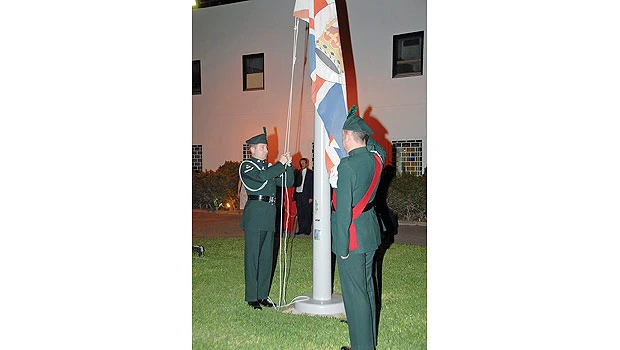
- Once a year in Saudi Arabia, a short ceremony that is a long held British tradition dating back almost 500 years takes place.
- The Sunset Ceremony, which marks the close of day, is the final act at Queen Elizabeth’s official birthday celebration.
The ceremony started as a simple “Watch Setting” delivered by drum. It has changed hugely over the years into displays by massed bands and public events such as Beating the Retreat. At the Queen’s birthday celebrations at the British missions in the Kingdom, the ceremony returns to almost its original and purest form.
It was in the “Rules and Ordynaunces for the Warre” dated 1554 and Robert Barrett’s “Theorie and Practice of Moderne Warres” dated 1598 that a simple ceremony called Watch Setting first received written mention.
It was a simple ceremony using drums that served several purposes. Foremost, it marked the conclusion of the day’s hostilities, but also notified soldiers outside the camp to return or face overnight exclusion and to order the setting of the overnight watch.
A century later, the term “retreat” had come into use for the ceremony. This term derived from the French word “retraite,” which they used to describe the British (and their own) “tattoo.”
The term “tattoo” comes from the Dutch phrase “Doe den tap toe,” meaning “turn off the taps,” and hails from the 17th century when a soldier’s life was strictly controlled by his regiment. The daily routine of a military post was signaled by the beat of a drum.
At sunset, a lone drummer was sent into the streets of town to beat out a tattoo. It was the signal for tavern owners to close down for the night and for military personnel to return to the post. When the latter were back at the post, the flag was lowered in a ceremony marking the end of the day.
Thus a tattoo was part of the system of drumming daily routine orders to soldiers and was delivered at night, whereas a retreat ordered a watch setting and significantly the cessation of battle for the day and was delivered at sunset.
It is not clear whether it always involved lowering the flag, unless the ceremony was after a day’s battle during a campaign.
The earliest reference to the ceremony as a retreat itself is in an order dated June 18, 1690, from an officer in the Army of James II. It states: “The generalle to be beate att 3 clock in ye morning…. Ye retreate to beate att 9 att night and take it from ye gards.”
Another reference was in an order from William III in 1694: “The Drum Major and Drummers of the Regiment which gives a Captain of the Main Guard are to beat the Retreat through the large street, or as may be ordered. They are to be answered by all the Drummers of the guards, and by four Drummers of each Regiment in their respective Quarters.”
These two references would, however, appear to refer more to what we now call a tattoo, as they were carried out at night and not at dusk.
The General Orders of the Duke of Cumberland clearly differentiate between the two ceremonies. “The Retreat is to beat at Sunset,” whereas “Tattoo (is) to beat at (Ten, nine or eight) o’clock at night.”
Whilst the Army was serving in Flanders, the Duke’s Orders define the seriousness of the ceremony of the retreat.
“Soldiers who take their arms out of the bell tents after Retreat to suffer Death,” one said. “No Drummers to practice…. After the Retreat,” another directed.
In “An Universal Military Dictionary,” dated 1779 by Captain George Smith, Inspector of the Royal Military Academy in Woolwich, retreat and tattoo are definitely separated and clearly link the retreat with watch setting. “The Retreat is likewise called setting the watch.”
Often, it is accompanied by a piper or the “last Post” played by a single bugler.
The Last Post call (or 2nd Post) is used in British Army camps to signal the end of the day when the duty officer returns from the tour of the camp and quarters after visiting the last sentry post. The “First Post” call is used to mark the start of the inspection.
The sunset ceremony has continued as part of British military tradition to this day. In its simplest and purest form, as demonstrated at the Queen’s Birthday Party in Jeddah on April 19, it is a simple and moving moment symbolizing the end of the “official” day, but also giving pause for a moment of reflection on the hope for cessation of hostilities.
All hostilities, everywhere.