
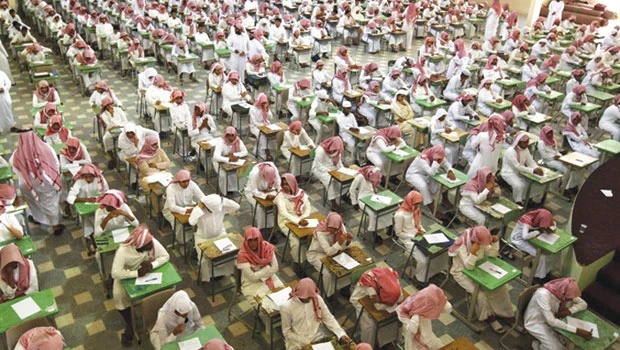
- The curriculum implemented in both public and private schools in Saudi Arabia fails to lay a universal foundation, therefore, disabling students from succeeding in a foreign school system.
The curriculum in Saudi schools is created and enforced by the Ministry of Education through a thorough system of meticulous recording and supervisory authorities. From the approved-only texts that must be utilized, to the activities teachers must complete on schedule, the curriculum dictates the syllabi of courses entirely.
But, as many experts in the field agree, the main issue may not be the actual content of the curriculum itself, but the indirect consequences it yields. The rigid teaching methods imposed on teachers reduces the varying approaches a student will be exposed to in learning. This lack of variation trains students in but a single approach, often memorization. Thus, students are unable to adjust to alternative methods of learning when presented to them.
“I had a really difficult time when I went to college,” revealed Iman, a graduate of a Saudi private high school, who later attended and graduated from the American University in Sharjah. “I literally had to teach myself how to learn all over again,” she stated. Iman revealed that in high school she was used to the teacher highlighting the necessary information and would simply memorize it for exams. “In university, it was completely different. I had to take notes and absorb all the information and then later decide what was important and what wasn’t,” she said. “It wasn’t just given to us like I was used to and I also had to learn how to take what was taught in lectures and translate that into practical applications.”
The curriculum, which stands independent from other foreign standards, makes it harder for students to assimilate into other systems in their higher education. “Many students are three grade levels behind when they switch systems—and not just in language, but in application skills,” says education consultant Arlene Attar, who works on curriculum development in private Saudi schools in accordance with the Middle State Association of Colleges and Schools’ accreditation guidelines.
Attar, who has extensive experience in the Middle East and Far East school systems, believes that students in the Kingdom headed to college abroad are not equipped with adequate critical analysis skills. “Most students of the government’s curriculum who later transfer to a foreign one are not used to the demand of homework, or unassisted work,” she continued. These students are accustomed to information being dictated to them by teachers, in which they simply regurgitate what they learn word-for-word in the exams.
Another factor is the curriculum fails to highlight the importance of alternative resources. Often, a teacher’s lecture and government-approved textbook are the only sources of information in the classroom. Students are often not required to seek outside sources, thereby weakening their skills in deduction and research-based applications. “Students should be responsible for generating their own major ideas and conclusions,” suggests Attar. “They need to develop independent meta-cognitive skills through practicing justifying their opinions with sources.” She asserts that the current focus on spelling and dictation tests is not the way to do it and ultimately discourages creativity and individual progress. One way to counteract this handicap, she suggests, is to emphasize creative formal writing assignments.
“Students are trained to memorize information that is provided, rather than absorbing it comprehensively and applying it critically,” Attar stated. “The difference you’ll often see with students of the Saudi curriculum versus a student of a foreign one lies in reading; critical analysis and comprehension need to be stressed,” she said. But she insists the burden lies with the teachers. “Teachers need to present formal writing strategies and models,” she added. Educators need to be responsible for guiding their students, not just dictating to them.
Pamela Ridge, a teacher with a degree in elementary education who has been teaching in Saudi for the past five years, agrees. “The ministry is indirectly restricting educators with their quotas,” she explained. “Teachers are required to cover and complete a certain syllabus, regardless if the class fully comprehends the lesson or not.” She revealed that most educators incorrectly feel an obligation toward completing the imposed curriculum, rather than an obligation toward the students.
But if it’s more to do with the teaching style, then is it not the educators who are the main setback, rather than a deficiency in the ministry’s curriculum? Some people, like Bangladesh International School English Section principal Nawell Mossalli, see it that way. Mossalli, who is currently completing her doctorate in educational leadership, believes that the curriculum does in fact leave room for a differentiation in teaching styles. “The ministry is consistently providing workshops for teachers and instructing them on new, effective teaching techniques,” she stated. “Whether those workshops are followed up or applied is another issue.” She adamantly believes that it is today’s Saudi system educators who are at fault due to their “comfortableness” in Saudi’s “result-centered culture.”
“Teachers are satisfied by the students’ grades, and that’s where the teaching stops,” Mossalli revealed. “That is why the system tends to churn out students who are used to producing exactly what is expected from them by their teachers—and nothing more.” She agrees with Attar and Ridge, that this has made creativity and “thinking outside-the-box” a discouraged attribute in the classrooms. She also believes that the issue will not resolve itself as long as teachers raised in the same result-centered culture are allowed to teach. “Unfortunately, it’s a cycle,” Mossalli stated, “A teacher will teach the way he or she has been taught, unless trained differently.”
Proof of this culture can be witnessed by a visit to a SACO hardware store or Jarir Bookstore, where purchased final projects are on sale from SR500.
“No one is even checking for plagiarism and purchased projects—which are not only popular, are almost encouraged!” stated Mossalli. Educators just want to see the final result, a passing grade, and are satisfied with that. As long as the project is complete, they see no further reason to inquire about it. This may not be the case with all the educators in the Saudi system, but unfortunately, it applies to the majority.
On the other hand, some experts such as Attar feel teachers of the Saudi curriculum are aware of its setbacks and are dedicated to correcting them. “The bulk of the teachers that I meet during my educational workshops are eager to learn new teaching methodologies and strategies and apply them,” she revealed, “Unfortunately, there just aren’t enough of us (educational instructors) in the private or public sector to go around.” She claims that time constraints and lack of teacher resources and training is the issue here, not so much the educational culture.
Mossalli believes that even if the curriculum is redeveloped, like some suggest, a problem will still exist. “The key here is not only to have a curriculum that coincides with foreign standards, but to have more training and workshops for educators.” She stated. “Teachers need to be less concerned with the results and focus more on the process of learning for these students.”
The obvious solution is a combination of both. All experts agree consistent training and workshops are a must for all educators. The same staunch system used to verify that the curriculum is being adhered to should be utilized to ensure that current universal teaching methods are applied. Through a revised curriculum, students need to be taught comprehensive application skills that are necessary for success in institutions of higher education.
Yet while educational authorities may differ on the exact details of how to rectify the issue of Saudi high school students being unprepared come graduation day, one thing is certain. The students are the ones suffering.