
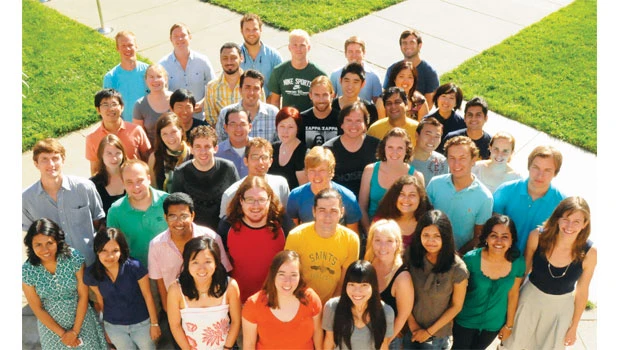
- Canada ranks among the most multicultural nations in the world, and it is well known for its diverse, welcoming and vibrant society.
- It is also renowned for its high quality of education.
This explains why more than 150,000 international students go to Canada every year to study. Many of those students are Arabs and their numbers have more than doubled between 2008 and 2009.
“There has been a 95 percent increase in study permits issued to Arab students since 2006,” said Jean-Philippe Tachdjian, deputy director and trade commissioner of Edu-Canada, the unit in the International Education and Youth Division of Foreign Affairs and International Trade Canada (DFAIT), which is responsible for the promotion of Canada as a study and research destination.
“Based on data of Arab student enrollments from 2009, there are 28,280 long-term students from Arab countries studying in Canada. Of those, Saudi Arabia is the sixth source country with 8,745 students. Arab students make up 14.4 percent of Canada’s long-term international student population, which is up from 7.6 percent in 2008,” added Tachdjian. What is more significant is the dramatic increase in the number of Saudi students studying in Canada in both colleges and universities on the King Abdullah Foreign Scholarship Program from 2008 up to now.
“In 2008, there were approximately 2,500 Saudis students and trainees in Canada officially registered with the Cultural Bureau. As of April 2011, the figure is 13,000,” Saudi Arabia Cultural Attaché in Canada Dr. Faisal Mohammad Al-Mohanna Abaalkhail told Arab News. This translates to an increase of at least four times the number of students over a period of three years.
“This dramatic increase has proven to be challenging to us but very interesting and enlightening. We appreciate the fact that we need to put more effort to be on the level of the challenges,” said Abaalkhail.
However, the total number of Saudi students (not just those on scholarship) is much higher.
“Our records show that we have 15,001 students in total, which includes those who are self-funded, on scholarship and those who come as companions to the scholarship students and end up enrolling in post-secondary educational programs,” explained Abaalkhail. “Still, the numbers are increasing. We are opening approximately 500 new student files per month. So far, our records show that we have 11,662 male students and 3,339 female students registered.” Although there are students in all 10 provinces, the highest number of students is found in Ontario and British Columbia.
The reason for the dramatic increase in numbers of Saudi students on the King Abdullah Foreign Scholarship Program is due to the fact that in 2008 Canada was added to the list of countries included in the program. Furthermore, the scholarship program’s list of academic disciplines has been expanded to include engineering, computer specializations, accounting, finance and marketing, among many others.
“Before, the King Abdullah Foreign Scholarship Program was mainly open to students interested in the health care sector who wanted to train as doctors. Now, however, it is open to a full spectrum of education programs and is not just limited to medicine and the sciences. Also, these programs are now open to all levels: Bachelor’s, Master’s and PhD,” explained Abaalkhail.
However, he said that it is very difficult to get the scholarship.
“Out of the total number of applications, we only accept 12 percent. Each year, around 65,000 to 70,000 students apply and eventually 6,000 to 7,000 get accepted. It’s a very rigorous process of selection, which is very justified. We want the ones that are qualified, capable and who have the personal characteristics that would help meet the challenges ahead.”
Even though the US gets more Saudi students compared to Canada, it is because the US has thousands of universities compared to 90 in Canada.
“From the total number of Saudi students studying in the world on the King Abdullah Foreign Scholarship Program, we have around 13 percent here in Canada in these 90 universities. Let’s not forget that a few do not offer graduate and postgraduate programs and 20 universities are French-speaking. With that said, 13,000 students is a very high number compared to the number of universities here,” stated Abaalkhail.
The King Abdullah Foreign Scholarship Program, which was established in 2005, sends students to more than 21 countries. Its mission is to actively develop Saudi human resources to be world competitive in the work market and academic research and to have a high caliber base in Saudi universities as well as the public and private sectors. Along with tuition, a full year of language training, medical insurance, and yearly trips home, students on the scholarship program get a monthly stipend.
The Saudi Arabian Cultural Bureau in Canada is attached to the Royal Embassy of Saudi Arabia in Canada and on all educationally related matters reports to the Ministry of Higher Education of the government of Saudi Arabia. It was established in 1978 in Ottawa to meet the educational needs of Saudi students wishing to pursue their higher education in Canadian universities and technical colleges. The Cultural Bureau also serves as a link between Saudi Arabia and Canada in the promotion of cultural and educational relations and the establishment of cooperation between Saudi institutions of higher learning and their counterparts in Canada.
To find out more about Canada’s education system, make sure you attend the International Exhibition and Conference for Higher Education at the Riyadh International Exhibition and Convention Center April 19-22 where 40 Canadian institutions and associations will be present.
The exhibition and conference is one of the largest delegations for recruitment, partnership building and networking and attracts approximately 300,000 visitors.