
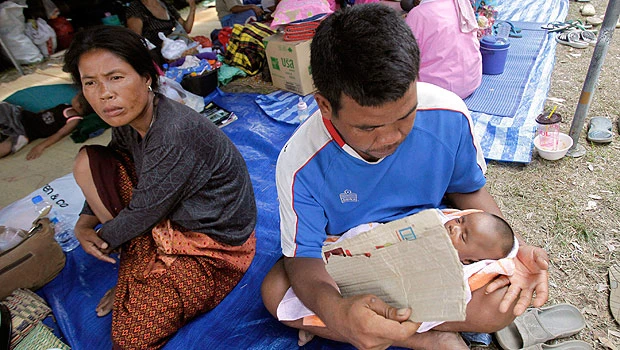
- NONG KANNA, Thailand: The worst fighting in years between Thailand and Cambodia spread Tuesday to a third stone-walled temple, as the neighbors exchanged artillery fire in border clashes that have killed 13 soldiers and displaced 50,000 villagers.
The skirmish near the 11th century Hindu temple Preah Vihear followed unsuccessful international attempts to secure a cease-fire in the largely long-distance artillery battles that erupted Friday at two other temples about 100 miles (160 kilometers) to the west.
Preah Vihear was the scene of four days of deadly fighting in February and is the most prominent symbol of a border dispute between the Southeast Asian nations that has long stirred nationalist sentiment on both sides.
Domestic politics on both sides may also be spurring the conflict, especially in Thailand, where a military that staged its latest of several coups in 2006 could be flexing its muscle ahead of elections due in June or July.
“I still don’t know why they are fighting. Maybe they want the land,” said Boonhome Surasuk, one of about 80 men left in the mostly abandoned Thai village of Nong Kanna, about three miles (5 kilometers) from the Cambodian border.
The village normally has about 1,000 people.
“All I can say is that it affects us all,” he said.
Shortly after speaking to an Associated Press reporter, Boonhome fled to a concrete and wood bomb shelter built into the earth near a school as Cambodian shells again rained down on the area, causing no casualties.
“I don’t dare go out of the bunker right now,” the 56-year-old farmer later told the AP by cell phone. “This is even worse than the days before.” Boonhome has slept in the bunker since Friday, when the latest skirmishes erupted around the ruins of the nearly 1,000-year-old Ta Moan and Ta Krabey temples, which are on territory claimed by both countries.
A Cambodian field commander, Col. Suos Sothea, said there was a new round of artillery duels Tuesday near Ta Moan.
Boonhome said Nong Kanna was alive with the sound of playing children last week, but that now, “all we hear is the sound of gunshots and fighting.” Each side has accused the other of starting the battles.
Cambodia said one of its soldiers was killed in fighting late Monday, bringing the total toll among Thai and Cambodian troops to 13.
The US threw its support Monday behind the efforts of Indonesia, current chair of the Association of Southeast Asian Nations, to mediate an end to the conflict.
Secretary of State Hillary Rodham Clinton said the US
was deeply concerned about the violence. In a statement, she urged both sides to exercise restraint and act to reduce tensions. Clinton said US officials were talking with both countries.
Thailand has so far rejected mediation, saying the two countries have to resolve the dispute alone. But on Sunday, Thai Foreign Minister Kasit Piromya indicated that Bangkok might accept Indonesian military observers at the border, a proposal already accepted by Cambodia.