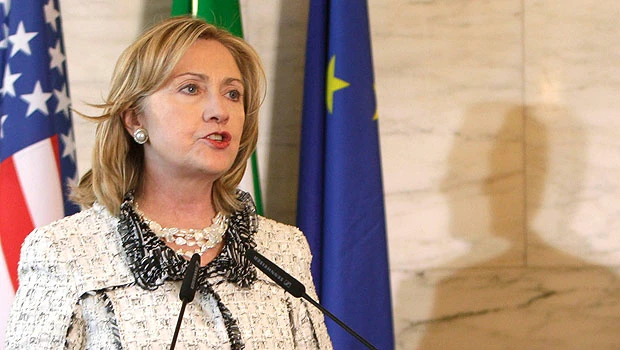
- ROME: The United States is trying to free up part of $30 billion it has frozen in Libyan assets so it can better support opponents of Muammar Qaddafi, US Secretary of State Hilary Rodham Clinton told a conference Thursday on Libya.
Twenty-two nations and international organizations met in Rome to figure out how to help the Libyan fighters, who say they need up to $3 billion in the coming months for military salaries, food, medicine and other basic supplies.
Clinton said the Obama administration, working with Congress, wants “to tap some portion of those assets owned by Qaddafi and the Libyan government in the United States, so we can make those funds available to help the Libyan people.”
The US has already pledged $53 million in humanitarian aid and authorized up to $25 million in nonlethal assistance to the fighters, including medical supplies, boots, tents, rations and protective gear. The first shipment is to arrive in the western, rebel-held city of Benghazi in the coming days.
Clinton declared that ousting Qaddafi was still a top goal.
“We have made it abundantly clear that the best way to protect civilians is for Qaddafi to cease his ruthless, brutal attack on civilians from the west to the east, to withdraw from the cities that he is besieging and attacking and to leave power,” Clinton said. “This is the outcome we are seeking.”
The Rome conference agreed to establish an internationally monitored fund the fighters can access to provide basic things like food and medicine. Italian Foreign Minister Franco Frattini, cohost of the Contact Group conference, said nations have already pledged $250 million in humanitarian aid.
It will be “an international fund in which nations can make their contributions in a transparent way,” British Foreign Secretary William Hague said. Britain has so far provided £13 million ($21.5 million).
But Britain did not plan to offer direct funding to Libya’s freedom fighters beyond the aid money and the non-lethal equipment — satellite phones and body armor — it has already offered.
Mahmoud Jibril, head of the fighters’ executive body, welcomed the financial pledges.
“We are more than satisfied,” he told reporters.
Jibril said he briefed the conference for the first time on a “road map” for the future of Libya, including writing a constitution and calling parliamentary elections.
The conference also focused on isolating Qaddafi’s regime, which has launched a relentless military assault against dissidents.
Since the uprising against the authoritarian leader broke out in mid-February, the two sides have largely been locked in a stalemate. A US and now NATO-led bombing campaign launched in mid-March has kept Qaddafi’s forces from advancing to the rebel-held east, but has failed to give the fighters a clear battlefield advantage.
NATO says its warplanes will keep up the pressure on Qaddafi’s regime as long as it takes to end the violence in Libya. But NATO member nations are increasingly realizing, however, that air strikes and other military action alone won’t end Qaddafi’s attacks on rebel-held areas, and that funding the opposition and working for his ouster could be the key to success.
Clinton said the world must keep isolating the Qaddafi regime, including imposing travel bans on top officials, suspending Libyan embassies and sending envoys to work with the opposition’s Transitional National Council.
“Isolating Qaddafi means pulling the plug on his propaganda and incitements to violence,” she said.
The conference’s document said the group “will intensify the pressure on the regime, politically, militarily and economically.”
“Time is running out for Qaddafi’s regime,” it said.
French Foreign Minister Alain Juppe said he expected NATO’s military campaign to last “months.”
He insisted the Rome meeting showed “the determination of the coalition to maintain all means of pressure to get the departure of Qaddafi, military pressure but also sanctions and other means of pressure.”
NATO chief Anders Fogh Rasmussen, also at the conference, refused to “guess about dates” on when NATO’s military campaign would end. He insisted the mission aims to achieve its twin goals of protecting Libyan civilians and guaranteeing humanitarian aid.
NATO’s campaign has reduced Qaddafi’s forces by 40 percent, according to Frattini.
Italy, conference cohost Qatar, and France have given diplomatic recognition to the fighters, who are based in Benghazi. Frattini opened Thursday’s closed-door conference with a call for other nations to do so as well.
“This will help strengthen our Benghazi partners and increase the Qaddafi regime’s sense of isolation,” the minister said.