
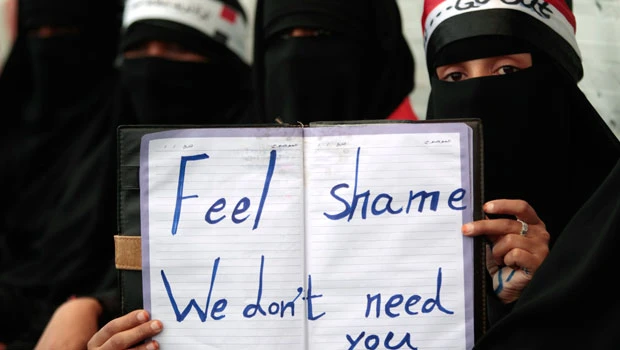
- SANAA: As talks on the GCC proposal for a peaceful transition of power appeared in the doldrums, Yemeni forces fired at protesters blockading a government building on Monday, killing a shopkeeper and two protesters in a city that has seen some of the largest rallies against President Ali Abdullah Saleh, witnesses said.
At least 80 protesters were wounded when security forces, some in armored vehicles, moved in to disperse the rally in the city of Taiz, south of the capital Sanaa. “A large force of police and army attacked protesters and then chased them in residential areas. They opened fire and used tear gas heavily,” said Bushra Al-Maqtari, an activist in Taiz.
The protesters had come in support of teachers and students who were demanding the Ministry of Education release their salaries and postpone final exams.
The government said that groups of pro-opposition teachers besieged the provincial office of the ministry, preventing staff from working and obstructing traffic in the city’s main street.
Tawfiq Al-Shouib, a protest leader in the city, told Arab News by telephone that all sections of the security services took part in the assault. “General security, Republican Guard, Army and Central Security fired extensively on the protesters. It was like a real war.”
Al-Shouib said the protesters would organize two or three massive protests everyday to mount pressure on the regime.
“We strongly denounce the GCC reconciliation deal and we call upon the opposition to stop negotiations, otherwise it will be regarded as part of the regime that we will pressure to quit,” he added.
Violence was also reported in the western port city of Hudiadah, where 15 protesters were injured in clashes with police.
A massive protest was organized in Ataq, Shabwa province, to stress the demand for Saleh’s ouster and to condemn the killings of protesters.
In an important development that could add pressure on the troubled president, a leading secessionist figure said that Saleh’s regime had driven the southerners to call for separation of the south and that Yemeni people would remain united after the departure of the regime.
Abdullah Hassan Al-Nakhibi, secretary general of the Southern Mobility Movement, told Akhbar Al-Youm newspaper that the moment Saleh’s regime goes, people in Yemen will see reason and logic and sit across the dialogue table to find ways to maintain national unity.
Many demonstrators across Yemen, who include students, tribesmen and activists, have vowed to stay on the streets until Saleh steps down. About 150 have been killed in the unrest.