
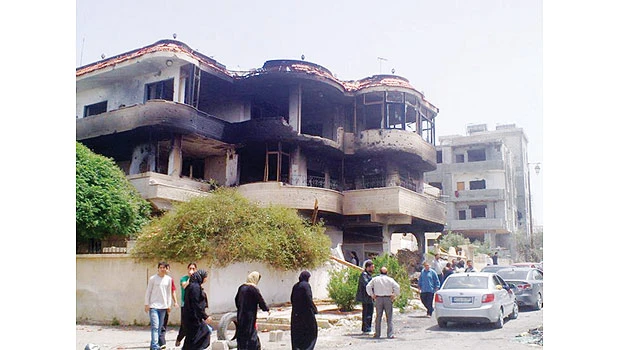
- AMMAN: Syrian forces spread through southern towns on Thursday and tightened their grip on two other cities, broadening a military crackdown on protests against President Bashar Assad’s government.
While Assad has promised reforms in the hope of dampening dissent, tanks advanced in the southern towns of Dael, Tafas, Jassem and Al-Harra before Friday — the Muslim day of prayer which has become a major day of Arab protest.
Friday prayers offer the only chance for Syrians to assemble in large numbers, making it easier to hold demonstrations.
Tanks are deployed in areas on the Syrian coast, the central region of Homs, outside the city of Hama to the north and now across the southern Hauran Plain, regions which cover large swathes of the country of 20 million people.
The official SANA news agency said army units were chasing “armed terrorist groups,” backed by militants and foreign agitators, whom authorities have blamed for the violence. The government says about 100 soldiers and police have been killed, including two on Wednesday in the cities of Homs and Daraa.
The uprising against Assad’s autocratic rule erupted on March 18 in the strategic Hauran region, bordering the Israeli-occupied Golan Heights to the west and Jordan to the south.
A prominent lawyer in Hauran said hundreds of people had been arrested in the area since Wednesday, when 13 people were killed in what a rights activist said was tank shelling of houses in Harra, about 60 km (40 miles) northwest of Daraa city.
“The regime want to extinguish the centers of demonstrations in Hauran by reminding the people of its legacy of repression,” the lawyer said, referring to the crushing of secular and Islamist challenges to Assad family rule in the 1980s.
There was no immediate comment from Syrian authorities, who have banned most international media from Syria, making it difficult to verify accounts of events.
In the besieged coastal city of Banias and nearby village of Baida, security forces arrested scores of residents on Thursday, two Syrian human rights organizations said. “The sound of heavy gunfire was heard as security forces made the arrests,” a spokesman for the Syrian Observatory for Human Rights said.
In Homs, Syrian security forces arrested veteran human rights campaigner Naji Tayara on Thursday, the Observatory said.
Tayara has been an outspoken critic of a military incursion into residential neighborhoods of the city, which had seen growing pro-democracy demonstrations.
A former political prisoner, Tayara played a leading role in a movement demanding political freedoms known as the Damascus Spring that was crushed in 2001, a year after Assad succeeded his late father, President Hafez Assad.
A main residential neighborhood in Homs remained sealed by security forces after it was shelled by tanks on Wednesday and at least five people were killed, a witness said. “I passed by a major road block at the main entrance to Homs off the highway to Damascus. Armed security men were checking names and they asked me what business I had going into Homs,” a woman who traveled to Homs from Damascus to see relatives said.
Assad has responded to the unrest with promises of reform, lifting a 48-year-old state of emergency and granting stateless Kurds Syrian citizenship last month.
Rights groups say thousands have been arrested and beaten since he made the promises.
The 45-year-old president, who had been emerging from Western isolation before the unrest and strengthening ties with NATO member Turkey, has reinforced an alliance with Iran. Damascus and Tehran back the militant Hezbollah group in Lebanon and Hamas in Gaza.
Turkish Prime Minister Tayyip Erdogan criticized this week Syria’s use of force “because it’s not an armed group you’re firing at ... it’s just people in this case.”
Rights groups say at least 650 civilians have been killed in the crackdown while Erdogan put the figure at 1,000.
Protests have continued for nearly eight weeks, but the two main cities of Damascus and Aleppo have not seen major unrest.