
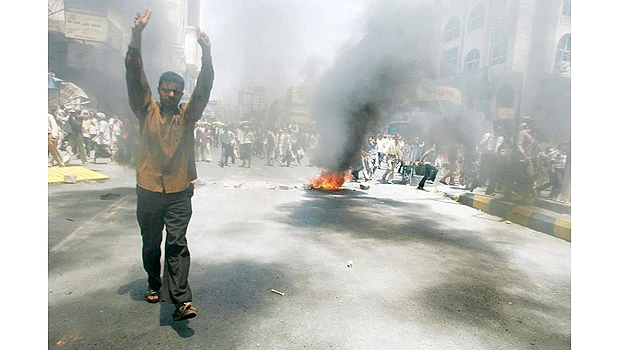
- SANAA/TAIZ: Government forces fired machine guns to halt a protest against Yemen’s president on Thursday, wounding dozens, and Gulf states sought to revive talks on a power transition to stem the rising bloodshed.
An opposition leader told Reuters the secretary general of the Gulf Cooperation Council(GCC) was due in Sanaa on Saturday to try to resurrect a deal to end the crisis which fell through last month when President Ali Abdullah Saleh refused to sign.
“They told us that Abdullatif Al-Zayani will come to Sanaa on Saturday in a new attempt to revive the initiative,” he said.
A government official played down prospects of an imminent deal, saying only that Zayani would come at some point next week to hear differing views on the plan, which would ease Saleh out within a month after nearly 33 years in power.
There was no immediate comment from the GCC, but Zayani released a statement condemning the violence of recent days, part of a crackdown on three months of protests inspired by uprisings across the Arab world.
“The secretary general calls on all sides to return to the Gulf initiative to solve the crisis, as it is the best exit to the tragic situation Yemen is living,” he said.
Security forces, using machine guns mounted on military vehicles, fired in the air, wounding dozens of protesters setting up roadblocks along a main street in the city of Taiz, 200 km (125 miles) south of Sanaa, a Reuters reporter said.
The injured were rushed to a clinic in a square where demonstrators have been camped out for months. Leaders shouting on megaphones urged protesters to head to the main road to reinforce demonstrators as clashes continued.
In the southern city of Al-Baydah, angry protesters attacked the ruling party building and set it ablaze after two demonstrators were shot dead by men in civilian clothes believed to be security officers, residents said. Seven protesters were wounded in the shooting, a witness said.
Washington and Gulf Arab states, especially neighboring oil giant Saudi Arabia, worry more chaos could give ample room for Al-Qaeda’s aggressive Yemen-based wing to operate more freely, and have been eager to implement the Gulf-brokered deal.
Reaching a deal may grow harder as violence increases.
Yemeni forces killed 13 protesters on Wednesday, bringing the overall death toll above 160, and raising fears of a broader conflict in a country where half the population owns a gun.
This week’s bloodshed may fuel public rage ahead of Friday, the Muslim day of prayer and traditionally the largest day of rallies in the three-month-old revolt against Saleh.
“We expect anything now. The more the regime thinks it’s reaching its end, the more it increases the violence against us, but we’ll remain firm and we’re not leaving,” Sanaa protester Abdulkarim Mohammed said.
The European Union condemned Wednesday night’s violence.
But the opposition said: “Arab and international silence to earlier killings by military forces run by Saleh gave a green light to continue in a more brutal way. The international community must take decisive measures to stop these massacres.”
The defense ministry website said on Thursday Saleh was planning to deploy students of Yemen’s military academy to bulk up security forces dealing with widespread protests.
That may indicate he is running out of manpower to enforce his rule after a string of political, tribal and military defections in past months, including the loss of a top general.
Protesters, who paralyzed two cities on Wednesday, are ratcheting up pressure by trying to blockade or march on government buildings as they grow increasingly frustrated by their inability to dislodge Saleh. Sporadic clashes have been on the rise recently between forces loyal to Saleh and some tribes that back the protests.
Tribesmen have blockaded Yemen’s oil- and gas-producing Maarib province for weeks, creating a fuel crisis in the country some shipping sources say is costing Yemen $3 million a day in blocked exports that are the government’s main source of income.
But those pressures have hurt the local population just as much — fuel shortages mean dry parts of the country have not received water shipments and even capital Sanaa is grappling with power cuts that last up to 10 hours a day.
Food prices have skyrocketed and cooking gas quadrupled in a country where some 40 percent of the population of 23 million live on less than $2 a day and a third face chronic hunger.