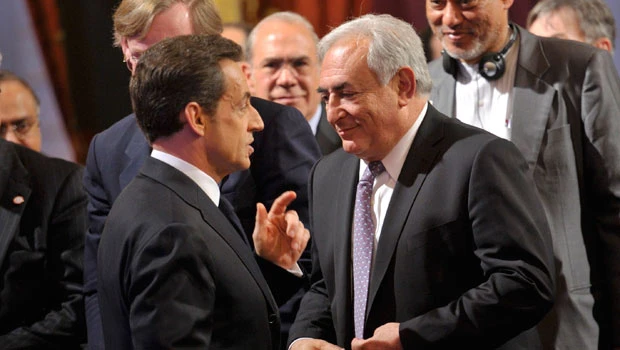
- JEDDAH: The news of IMF chief Dominique Strauss-Kahn’s arrest has come as a political bombshell in France and particularly for the French socialist party.
- Presidential and parliamentary elections take place next year and Strauss-Kahn was seen as the likely socialist presidential candidate against the incumbent Nicolas Sarkozy.
Strauss-Kahn, 62, was yanked from an Air France flight moments before it was to depart New York for Paris and arrested in the alleged sexual assault of a hotel maid.
Strauss-Kahn checked into the luxury Sofitel hotel not far from Manhattan's Times Square on Friday afternoon, police said. The 32-year-old maid told authorities that she entered his suite early Saturday afternoon and he attacked her. The maid said she had been told to clean the spacious $3,000-a-night suite, which she thought was empty.
According to an account the woman provided to police, Strauss-Kahn emerged from the bathroom naked, chased her down a hallway and pulled her into a bedroom, where he began to sexually assault her. She said she fought him off, then he dragged her into the bathroom and tried to remove her underwear. The woman was able to break free again and escaped the room and told hotel staff what had happened, authorities said. They called police.
When detectives arrived moments later, Strauss-Kahn had already left the hotel, leaving behind his cellphone, police said.
Strauss-Kahn's lawyer, Benjamin Brafman, said his client denies all the charges against him.
The scandal is seen as destroying Strauss-Kahn's political future. Jacques Attali, a leading French socialist and former head of the European Bank for Reconstruction and Development, said even if he is found not guilty suspicions will stick.
Party leaders moved quickly to try and contain the damage. Former Socialist Prime Minister Laurent Fabius said that the accusations had come as an enormous shock but that many people would find them unbelievable.
Ségolène Royal, the party’s presidential candidate in 2007 and who likewise hopes to be chosen for next year’s contest, was quick to ensure that she would not be seen profiting from the debacle. “I don't want to make use for myself of what has happened,” she said. She thought it would be “indecent” to make an issue out of it.
From President Nicolas Sarkozy’s government, there was also caution. Budget minister and official government spokesman François Baroin said that the IMF chief was innocent until proven guilty, but that the matter had to be left in the hands of the US law.
Martine Aubry, the Socialist party leader and herself a potential candidate for the party’s presidential bid, spoke of a "thunderbolt." She called on the French public to await the facts with “necessary decency” and reminded them that anyone arrested should be presumed innocent until found guilty. Party members had to remain “united and responsible,” she said.
However, François Bayrou, the centrist candidate in the 2002 and 2007 presidential elections and who is often seen as a voice of political common sense, said the scandal was humiliating for France. "All this is completely astounding, immensely troubling and distressing. If the facts prove true ... it's something degrading for all women. It's terrible for the image of France."
A number of French politicians on the right also spoke of the arrest being a humiliation for France.
Inevitably because of the domestic political ramifications, conspiracy theories were already being voiced within hours of the arrest being announced. The vice president of the Ile de France regional council, Michèle Sabban, a supporter of Strauss-Kahn, said she was “convinced” that there was an international plot. The aim was to “decapitate” the IMF rather than a candidate for the Socialists’ presidential bid. He is, she said, the “most powerful man in the world after Obama.” It was, she said, a new form a political terrorist attack.