
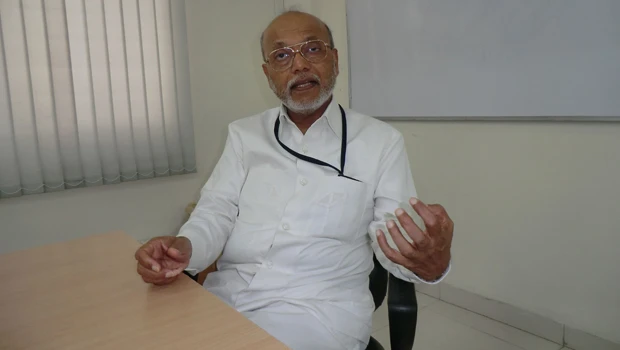
- BANGALORE: Indian-American Space Scientist Dr.
- Nazeer Ahmed holds 14 US patents to his credit, 12 of them coming to him for devising advanced composites, the material used for space ships and shuttles.
Having won two doctorates, one each from Caltech (California Institute of Technology) and Cornell University, he was associated with Apollo Mission to Moon in 1960s and Hubble Space Telescope project at Perkin Elmer Corp., at Danbury (Connecticut). While he was instrumental in devising the Moon Landrover for Apollo Mission, he was chief engineer of the team designated for devising the mirror for the Hubble, the most precise instrument to be ever built in the 20th century to explore the universe in the visible spectrum and look at the very edge of the known universe.
Nazeer frequently taught Physics at universities like Cornell, Caltech and Albuquerque and wrote nearly half a dozen books. He returned to India during 1978 and won the election for the Karnataka Assembly, only to resign a year later and return to the space career in the US.
Hailing from small town of Tumkur in the southern underbelly of Indian peninsula, Nazeer received his primary education in a government primary school while squatting on the mud floor. A rank student all through till he earned his Bachelor of Engineering from Mysore University in 1969, he earned the sobriquet of "Rank Nazeer" in his hometown.
This correspondent spoke to him while he was on a visit to Bangalore last month on turning a new leaf in matters of learning in the Islamic World.
Excerpts:
Education is a composite system that cannot be delinked from society. If we wish to transform the education we must look at the society and integrate our culture and learning to compete with the rest of the world. There are a few fundamentals to understand:
1) There is no tension between science and Islam as it is in the West, hence we must change and bring about synchronization between faith and sciences. True scientists are people of great faith.
2) Islam did integrate faith and sciences. Islamic world was leading the caravan of enlightenment. It is therefore imperative for us to focus on our children learning - languages and - mathematical sciences. Both draw their support from the Qur'an. Secondly, we must identify good students and encourage them to learn faster. Thirdly, there must be integrated syllabus which takes into consideration our perspective of knowledge, culture and science. Lastly we must set up specialized institutions which are second to none in faculty, infrastructure etc.
It is good that Saudi Arabia is establishing one such university on its western seaboard. It is not sufficient to hire good professors from the West. There must be arrangement for teaching the children under our paradigm. It should focus on science being a servant of faith.
Lastly education is not merely physics and chemistry. We must give equal emphasis on applied sciences, project management, health sciences etc which are as much part of the education.
And there cannot be anything more important than saying that we must change the attitude of society toward learning science and technology.
People tend to jump to conclusions. But there are historical reasons for our getting here to this stage. The Muslim Ummah has passed through seven stages during its journey through history.
1: First was the time of Sahaba, tabaieen, taba tabaieen. It was an age of faith and a brilliant period. 2: It was followed by the age of rationalists which coincided with Abbasids from 765 AD to 846 when Muatazila ruled the roost. They applied reason. Reason is a servant of divine word. Reason is predicated upon assumption of the before and after and also subject and object, whereas the eternal truths are beyond the domain of time.
3: Then came the classical age of Islamic history. Ebullience of science in Islamic world came in its rejection of Mutazalites. Science is empirical. It is bottoms up and is based on observation. These were the heydays of Islamic science and produced scientists like Alkhwarizmi. They lasted up to Mongolian invasion which destroyed the classical age.
4: Classical age was succeeded by Sufis. They had their own God-focused perception of Islam. They saved the day for the Ummah. From them came Zawiyas. Ottomans were based on Zawiyas. That lasted up to 17th century AD. It saw great strides in art and architecture. Taj Mahal and Isfahan mosques were built in this period. They carried the message of Islam to Africa, India, Indonesia and East Europe in this period.
5: Then the age of the fiqh dawned upon us and Shaikh Mohammad Sirhindi was its founder in the subcontinent. It began with tasawwuf but by 1700 it witnessed a shift to fatwas with the narrowing of Islamic vision from being inclusive to being exclusive. Earlier we were studying mathematics, commerce, siyasat e madan, gunnery, metallurgy, languages et al. But now the focus got narrowed down how to lead a good life in keeping with fatwas. This age also produced great thinkers such as Shaikh Abdul Wahhab in Arabian Peninsula, Usman Dan Fodio in Africa etc.
6: This period saw Islam receding into background and the Muslim world coming under European colonial rule. Internal implosion was great and the entire educational system of Muslims was dismantled by the colonial powers. Only a skeleton remained in the form of theology. The educational system that replaced ours was meant to produce clerks from amongst us. This age produced the giants like Mohammad Iqbal, Mufti Muhammad Abduh and Sir Syed Ahmed Khan. The madrassa (Islamic theological schools) system which remained with us today is a caricature of its former self. It is not based on hikmah (wisdom).
7: Today we are copying the West in all spheres. We do not own our sciences. There is no original thinking to integrate the religious and modern sciences. Ulema opposed the technology at every step. They stopped the arrival of printing press in Turkey. Their contention was that the divine word can be written only by hand, not by wood (the types were made of wood in the beginning). It led to our being pushed back by 300 years.
To begin with, the orientation of society has to be changed and an atmosphere that is learning-friendly has to be created. Dichotomy of education into religious and modern has to be stopped. Both should go hand in hand. Training of teachers must be taken up as a high priority, even before the setting up of infrastructure. Some of the Arab countries have beautiful infrastructure, but teachers are of low quality. A string of educational institution of higher learning with specialization in various disciplines should be set up and developed. As a whole it will be a process and there will be at least two generations before which we will see it bearing fruit.
The technologies we need to focus could be different with regard to different regions. In the Middle East oil is a driver currently. We need to look at alternative and renewable energy sources such as solar and wind which are abundantly available in the vast stretches of sandy land. They also could develop communication and health sciences.
In Turkey and Eastern Europe, there is this robust tradition of integrating culture and technology. We could further stress upon social and technical sciences. Iran is too bogged down with ideology. In India which has a vast Muslim minority, the community should take up development of Internet, engineering, computer and mathematical sciences. In the South East Asia they need to elevate the level of learning in social and technical sciences. In the final analysis, there should be emphasis on quality on the top and quantity at the base. Care should be taken to keep politics away from influencing the policies of education.