- DEAUVILLE, France: The Group of Eight promised $20 billion in aid to Tunisia and Egypt on Friday and held out the prospect of billions more to foster the Arab Spring and the new democracies emerging from popular uprisings.
Likening it to the fall of the Berlin Wall that changed Europe, G8 leaders ending an annual summit in France launched a partnership for North Africa and the Middle East that ties aid and development credits to progress on political and economic reforms by states which have thrown off autocratic rulers.
Most is in the form of loans rather than outright grants, to the two countries in the vanguard of protest movements which have swept the Arab world from the Atlantic to the Gulf. Egypt and Tunisia are planning to hold free elections this year.
French President Nicolas Sarkozy said that on top of $20 billion of credits provided by the World Bank and similar regional lenders dominated by the major powers, there would be as much again from other sources — $10 billion from Gulf states and $10 billion from other governments.
Other countries could hope for aid in future. In a statement after the two-day summit in the northern resort of Deauville, the G8 leaders signaled they “strongly support the aspirations of the Arab Spring as well as those of the Iranian people.”
“The changes under way in the Middle East and North Africa are historic and have the potential to open the door to the kind of transformation that occurred in Central and Eastern Europe after the fall of the Berlin Wall,” the G8 said.
Multilateral development banks “could provide over $20 billion, including 3.5 billion euros from the EIB, for Egypt and Tunisia for 2011-2013 in support of suitable reform efforts.”
A US official traveling with President Barack Obama was among several to stress that money is tight, that the credits would be forthcoming only if political change went ahead and that the main goal was to help the Arabs help themselves.
“It’s not a blank check. It’s in the context of overall reform programs,” said Mike Froman, a deputy national security adviser at the White House. “It’s an envelope that could be achieved in the context of suitable reform efforts.
“More important than any numerical figure, I think, is the vision that it lays out,” he added “This is largely a case of trade not aid, investment not assistance over time. It’s really about establishing the conditions under which the private sectors in these economies can flourish and the benefits of growth are broadly shared.”
The popular movement for change has also left Libyan leader Muammar Qaddafi fighting to stay in power, and G8 leaders said he had lost all legitimacy because of his use of force against civilians protesting his rule: “He has no future in a free, democratic Libya. He must go,” the leaders said.
Russia signaled it was ready to mediate in the crisis, Moscow’s special representative on Africa Mikhail Margelov telling reporters Russia had contacts in Qaddafi’s entourage.
But Sarkozy said: “Mediation is not possible with Qaddafi.” And other Western leaders stressed that they were mainly grateful for Moscow’s agreement that the Libyan leader should step down, even if Russia has opposed NATO’s bombing campaign.
British Prime Minister David Cameron, however, said he did not recall Medvedev offer to mediate and said Britain was sending attack helicopters to Libya to step up pressure on Gaddafi.
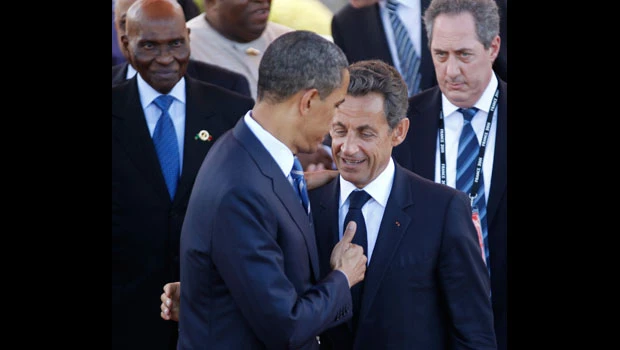
Earlier, Obama and Sarkozy said they were determined to “finish the job” in Libya.
On Syria, the G8 leaders said they were “appalled” by the killing of peaceful protesters opposed to the rule of President Bashar Assad, and demanded authorities stop using force against them.
They also condemned violence against protesters seeking the removal of Yemen’s President Ali Abdullah Saleh, and urged him to respect a pledge to stand down.