- BENGHAZI: Before Muammar Qaddafi’s forces attacked it on March 15, Ajdabiyah had a population of over 160,000.
- Eighty percent fled.
This help and support from ordinary Libyans to others is one of the most inspiring aspects of the Libya uprising. Stories of refugees knocking on doors and being taken in and accommodated are common.
The Transitional National Council (TNC) has now set up a committee to organize and oversee accommodation for IDPs, but before that ordinary Libyans did the task. “People opened their homes to IDPs. They opened schools and other buildings. They did not ask questions. They just did it,” explained a member of the committee now responsible for looking after the needs of 18,400 families — around 110,000 people. The others are still with relatives or those who have taken them in.
The IDP Committee itself is an example of Libyan solidarity. Operating out of a grand villa in a smart suburb of Benghazi that was seized from an absent Qaddafi supporter, it has 25 administrative staff and around another 80 working in the field. All are volunteers.
Not far away in the suburb of Ghuwarshah, Hussain Bosif Yasin and his brother Ahmad own a construction workers camp. It was empty at the time of the uprising. Meeting refugees by chance in March at a petrol station in Benghazi, Hussein invited them to move in. Others followed. The camp now houses 39 families from Ajdabiyah, Brega, Jalu and Kufra, 214 people in all, each in their own basic but separate unit.
It is not only a roof over their head that Hussain and his brother provide. For the first few days, before the IDP committee and other charities began to help, they provided all the food. They still cover all electricity costs and provide toys for the children and other needs — soap and washing powder.
Theirs is not a unique story.
When it comes to feeding the refugees, again Libyans have rallied around. And not just the refugees. There are the troops on the front line between Ajdabiyah and Brega to be fed as well as soldiers in the barracks — and people in hospital. One of the consequences of the conflict is that most of the expatriate workers from Bangladesh, the Philippines, Egypt and elsewhere who worked in the hospitals, restaurants and canteens, who cleaned the streets and did countless other low-paid jobs that the Libyans preferred not to do, have gone. There is probably a lesson there for Saudi Arabia and other Gulf states that rely so heavily on foreign labor. But in this case, the Libyans have simply rolled up their sleeves, picked up their brooms and mops, their kitchen knives and their buckets and got on with the job.
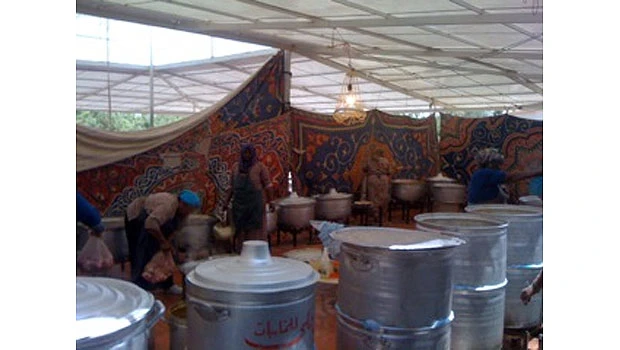
At the Qala restaurant, not far from Hussain’s campsite, a team is making free meals for the troops, IDPs and some hospitals. They make 18,000 meals a day — 9,000 lunches and 9,000 dinners, 2,500 of them for soldiers. Between 100 and 135 people are involved daily. Women do the cooking in an improvised outdoor kitchen, men the packing and delivery. All are volunteers. It is a slick and impressive operation. On Friday at lunch, it was couscous with lamb — and a lot tastier than the hotel food. All the ingredients are bought locally but the money to buy them, until a few days ago, came totally from private donations. Now, the Benghazi-based Arabian Gulf Oil Company is picking up the bill for half the food costs.
Sami Shakmak, the restaurant owner, started the operation with friend Ayman Qader shortly after the Feb. 17 uprising. Initially the focus was helping expatriates in Benghazi harbor leave the country. With 200 volunteers, they helped provide shelter, food, transport as well as paperwork for 25,000 departing foreigners. When that was over, they started taking supplies including arms and ammunition to the troops at Ras Lanouf. The need to feed them became obvious. That led to the Libyan Humanitarian Relief Organization.
“We decided to provide 2,000 meals a day," says Shakmak. It soon rose to 5,000 a day and by mid-May the figure touched 15,000, at a cost of 15,000 Libyan dinars a day (on the present black-market rate about $10,000). It now costs over 18,000 dinars a day.
The volunteers all turn up on time. There are all sorts — government employees now not overburdened with work, lawyers, boy scouts, teachers. One of them is 35-year-old Hassan Ismail. He last worked as a carpet layer in London’s West Ham. He was part of the large Libyan diaspora living abroad, most of them in the UK although like so many of the diaspora, he traveled back to Libya regularly.
The post-Christmas and New Year period in Britain is a lean time for carpet fitters so he decided, before the Feb 17 uprising, to return. “I had seen what had happened in Tunisia and Egypt and felt it had to happen here,” he says. Like Shakmak, who also spent part of his life in the UK, he took part in the protests against the Qaddafi regime. Afterward, looking around for ways to help, he and five friends started collecting money and making bags of food for the volunteers on the front line — nothing fancy: a packet of biscuits, a bar of chocolate, a bottle of water. He then came into contact with Shakmak and the two operations were merged. He and the five others are now the drivers who distribute the meals, but they still take food bags to the troops.
Solidarity in liberated Libya is not just about volunteering. There has been a complete lifestyle change. People have become more courteous to others. Foreigners, talking to whom once risked arrest, are welcomed with open arms, especially if they are American, British, French or Italian.
The new courtesy is seen on the roads, where the style of driving in Benghazi, pre-revolution, would have been instantly recognizable to anyone in Saudi Arabia — vehicles weaving in and out of traffic, speeding, jumping traffic lights. That has gone. Almost everyone now drives with a degree of consideration that does not exist anywhere in Europe let alone Saudi Arabia. Speeding is a thing of the past while drivers allow other vehicles wanting to move into the same lane in front of them with a smile and a nod.
At one intersection the traffic lights had been damaged; only the green was working. Yet the traffic stopped the instant the green light went out and waited till it came back on again. You would not see that in Jeddah.
Perhaps the most startling aspect of this new self-help and solidarity is the sense that Libyans are discovering and embracing each other for the first time.
It has been remarkable to see, as I did on several occasions in the past few days, young Libyan activists who had never met before finding out that they are distantly related or that the person that they are dealing with was once a friend of their parents or grandparents.
“That’s because Libyans did not talk to each other before,” said a Libyan with one of the UN agencies in Benghazi. “People did not know how their comments would be interpreted. They feared each other.”
It is said that before the uprising 20 percent of the population were used as government spies.
“Qaddafi destroyed our trust in each other,” says Salma. “Now we’re finding it again.”