- BENGHAZI: Awad, who has become Arab News’ driver and invaluable assistant in Benghazi, pointed to a large, burned-out villa.
- It is one of the few destroyed buildings in Benghazi that was not the offices of Qaddafi’s hated security forces or a prison or a courthouse.
It was the home of Huda Ben Amer. She was mayor of Benghazi until the uprising and a faithful lieutenant of Muammar Qaddafi. But that is not the reason why she is so hated and why, as far as the insurgents are concerned, there is a special place in hell reserved for her.
Thirty years ago, a young Libyan, Sadek Hamed Al-Shuwehdy, returned to Benghazi after studying aeronautical engineering in the US and got a job at the airport. He was unhappy with the state of Libya, with Qaddafi’s despotic rule. He was not militant activist, but he joined a group campaigning for change.
In a country where dissent is illegal, he was soon marked out as an enemy of the state and, in Qaddafi’s Libya, that is an offense punishable by death. In 1984, he was arrested in the middle of the night by the secret police and held, but he was not immediately shot in jail, unlike all the other opponents of the regime.
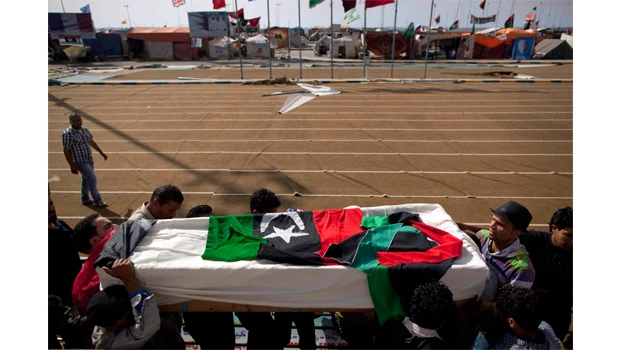
Three months later, he was taken to the city’s basketball stadium and in front of television cameras and hundreds of schoolchildren and students from Benghazi’s Garyounis University brought in — they were told — to witness the public trial of a traitor, he was hanged. Qaddafi had decided that his should be a very public death and a warning to students what would happen to them if they dared oppose him. There was no trial.
The students were deeply shocked. Some pleaded in vain for mercy for Sadek. But not all.
As he was hanging and writhing but obviously not yet dead, Huda Ben Amer ran out from the crowd of students, grabbed onto his body and with her weight pulled it down to make sure he died.
It was an act that still shocks Libyans. It earned her the name of Huda Al-Shaniqah, Huda the Hangwoman. “One seriously sick woman,” was how an official in Benghazi described her last week.
The driver, Awad, had good reason to point out her charred house. Sadek Al-Shuwehdy had been a relative of his.
Her sadism made her one of the richest and powerful woman in Libya. Qaddafi had been watching the execution on TV. Many Libyans say that was the reason why Huda, who came from a poor family, did it; that she was ambitious and knew that he would be watching and would reward her. He did.
She was made a member of one of his revolutionary committees, which in Libya is what the communist party was in Stalin’s Russia — the mechanism to ensure that people do as they are told. If they do not, it is prison or worse.
She rose rapidly within Qaddafi’s form of Islamic socialism, which is neither Islamic nor socialist. She was made mayor of Benghazi although she did nothing to arrest the city’s slow decline, merely ruling over it as the regime’s menacing presence.
As secretary of women’s affairs for several years, she traveled extensively, telling international conferences about how progressive Libya was and how advanced were women’s rights there. Two years ago, she hosted a group of American women activists who had flown in to discuss the subject.
Last year, almost to the day, as speaker of the Libyan People’ Congress, she headed a pan-Arab parliamentary delegation to Gaza. Apart from Qaddafi’s wife, Safiya and voluble daughter Aisha, she is the most powerful woman in the regime. She is currently in charge of the ominously named General People's Committee for Inspection and People's Control.
If the committee sounds Stalinist, she certainly is viewed as such. Nor has her cruelty and sadism left her. She is quoted as saying that Libya did “not need talking, we need hangings." Since the uprising, she has been seen in public beside Qaddafi.
In general, the insurgents show no hatred for those Libyans whom they are fighting, who still support the regime. They see them as victims too. Qaddafi and his family, of course, are the exception. And so is Huda the Hangwoman. Hatred for her runs only mildly less than hatred for Qaddafi, with whom it is widely alleged in Benghazi she had an affair.
If she is now Qaddafi’s closest and most loyal supporter, that is probably because she has to be. She has no escape route. She either survives with him or perishes with him. Since there is now almost no chance of the former, it is widely believed in today’s Benghazi that her day of reckoning is not far off.