
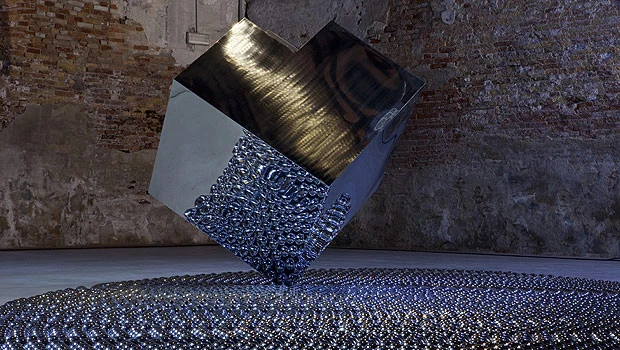
- <b>Behind ‘The Black Arch’ lie Illuminations and scenes from the East and the West</b><br/>Walking into the Saudi Pavilion at the Venice Biennale, a visitor will face an intimidating dark black arch that is devoid of life.
- Something surprising and illuminating is behind this black barrier, which is made even more mysterious by the sound of a desert wind playing through massive headphones.
The blackness conceals a complicated vision of life involving the blending of nationalities, colors and cultures. Such is the mixture of light, sound and blackness that make up the work of Shadia and Rajaa Alem.
Thousands of metal balls reflect light and the reflections of visitors, while a wave of interwoven sounds from the streets of Venice combined with sounds from Makkah, like prayers from the holy mosque, push viewers further toward that serene cube that sits in the middle of the installation.
Images from San Marco, the cathedral of Venice, are projected from above and show merchants wearing turbans. These are replaced by images of people praying in the Haram in Makkah, forming a beautiful colored mosaic. Another image appears of flowing water, which is another reflection of Venice.
“The black aspect of the work points to the lack of knowledge and darkness. But when you go around the arch, you see the other aspects; you can follow the light and sounds,” said Co-Curator Robin Start.
Referring to the pictures reflected on the ground of the hall, he adds: “The picture of water symbolizes Venice, while the cube in the middle expresses Makkah. Here, we see the blending of the two cities.”
Venice is surrounded by water on all sides, to the extent of almost being submerged, whereas Makkah receives rain rarely and always faces shortages of water.
“It is an amazing work,” says Dina Ameen, director of the post-war and contemporary art department at Christie’s auction house in London. “I believe that this represents a dialog between cultures, reaching out to the world. We are here in front of a Western crowd interacting with the Middle East through diverse, interwoven and complex elements. As far as I am concerned, this work realizes what I consider to be the original message of art, which is to break down barriers.”
Ameen points to the giant mirror and the images reflected on the metal spheres: “This makes the visitor an important part of the work,” she says.
In the first hour of opening, a galaxy of artists, critics and journalists visited the pavilion and a number of them were trying to talk with the sisters about their work and its meaning.
Mary-Ann Goly, a US art expert, said: “I am still absorbing the work, but I can now say that it is a global work of art that crosses local borders and even addresses me personally.”
Goly was inspired by the combination of oriental themes — represented by the Arabic calligraphy — and the Roman inscriptions representing the Occident. “I was enthralled by the reflections and illuminations on the ground and I can see in them the faces of various cultures.”
Hamza Serafi, founder of Jeddah's Athr Art Gallery, spoke of the installation’s importance: “It is a great pleasure to see Saudi art at the Venice Biennale. The works of Shadia and Raja Alem have brought together the cultural legacy of the Kingdom and the concepts required for the Biennale as reflected in the title ‘ILLUMInations.’” Serafi added that the beauty of the work comes from its summary of the Islamic culture and the idea of a confluence at the global level.
Mona Khazindar, co-curator and director of the Paris-based Arab World Institute, said with great pride and happiness that all the comments of visitors at the pavilion showed that it was a great success. “The response to the work shows that it is a matter of pride, not only for the Kingdom, but for Saudi art and women as well. The impressions of the work are diverse and different. Interpretations differ from person to person in accordance with their backgrounds. Whenever such differences arise, it is evidence of the depth and richness of the work.”
As far as Khazindar is concerned, it also represents exploration, travel and the things that link various cities.
The pictures reflected on the ground are “a mix of snaps about Venice from the camera of Shadia and Raja Alem. These include pictures taken from San Marco Cathedral. There are men wearing turbans, and this indicates the historic relations between East and West. There are also pictures from Makkah that showed that various nationalities and cultures coexist in that ancient city. As for the sounds, they are also another mix, with some representing Makkah through the noises of its marriage ceremonies, coffee shops and music, jumbled with the noises of street vendors and pedestrians on the streets of Venice. These sounds give the viewer an impression of living within the work of art.”
Khazindar also points to the relations between Makkah and Venice. As she puts it: “These artists strive to link the two cities with symbols. From the cultural environment, the contrasts are obvious between the two. One of these two cities is in the middle of the desert and protects a black stone, descended from heaven, inside a cubic building. This city is a permanent place of gathering; a land that is sanctified from time immemorial to the worship of God and it has a lone source of water — the well of Zamzam that saved the lives of Hajer and Ismail when they lived alone in Hejaz. The other city is in the middle of a lagoon and is criss-crossed by more than 100 canals. These are filled with noise and color and have always been the scene of commercial transactions.”
They are two very different cities; yet, the links between them are more informative than the differences. It is as if the opportunity to travel here has allowed the sisters to follow in the footsteps of the great travelers from both cultures, the famous Italian traveler Marco Polo and the Muslim traveler Ibn Battuta, and bridge cultures through travel.
Shadia explains how she was haunted by a desire to follow the example of Marco Polo: “I have brought my city, Makkah, with me to Venice in the form of certain things from there: a black arch, a cubic city and a handful of pebbles from Muzdalifah.”