
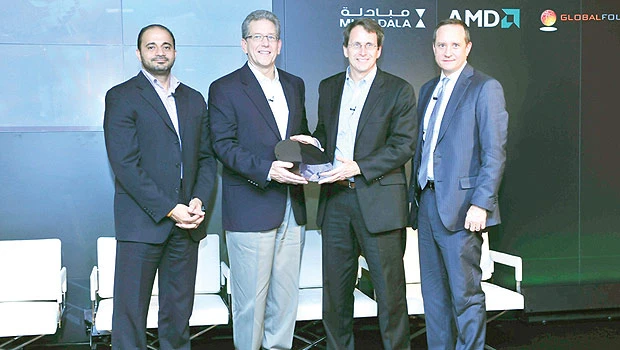
- In a week, AMD launches its 32nm AMD Fusion Accelerated Processing Unit (APU) code-named “Llano.” Manufactured by GlobalFoundries, an ATIC portfolio company and one of the world’s leading semiconductor chip manufacturers, the upcoming “Llano” APU is set to enhance the computer user experience, increase battery life and provide consumers with powerful discrete-level graphics capabilities.
While the Llano launch will be significant for AMD, it will be also be a milestone for ATIC, as it shows that the organization's investment strategy is moving forward. ATIC, the Advanced Technology Investment Company, is a subsidiary of Mubadala Development Company, the wholly owned investment vehicle of the Government of Abu Dhabi.
The semiconductor market was worth an estimated $300 billion in 2010, with microchips acting as "the brains" behind an ever-growing number of products that have become essential tools of modern life. ATIC is pushing the development of the semiconductor industry worldwide. The investment company currently owns 87 percent of GlobalFoundries, which is a full-service semiconductor foundry, and 20 percent of AMD, which designs computing and graphics chips that power notebooks, desktop PCs, embedded devices and servers.
GlobalFoundries owns eight fabrication facilities of which six are located in Singapore, one in Dresden, Germany and another is under construction in the Luther Forest Technology Campus in Saratoga County, New York, about half an hour north of Albany. GlobalFoundries plans to invest $5.5 billion this year on expanding its plants in Dresden and Singapore, and building costs for the New York fab. Production is scheduled to begin next year in New York and by that time, according to company executives, ATIC will own more than 90 percent of GlobalFoundries.
Of most interest for the Gulf Region is that ATIC, through GlobalFoundries, plans to invest $6–8 billion to build a semiconductor fab, GlobalFoundries 9, in Abu Dhabi. Sami Issa, executive director, Abu Dhabi Ecosystem Development, ATIC, advised that construction of the plant in Abu Dhabi would begin next year, with production scheduled to start in 2015. The fab will be the anchor of Abu Dhabi's new research and innovation hub.
In an exclusive interview with Arab News, Daniel Durn, executive director, Acquisitions, ATIC, stated that the organization's mission is far greater than just financial returns.
"Part of our mission is to drive what we call regional returns. Human capital is right at the forefront of regional returns," Durn explained. "If you cannot fundamentally educate people in a way to take advantage of the commercial opportunities that you're bringing through your investments, what have you really accomplished at the end of the day? So developing human capital and educating people to think about these opportunities differently going forward, versus how they've though about them historically is really an important component of what we're doing."
The governing strategy that ATIC works under is part of Abu Dhabi's Economic Vision 2030. This strategy outlines a set of economic diversification vectors that the government of Abu Dhabi is pursuing. ATIC provides an underlying pillar to support that vision. Durn advised that ATIC is moving forward on several fronts. They are building out the manufacturing footprint of GlobalFoundries to create a "global champion which will help drive this diversification strategy in Abu Dhabi." They are also in the process of forging relationships with companies to bring R&D capabilities into the region.
"For the R&D initiative to be done right, it's going to take some time to grow and build momentum," said Durn. "We are in the process of discussions and negotiations with several partners right now and very close to formalizing a set of relationships where they will bring resources into Abu Dhabi and begin to focus on very industry relevant and leading edge research and development. We want to build a diversified technology hub so it can't be just one manufacturing facility."
It is expected that GlobalFoundries 9 will be surrounded by co-locator businesses that naturally arise near any fabrication plant. The R&D partners joining in the Abu Dhabi technology hub will be attractive to Ph.D. students and scientists pursuing cutting edge research.
"With the critical mass of intellectual talent in one location, plus a dedicated slice of capital to pursue entrepreneurial activities and start companies that begin to solve industry problems with the hope and dream of creating significant wealth, you begin to have a virtuous cycle that is catalyzed and moves in all the right directions," said Durn.
But the growth of the technology hub won't come overnight and the transformation for the people of Abu Dhabi requires them to redirect both mental and physical energy.
"The type of change that we're talking about is generational," said Durn. "If people are expecting an investment and having a dramatic shift in either economic activity or the decisions people make with their lives to happen in a one, two or three year time frame, such a time horizon is wholly insufficient to drive the change that we want to bring to Abu Dhabi."
But the push toward a new direction has begun. Two years ago, 20 Emirati college students went to Dreisden and spent the summer doing an internship with GlobalFoundries. The size of that program doubled to forty last year and it is expected that sixty Emiratis, both men and women, will join the program this summer. ATIC has also put in place a number of scholarship programs, which are reaching down into the high schools within Abu Dhabi and the UAE and identifying high potential students. These scholarships encourage study in sciences, mathematics and engineering.
"When you have a highly capable set of human capital, it can then intersect with the commercial opportunities that we're creating," Durn commented. "This type of change takes time. It's about identifying the right kind of programs. It's about changing the dialog at the kitchen table. When I was growing up, a big influencer on the decisions I made in life was the dialog I had with my family and my parents. We need to change the dialogue that happens around the kitchen table, around the types of opportunities that are available to these students and the types of degrees they want to pursue. They must rethink their hopes, their dreams and the aspirations that they will pursue over their lifetime. When we can change the dialog and influence the decisions that these students are fundamentally making about how they get educated and how they spend their time post education, we then begin to see the type of change that we're trying to drive. This change is tangible, it's lasting and it's meaningful."