
- THE first independent contacts between Moscow and the OIC, after its establishment in 1969 took place during the late seventies and early eighties of the last century.
The issue that brought these two entities together was the situation in Afghanistan. The OIC at that time responded positively to Russia's appeals for assistance in the course of releasing Soviet prisoners of war in Afghanistan as well as the Russian pilots held in captivity in Kandahar.
Relations continued to develop during the last years of the previous century. However, it was an issue-based relationship. In this period, special emphasis was given to the Chechen problem while developing contacts between Russia and the OIC. Secretaries-General of the OIC Hamid Algabid and Ezeddine Laraki visited Moscow in 1994 and in 1997 respectively. Following these visits an OIC delegation led by the Minister for Foreign Affairs of Iran K. Harrazi paid a working visit to Russia in December 1999. The delegation was received by then Russian President Vladimir Putin at the end of 2002, for the first time in the history of Russia the post of an ambassador for affairs related to the OIC and other international Islamic organizations was created at the Russian Ministry of Foreign Affairs.
Ambassador at large V.V. Popov was appointed to this post and he held talks for the first time with the OIC Secretary-General Abdelouahed Belkeziz in Jeddah in December 2002. Belkeziz was invited by Russian Foreign Minister I.S. Ivanov to visit the Russian Federation, and he visited Moscow in January 2003 and met with the president of the Federation Council, the foreign minister, a number of muftis, and also representatives of Russian Orthodox Church.
In April 2003, President Putin at a meeting with the mufti of the Muslims of Tajikistan Amonulla Nematzade floated the idea that Russia to a certain extent be considered a part of the Muslim world since about 20 million Muslims live in the country. However, it was only in 2005 that a full-fledged working relationship between Russia and the OIC started to develop.
August 2003 and June 2005 are the two key dates in the history of mutual relations of Russia and the OIC. In August 2003, the then Russian President Putin during his official visit to Malaysia, for the first time, declared that the Russian Federation would like to join the activities of the OIC.
The Russian leader’s initiative received warm response from the Muslim world despite the known criticism of Russia's actions in Chechnya. Putin received an invitation from the Malaysian Prime Minister Mahathir Mohamed to take part in the 10th Islamic Summit in Kuala Lumpur in October 2003 as a guest.
Putin attended the opening ceremony of the summit and addressed the leaders of the Muslim world. His seven-minute speech was interrupted four times by applause and has become one of the most significant documents of Russian foreign policy. Through his speech, Putin extended the hand of friendship and cooperation to the Islamic world. He declared "it is obvious that by combining our efforts and those of the countries of the Muslim world — in the sphere of finance, technology and human resource — we can serve as a real factor in the world politics and can have breakthroughs in many trends of the global economy.”
During the 10th Islamic Summit a notable development took place that might not appear to be very significant at that moment, however, later on it had a far-reaching impact on the OIC-Russia relations and to a large extent is responsible for the present warm and close relations between the two. During this summit, personal contacts were established between Putin and Ekmeleddin Ihsanoglu, the incumbent OIC secretary-general. The speech of Putin had a big impact on the OIC delegates.
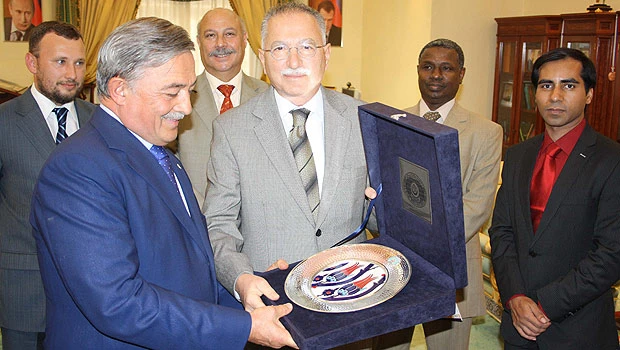
Ihsanoglu, who was the head of the OIC Center for Islamic History, Art and Culture (IRCICA) based in Istanbul, presented the IRCICA award to the host of the summit —Mahathir Mohamed. After Putin’s speech, Ihsanoglu was one of the first to congratulate Putin on his brilliant speech and elaborated on the importance of establishing direct active relations between the OIC and Russia.
Putin entrusted his ambassador at large for the OIC with the task to establish direct communications with Ihsanoglu. Accordingly, in the beginning of February 2004, Ambassador Popov specially visited Istanbul for the purpose of establishing such communications. As the head of IRCICA, Ihsanoglu also visited Russia, in particular Tatarstan, and became convinced of the spiritual renaissance Russia had been experiencing for around two decades. He then said it was his duty to support the Putin initiative.
The OIC is the second largest organization after the United Nations in terms of its membership that represents and upholds the interest of more than 1.5 billion Muslims all over the world. These facts combined with the traditional bond between Russia and the Muslim world further strengthened Russia's will to establish formal relations with the OIC. The Russian Foreign Minister S.V. Lavrov dispatched an official letter in May 2004 requesting the OIC to grant Russia observer status in the organization. However, the procedure of getting the observer status at the OIC for Russia was not easy.
Some countries without opposing Russia's joining the organization still expressed concern that such a precedent may open the door for similar applications on the part of other non-Islamic countries with Muslim minorities.
The year 2005 became the next important landmark in Russia's relations with the OIC. At the conference of Ministers of Foreign Affairs of the OIC member states held in the capital of Yemen — Sanaa at the end of June in 2005, thanks to the efforts of Ihsanoglu to a great extent, observer status in the OIC was unanimously granted to Russia. It became the biggest event in the history of Russia's relations with the Muslim world. As a matter of fact, a new era was born in the OIC-Russia relations that started to develop rapidly and intensively.